Academic Medical Center, Department: Coronel Institute of Occupational Health, Amsterdam Public Health Research Institute, Room K0-115, Meibergdreef 15, 1105, AZ, Amsterdam, The Netherlands.
J Cancer Surviv. 2018 Apr;12(2):169-177. doi: 10.1007/s11764-017-0655-7. Epub 2017 Oct 26.
This study aims to investigate how perceived work ability, job self-efficacy, value of work, and fatigue predict return to work (RTW) in cancer patients who received chemotherapy.
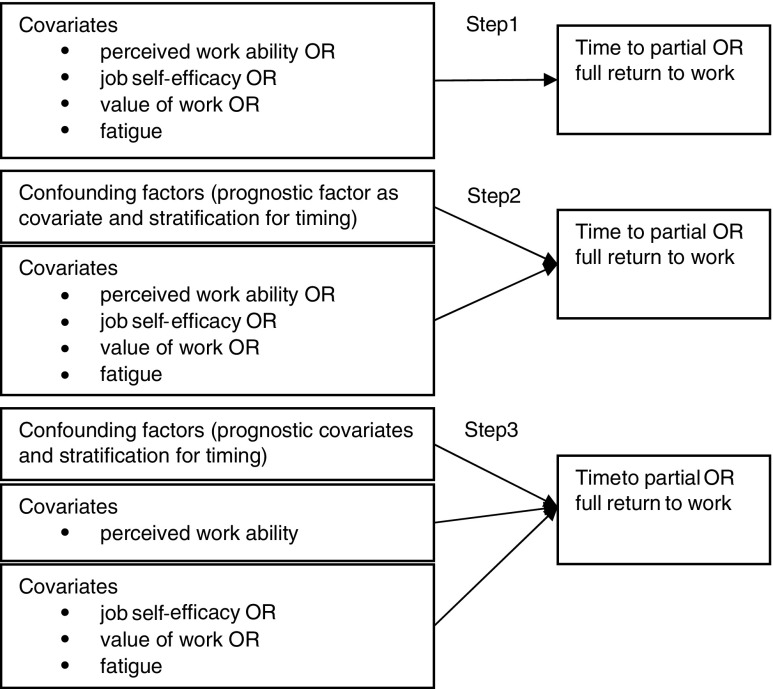
Data of a before-after study on a multidisciplinary intervention that aimed to enhance RTW was used, consisting of four assessments up to 18 months. Time to partial and full RTW of 76 and 81 participants, respectively, was analyzed in Cox proportional hazard analysis with time-dependent variables. Univariate analyses of work ability, job self-efficacy, value of work, or fatigue as covariates were succeeded by multivariate analyses of work ability and either job self-efficacy, value of work, or fatigue as covariates.
Participants were mostly female (93%), and diagnosed with breast cancer (87%). Most participants were permanently employed (84%) and 48% was sole breadwinner. When adjusted for timing variables and prognostic factors, all hypothesized factors were predictive for earlier RTW (p < .05). In models that also included work ability, only job self-efficacy significantly predicted earlier full RTW: hazard ratio = 1.681; p = .025.
Lower fatigue and higher value of work, work ability, and job self-efficacy of cancer survivors are associated with earlier RTW. Work ability and job self-efficacy seem to be key predictors.
Limiting fatigue, increasing value of work, job self-efficacy, and perceived work ability are promising goals for enhancing earlier RTW. Occupational rehabilitation should empower patients to organize appropriate conditions for work and to educate them on rights and obligations during sick leave.
本研究旨在探讨在接受化疗的癌症患者中,感知工作能力、工作自我效能、工作价值和疲劳感如何预测其重返工作岗位(RTW)的情况。
本研究使用了一项多学科干预措施的前后研究数据,该措施旨在促进 RTW,共进行了四次评估,时间跨度为 18 个月。使用时变变量的 Cox 比例风险分析对 76 名和 81 名分别达到部分和完全 RTW 的参与者的时间进行分析。在多元分析中,将工作能力、工作自我效能、工作价值或疲劳感作为协变量进行单变量分析,然后将工作能力和工作自我效能、工作价值或疲劳感作为协变量进行多变量分析。
参与者主要为女性(93%),诊断为乳腺癌(87%)。大多数参与者为全职员工(84%),48%为唯一养家糊口的人。当调整时间变量和预后因素时,所有假设因素均与更早的 RTW 相关(p<0.05)。在还包括工作能力的模型中,只有工作自我效能对更早的完全 RTW 具有显著预测作用:风险比=1.681;p=0.025。
癌症幸存者的疲劳感较低、工作价值、工作能力和工作自我效能较高,与更早的 RTW 相关。工作能力和工作自我效能似乎是关键的预测因素。
限制疲劳感、提高工作价值、工作自我效能和感知工作能力是增强早期 RTW 的有前途的目标。职业康复应赋予患者组织适当工作条件的能力,并教育他们在病假期间的权利和义务。