ScribCo, Effort, PA, USA.
University of Wisconsin-Madison School of Pharmacy, Madison, WI, USA.
Drugs R D. 2017 Dec;17(4):645-653. doi: 10.1007/s40268-017-0216-6.
Patient adherence to a medication regimen is usually expressed as an adherence rate, defined as the proportion of prescribed doses actually taken. An adherence rate threshold, above which the therapeutic effect is maintained, is typically assigned an arbitrary value, commonly 0.8.
Here, we determined the value of the adherence rate threshold objectively in different drugs of the same class, using statins as an example.
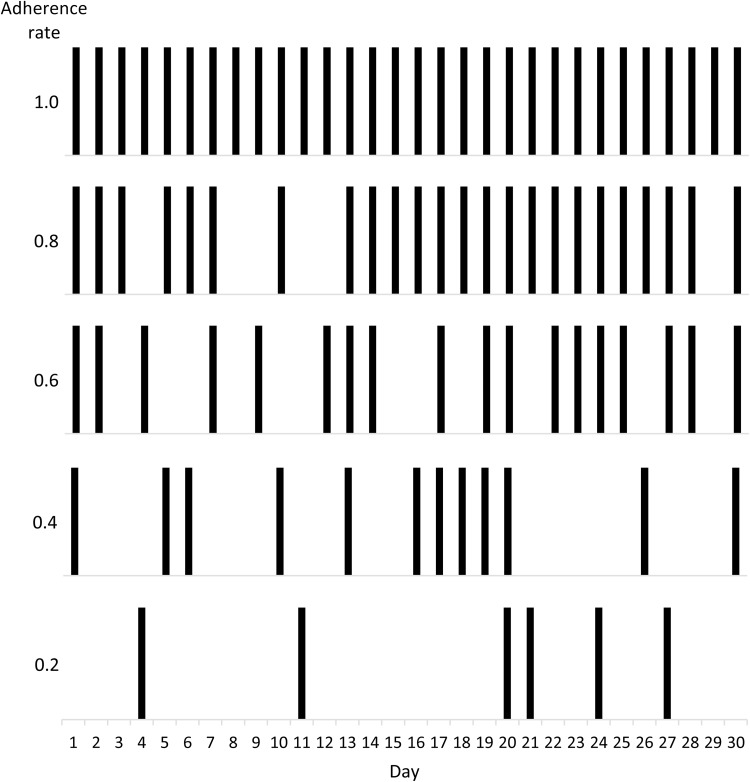
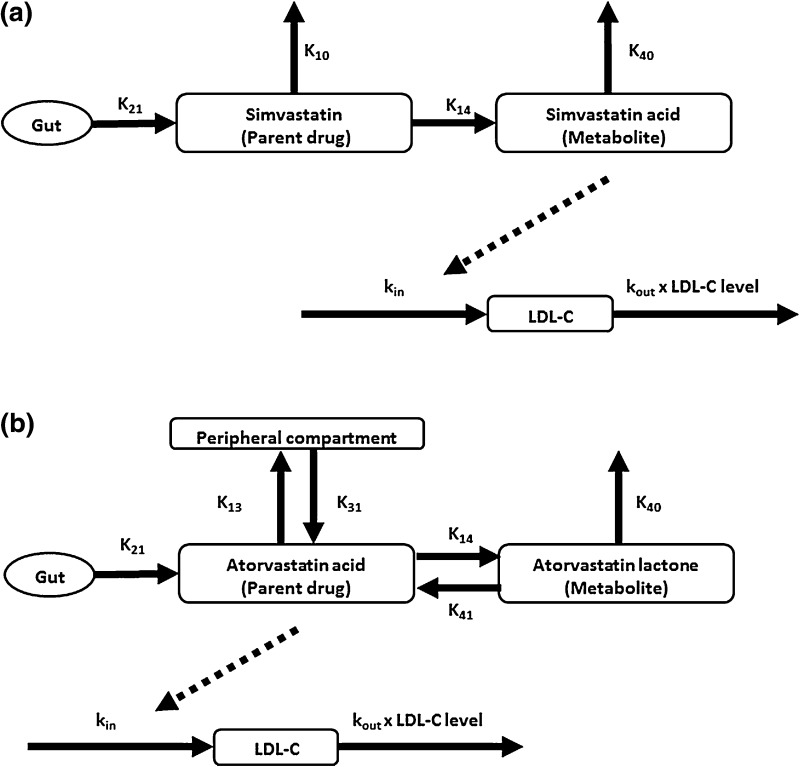
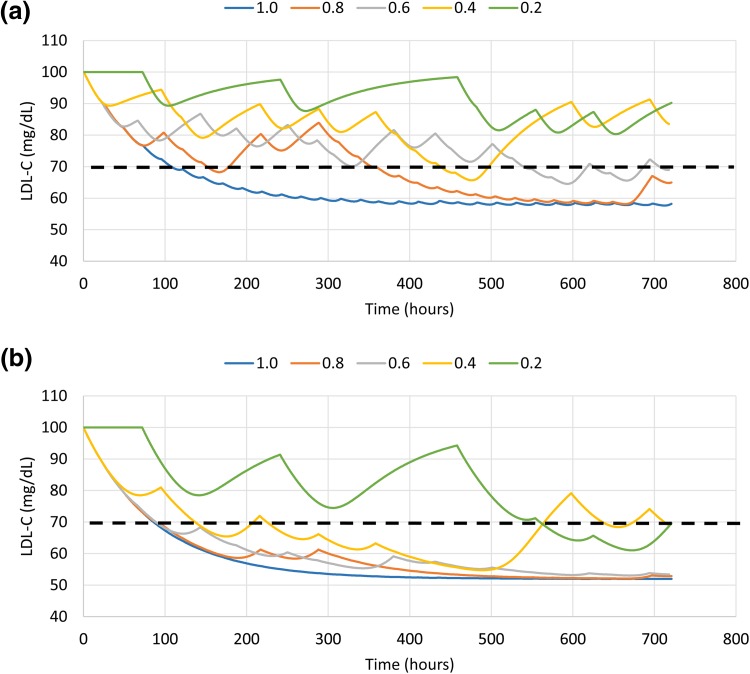
We used pharmacokinetic/pharmacodynamic (PK/PD) modeling to predict serum levels of low-density lipoprotein cholesterol (LDL-C) in patients taking simvastatin 20 mg or atorvastatin 5 mg once daily for 30 days. LDL-C reduction was modeled for adherence rates of 1.0, 0.8, 0.6, 0.4, and 0.2. The results were expressed as the percentage of time spent at the LDL-C goal (< 70 mg/dL). The adherence rate threshold was defined as the minimum adherence rate that resulted in the same amount of time at goal as perfect adherence (i.e., a rate of 1.0).
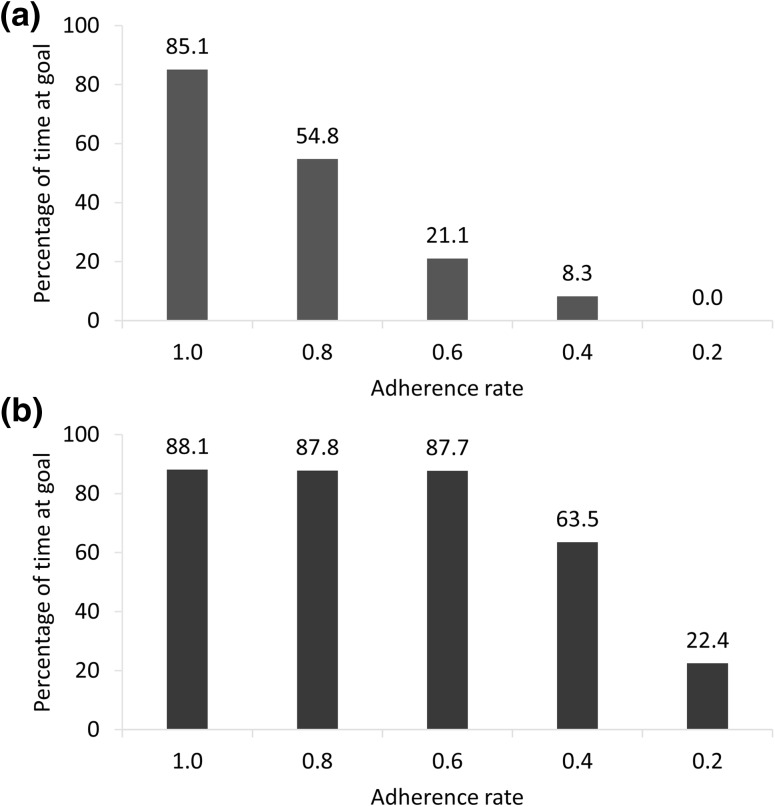
For simvastatin, an adherence rate of 0.8 resulted in a significant decrease in time at the LDL-C goal compared to perfect adherence (54.8% versus 85.1%; P < 0.001), and rates < 0.8 resulted in progressively less time at goal. For atorvastatin, the rates of 0.8 and 0.6 resulted in essentially the same amount of time at goal as perfect adherence (87.8% and 87.7%, respectively, versus 88.1%; P > 0.05 for both), with less time at goal only occurring at rates ≤ 0.4 (P < 0.001). Thus, the adherence rate thresholds are > 0.8 for simvastatin and between 0.4 and 0.6 for atorvastatin.
These results indicate that a value of 0.8 cannot be applied universally.
患者对药物治疗方案的依从性通常以依从率表示,定义为实际服用的规定剂量比例。通常会为维持治疗效果的依从率阈值指定一个任意值,通常为 0.8。
本研究以他汀类药物为例,旨在客观确定同一类药物中不同药物的依从率阈值值。
我们使用药代动力学/药效学(PK/PD)模型预测服用辛伐他汀 20mg 或阿托伐他汀 5mg 每天一次的患者在 30 天内的低密度脂蛋白胆固醇(LDL-C)的血清水平。对于依从率为 1.0、0.8、0.6、0.4 和 0.2 的患者,模拟 LDL-C 降低情况。结果表示 LDL-C 目标(<70mg/dL)的达标时间百分比。依从率阈值定义为与完全依从(即依从率为 1.0)达到相同目标时间的最低依从率。
对于辛伐他汀,与完全依从相比,依从率为 0.8 时 LDL-C 目标的达标时间显著减少(54.8% 比 85.1%;P<0.001),而依从率<0.8 时目标达标时间逐渐减少。对于阿托伐他汀,0.8 和 0.6 的依从率与完全依从达到的目标时间基本相同(分别为 87.8%和 87.7%,与 88.1%相比,P>0.05),只有在依从率≤0.4 时目标达标时间才会减少(P<0.001)。因此,辛伐他汀的依从率阈值>0.8,阿托伐他汀的阈值在 0.4 和 0.6 之间。
这些结果表明,0.8 的值不能普遍适用。