Evandt Jorunn, Oftedal Bente, Krog Norun Hjertager, Skurtveit Svetlana, Nafstad Per, Schwarze Per E, Skovlund Eva, Houthuijs Danny, Aasvang Gunn Marit
Division of Infection Control and Environmental Health, Department of Air Pollution and Noise, Norwegian Institute of Public Health, P.O. Box 4404 Nydalen, N-0403, Oslo, Norway.
Division of Mental and Physical Health, Department of Mental Disorders, Norwegian Institute of Public Health, P.O. Box 4404 Nydalen, N-0403, Oslo, Norway.
Environ Health. 2017 Oct 23;16(1):110. doi: 10.1186/s12940-017-0330-5.
Road traffic noise has been associated with adverse health effects including sleep disturbances. Use of sleep medication as an indicator of sleeping problems has rarely been explored in studies of the effects of traffic noise. Furthermore, using registry data on sleep medications provides an opportunity to study the effects of noise on sleep where attribution of sleep problems to noise is not possible.
We used questionnaire data from the population-based study Health and Environment in Oslo (HELMILO) (2009-10) (n = 13,019). Individual data on sleep medications was obtained from the Norwegian Prescription Database (NorPD). Noise levels (L ) were modeled for the most exposed façade of the building at each participant's home address. Logistic regression models adjusted for potential confounders were used to analyze the association between traffic noise and sleep medication use both for one whole year and for the summer season. The results were reported as changes in the effect estimate per 5 decibel (dB) increase in noise level.
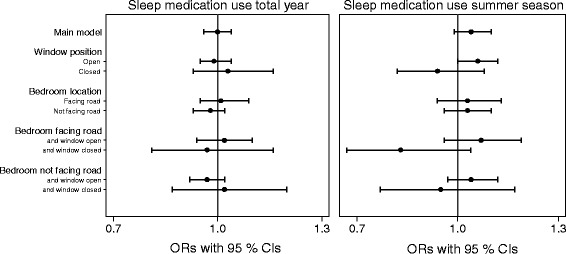
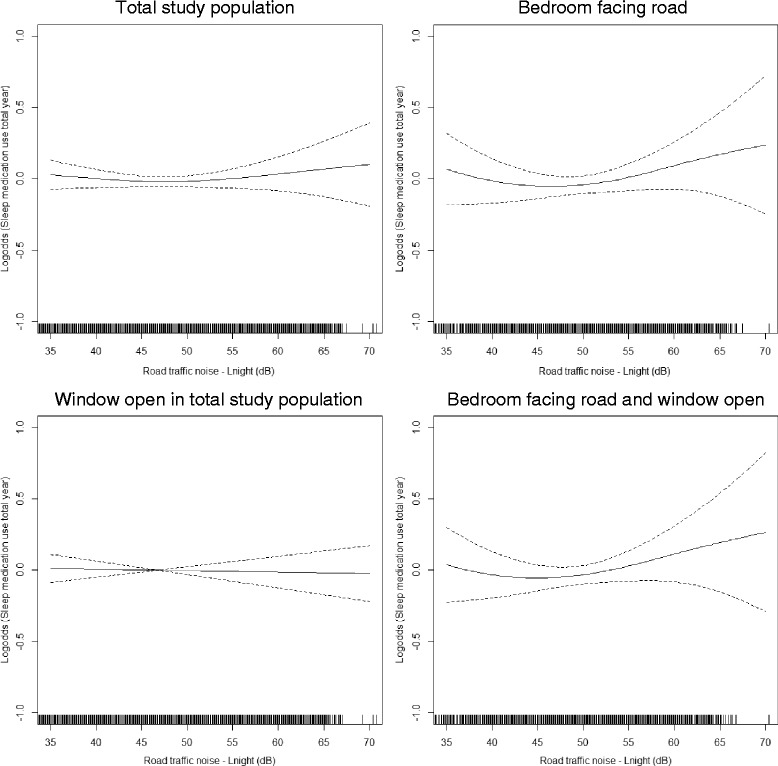
We observed no association between traffic noise and sleep medication use during one year [odds ratio (OR) = 1.00; 95% confidence interval (CI): 0.96, 1.04]. For sleep medication use in the summer season, there was a positive, however non-significant association (OR = 1.04; 95% CI: 0.99, 1.10). Among individuals sleeping with the bedroom window open, the association increased slightly and was borderline statistically significant (OR = 1.06; 95% CI: 1.00, 1.12).
We found no evidence of an association between traffic noise and sleep medication use during one year. However, for the summer season, there was some suggestive evidence of an association. These findings indicate that season may play a role in the association between traffic noise and sleep, possibly because indoor traffic noise levels are likely to be higher during summer due to more frequent window opening. More studies are, however, necessary in order to confirm this.
道路交通噪音已被证实与包括睡眠障碍在内的不良健康影响有关。在交通噪音影响的研究中,很少探讨将使用助眠药物作为睡眠问题指标的情况。此外,利用关于助眠药物的登记数据提供了一个研究噪音对睡眠影响的机会,在这种情况下,无法将睡眠问题归因于噪音。
我们使用了基于人群的奥斯陆健康与环境研究(HELMILO)(2009 - 10年)的问卷数据(n = 13,019)。关于助眠药物的个体数据来自挪威处方数据库(NorPD)。为每位参与者家庭住址处建筑物最暴露的外立面模拟噪音水平(L )。使用针对潜在混杂因素进行调整的逻辑回归模型,分析一整年以及夏季交通噪音与助眠药物使用之间的关联。结果以噪音水平每增加5分贝(dB)时效应估计值的变化来报告。
我们观察到一整年中交通噪音与助眠药物使用之间无关联[优势比(OR)= 1.00;95%置信区间(CI):0.96,1.04]。对于夏季的助眠药物使用,存在正相关,但不显著(OR = 1.04;95% CI:0.99,1.10)。在卧室窗户打开睡觉的个体中,这种关联略有增加且在统计学上接近显著(OR = 1.06;95% CI:1.00,1.12)。
我们没有发现一整年中交通噪音与助眠药物使用之间存在关联的证据。然而,对于夏季,有一些提示性证据表明存在关联。这些发现表明季节可能在交通噪音与睡眠的关联中起作用,可能是因为夏季由于开窗更频繁,室内交通噪音水平可能更高。然而,需要更多研究来证实这一点。