Division of Rheumatology, Immunology and Allergy, Brigham and Women's Hospital, Boston, MA.
Harvard Medical School, Boston, MA.
J Am Heart Assoc. 2017 Oct 27;6(11):e006874. doi: 10.1161/JAHA.117.006874.
Topical NSAIDs have less systemic absorption than oral NSAIDs. We examined the risk of cardiovascular events associated with nonselective topical NSAIDs versus oral NSAIDs among patients with rheumatoid arthritis in Taiwan.
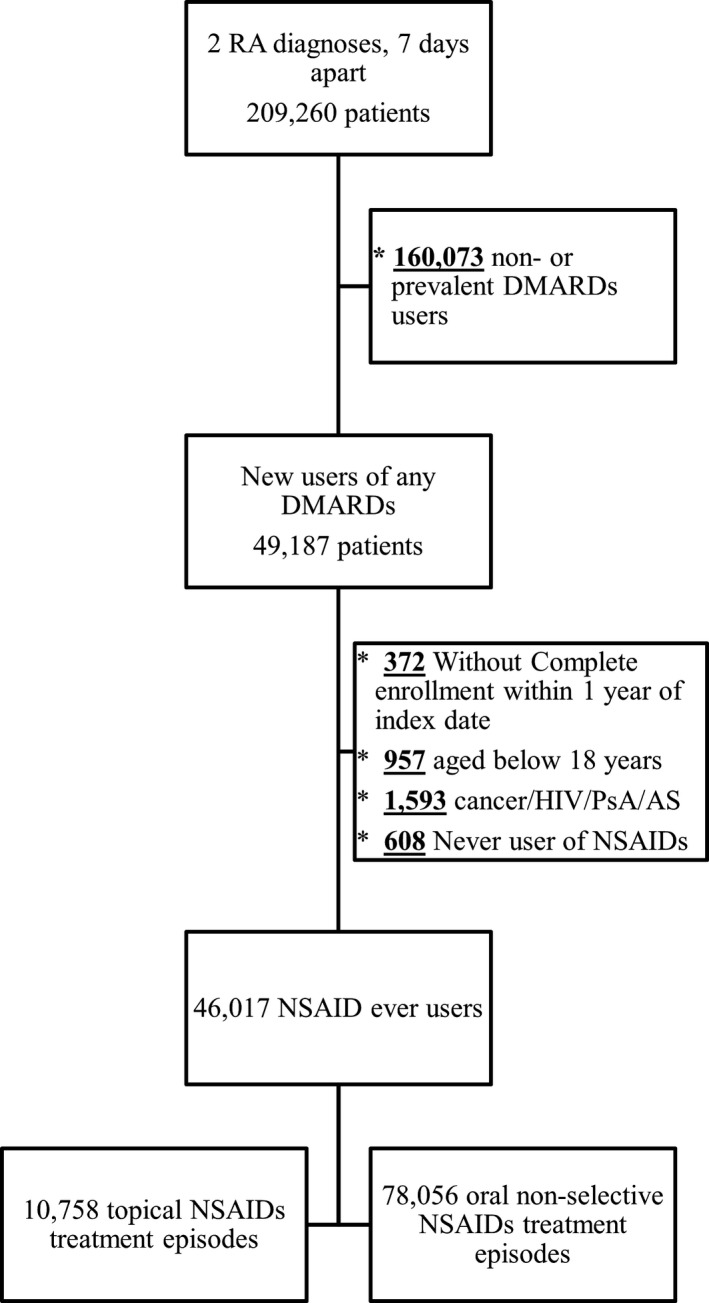
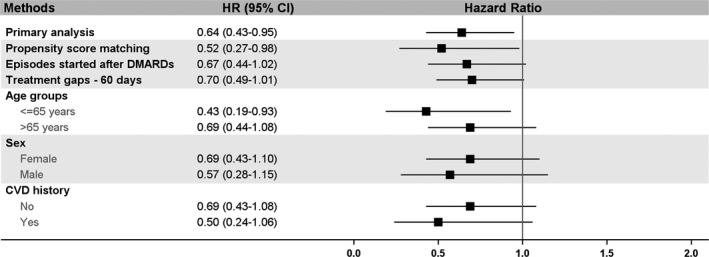
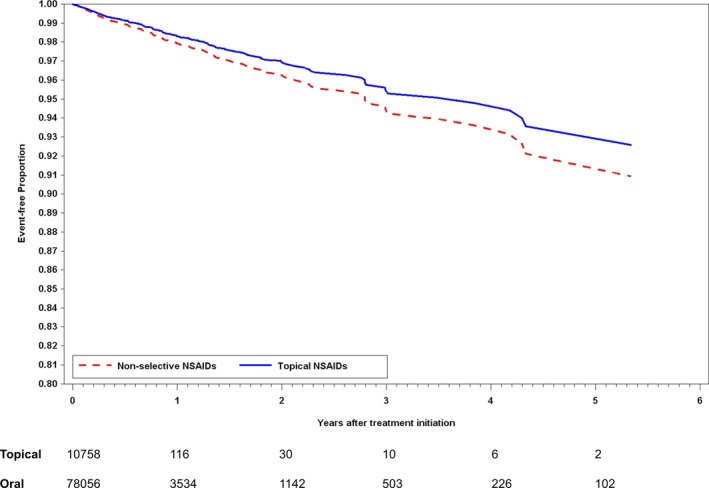
We conducted a retrospective cohort study that included patients with incident rheumatoid arthritis who were newly starting therapy with nonselective topical NSAIDs or oral NSAIDs. We used the Taiwan National Health Insurance Research Database (NHIRD). The first date patients received either type of NSAID was defined as the index date. NSAID exposures continued until there was a treatment gap of >30 days. The main outcome was composite cardiovascular events, including myocardial infarction, unstable angina, heart failure, stroke, or revascularization. Follow-up was censored at treatment discontinuation, switch or addition of other NSAID category, cardiovascular outcome, death, or the end of the study. Propensity score weighted Cox regression models were used to compare the risk of cardiovascular events between topical NSAIDs and oral NSAIDs. There were 10 758 and 78 056 treatment episodes for topical and oral NSAIDs identified. After weighting by propensity score, the cohorts were well balanced over all covariates. The crude cardiovascular event rate was 1.87 per 100 person-years for topical NSAIDs and 2.14 per 100 person-years for oral NSAIDs. Results of propensity score weighted Cox regression found the topical NSAID group had 36% lower risk for cardiovascular events compared with the oral NSAID group (hazard ratio, 0.64; 95% confidence interval, 0.43-0.95).
We found topical NSAID users experienced a reduced risk of cardiovascular events compared with oral NSAID users. If future studies with a larger sample size and longer follow-up confirm these results, NSAID prescribing might change accordingly.
与口服 NSAIDs 相比,局部用 NSAIDs 的全身吸收较少。我们在台湾的类风湿关节炎患者中研究了非选择性局部用 NSAIDs 与口服 NSAIDs 相关的心血管事件风险。
我们进行了一项回顾性队列研究,包括新开始使用非选择性局部用 NSAIDs 或口服 NSAIDs 治疗的类风湿关节炎患者。我们使用了台湾全民健康保险研究数据库(NHIRD)。患者接受任何一种 NSAID 的第一天被定义为索引日期。NSAID 暴露持续到治疗间隔>30 天。主要结局是复合心血管事件,包括心肌梗死、不稳定型心绞痛、心力衰竭、中风或血运重建。随访截止于治疗停药、改用或加用其他 NSAID 类别、心血管结局、死亡或研究结束。采用倾向评分加权 Cox 回归模型比较局部用 NSAIDs 和口服 NSAIDs 的心血管事件风险。共确定了 10758 例和 78056 例局部用 NSAIDs 和口服 NSAIDs 的治疗发作。通过倾向评分加权后,两个队列在所有协变量上均平衡良好。局部用 NSAIDs 的心血管事件粗发生率为 1.87/100 人年,口服 NSAIDs 为 2.14/100 人年。倾向评分加权 Cox 回归结果显示,局部用 NSAIDs 组心血管事件风险较口服 NSAIDs 组降低 36%(危险比,0.64;95%置信区间,0.43-0.95)。
我们发现局部用 NSAIDs 使用者的心血管事件风险较口服 NSAIDs 使用者降低。如果未来有更大样本量和更长随访时间的研究证实这些结果,NSAID 的处方可能会相应改变。