Bariguian Revel Frédérique, Fayet Marina, Hagen Martina
GSK Consumer Healthcare S.A, Route de l'Etraz 2, 1260, Nyon, Switzerland.
Rheumatol Ther. 2020 Jun;7(2):217-236. doi: 10.1007/s40744-020-00196-6. Epub 2020 Feb 21.
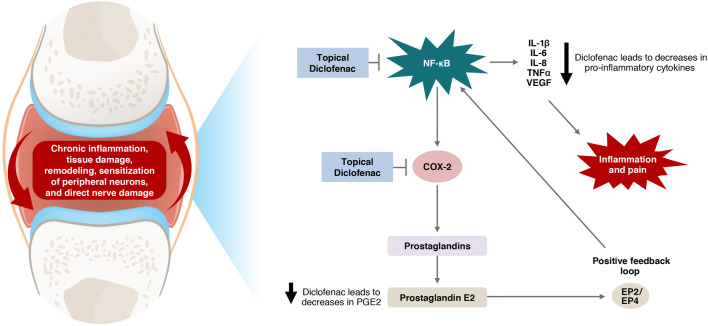
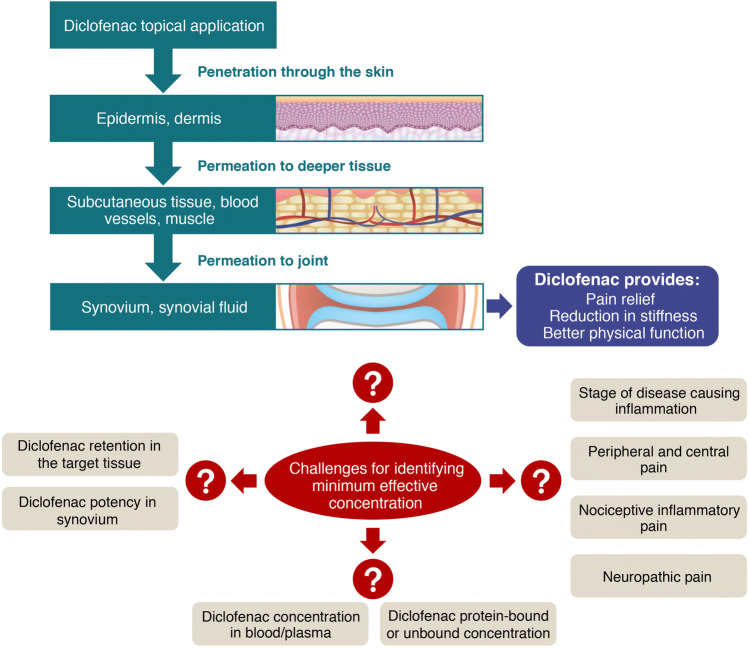
Multiple head-to-head trials have demonstrated that topical nonsteroidal anti-inflammatory drugs (NSAIDs), including topical diclofenac, provide at least equivalent analgesia, improvement in physical function, and reduction of stiffness compared with oral NSAIDs in osteoarthritis and have fewer systemic adverse events. While efficacy of topical diclofenac in osteoarthritis is well established, understanding of the time to onset of action, duration of effect, and the minimum effective concentration is limited. Factors likely to influence these parameters include drug penetration and localization. Diclofenac concentrations in the joint tissues are likely to be more relevant than plasma concentrations. However, although diclofenac penetrates and is retained in these "effect compartments" at the site of inflammation and drug activity, no specific minimum effective concentration of diclofenac in plasma or synovial tissue has been identified. Recent evidence suggests that a reduction in inflammatory markers may be a better predictor of efficacy than plasma concentrations. This narrative review explores existing evidence in these areas and identifies the gaps where further research is needed. Based on our findings, topical NSAIDs such as diclofenac should be considered as a guideline-supported, generally well-tolerated, and effective first-line treatment option for knee and hand OA, especially for older patients and those who have comorbid conditions and/or risk factors for various systemic (gastrointestinal, hepatic, renal, or cardiovascular) adverse events associated with oral NSAIDs, particularly at high doses and with long-term use.
多项头对头试验表明,局部用非甾体抗炎药(NSAIDs),包括双氯芬酸,在骨关节炎中与口服NSAIDs相比,至少能提供同等程度的镇痛、身体功能改善和僵硬程度减轻,且全身不良事件较少。虽然双氯芬酸在骨关节炎中的疗效已得到充分证实,但对其起效时间、作用持续时间和最低有效浓度的了解有限。可能影响这些参数的因素包括药物渗透和定位。关节组织中的双氯芬酸浓度可能比血浆浓度更具相关性。然而,尽管双氯芬酸能渗透并保留在炎症和药物活性部位的这些“效应室”中,但尚未确定双氯芬酸在血浆或滑膜组织中的具体最低有效浓度。最近的证据表明,炎症标志物的降低可能比血浆浓度更能预测疗效。本叙述性综述探讨了这些领域的现有证据,并确定了需要进一步研究的空白。根据我们的研究结果,双氯芬酸等局部用NSAIDs应被视为一种有指南支持、耐受性良好且有效的一线治疗选择,用于膝关节和手部骨关节炎,特别是对于老年患者以及那些有合并症和/或与口服NSAIDs相关的各种全身(胃肠道、肝脏、肾脏或心血管)不良事件风险因素的患者,尤其是在高剂量和长期使用时。