Department of Preventive Medicine, University of Mississippi Medical Center, Jackson, MS
Division of Geriatric Medicine, University of Mississippi Medical Center, Jackson, MS.
J Am Heart Assoc. 2017 Oct 27;6(11):e007022. doi: 10.1161/JAHA.117.007022.
Whether the association of blood pressure (BP) during sleep (nocturnal BP) with cognition differs by race is unknown.
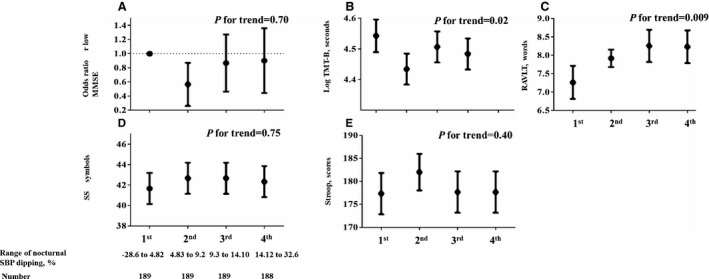
Participants in the GENOA (Genetic Epidemiology Network of Arteriopathy) Study underwent ambulatory BP measurements, brain magnetic resonance imaging, and cognitive function testing (the Rey Auditory Verbal Learning Test, the Digit Symbol Substitution Task, and the Trail Making Test Part B) between 2000 and 2007. We examined multivariable linear regression models of the nocturnal BP-cognition association. Among 755 participants (mean age, 63 years; 64% women; 42% self-identified black race; 76% taking antihypertensive medication), mean nocturnal systolic BP (SBP)/diastolic BP was 126/69 mm Hg, daytime SBP/diastolic BP level was 139/82 mm Hg, and mean reduction in SBP from day to night (dipping) was 9%. Among the entire sample, a race interaction was observed in Digit Symbol Substitution Task and Trail Making Test Part B (both <0.15). Race-stratified analyses showed that a 1-SD increase in nocturnal SBP levels was associated with poorer Digit Symbol Substitution Task and log-transformed Trail Making Test Part B scores (unstandardized regression coefficient [95% confidence interval]: -1.98 [-3.28 to -0.69] and 0.06 [0.004-0.12]; both 0.05) in black but not white individuals. Additional adjustments for white matter hyperintensity volumes or brain atrophy, measured via brain magnetic resonance imaging, did not change the results. Results were similar when nocturnal SBP dipping was assessed as the exposure, yet daytime SBP levels yielded no association with cognition.
Nocturnal SBP measurements may be useful in assessing the potential risk for lower cognitive function in middle-aged and older adults, particularly in black individuals.
目前尚不清楚睡眠期间(夜间血压)血压与认知之间的关联是否因种族而异。
GENOA(动脉粥样硬化遗传流行病学网络)研究的参与者在 2000 年至 2007 年间接受了动态血压测量、脑磁共振成像和认知功能测试(Rey 听觉言语学习测试、数字符号替代测试和 Trail Making 测试 B 部分)。我们检查了夜间血压与认知关联的多变量线性回归模型。在 755 名参与者中(平均年龄 63 岁;64%为女性;42%自我认定为黑人种族;76%服用抗高血压药物),平均夜间收缩压(SBP)/舒张压为 126/69mmHg,白天 SBP/舒张压水平为 139/82mmHg,夜间 SBP 从白天到夜间的平均降幅为 9%。在整个样本中,数字符号替代测试和 Trail Making 测试 B 部分均观察到种族交互作用(均<0.15)。按种族分层分析显示,夜间 SBP 水平每增加 1 个标准差,与数字符号替代测试和 log 转换的 Trail Making 测试 B 部分评分较差相关(未标准化回归系数[95%置信区间]:-1.98[-3.28 至-0.69]和 0.06[0.004-0.12];均<0.05),但在白种人则无此关联。通过脑磁共振成像测量的脑白质高信号体积或脑萎缩的额外调整并未改变结果。当夜间 SBP 下降被评估为暴露因素时,结果相似,但日间 SBP 水平与认知功能无关联。
夜间 SBP 测量可能有助于评估中年和老年人认知功能降低的潜在风险,尤其是黑人。