Cumming Kirsten, Macleod Angus D, Myint Phyo K, Counsell Carl E
From the School of Medicine (K.C.), Medical Sciences & Nutrition, and Chronic Disease Research Group (A.D.M., C.E.C.) and Ageing Clinical & Experimental Research Team (P.K.M.), Institute of Applied Health Sciences, University of Aberdeen, Scotland.
Neurology. 2017 Nov 28;89(22):2254-2261. doi: 10.1212/WNL.0000000000004691. Epub 2017 Oct 27.
To compare weight change over time in patients with Parkinson disease (PD), those with atypical parkinsonism, and matched controls; to identify baseline factors that influence weight loss in parkinsonism; and to examine whether it predicts poor outcome.
We analyzed data from the Parkinsonism Incidence in North-East Scotland (PINE) study, an incident, population-based prospective cohort of parkinsonian patients and age- and sex-matched controls with annual follow-up. Mixed-model analysis described weight change in patients with PD, those with atypical parkinsonism, and controls. Baseline determinants of sustained clinically significant weight loss (>5% loss from baseline) and associations between early sustained weight loss and death, dementia, and dependency in parkinsonism were studied with Cox regression.
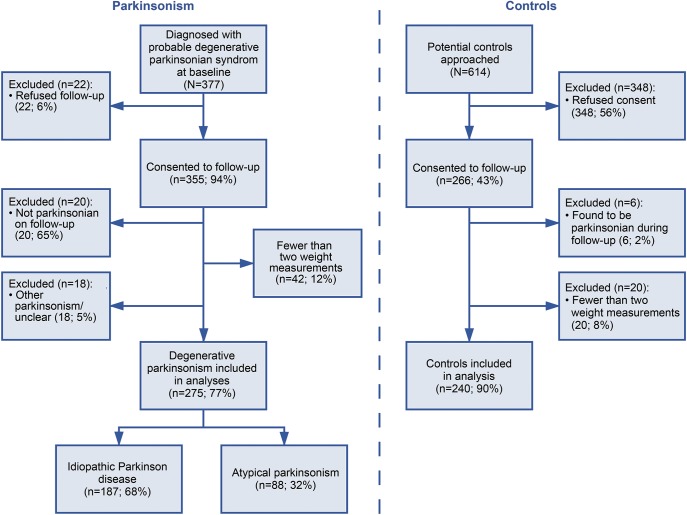
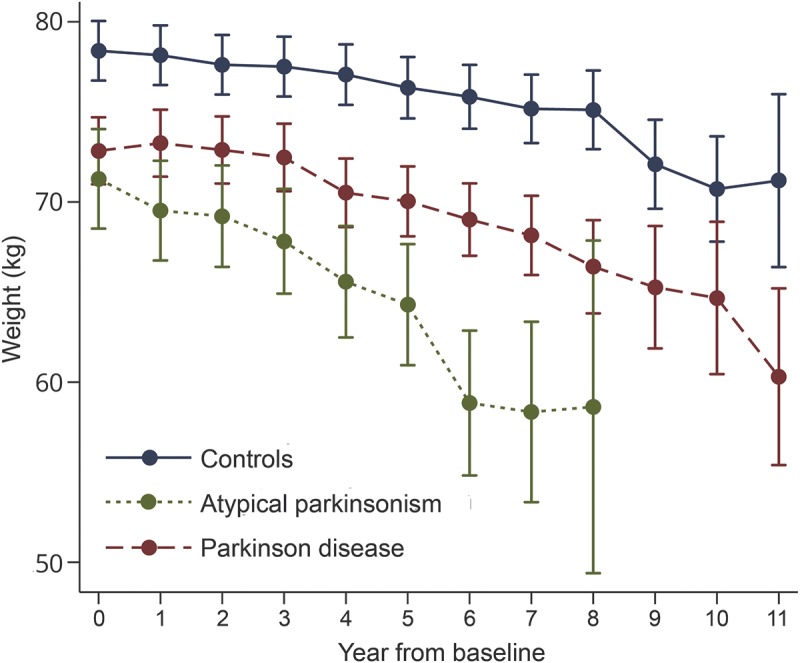
A total of 515 participants (240 controls, 187 with PD, 88 with atypical parkinsonism) were followed up for a median of 5 years. At diagnosis, atypical parkinsonian patients had lower body weights than patients with PD, who were lighter than controls. Patients with PD lost weight more rapidly than controls, and weight loss was most rapid in atypical parkinsonism. After multivariable adjustment for potential confounders, only age was independently associated with sustained clinically significant weight loss (hazard ratio [HR] for 10-year age increase 1.83, 95% confidence interval [CI] 1.44-2.32). Weight loss occurring within 1 year of diagnosis was independently associated with increased risk of dependency (HR 2.11, 95% CI 1.00-4.42), dementia (HR 3.23, 95% CI 1.40-7.44), and death (HR 2.23, 95% CI 1.46-3.41).
Weight loss occurs in early parkinsonism and is greater in atypical parkinsonism than in PD. Early weight loss in parkinsonism has prognostic significance, and targeted dietary interventions to prevent it may improve long-term outcomes.
比较帕金森病(PD)患者、非典型帕金森综合征患者及匹配对照组随时间的体重变化;确定影响帕金森综合征体重减轻的基线因素;并研究其是否可预测不良预后。
我们分析了苏格兰东北部帕金森综合征发病率(PINE)研究的数据,该研究是一项基于人群的帕金森病患者及年龄和性别匹配对照组的前瞻性队列研究,每年进行随访。混合模型分析描述了PD患者、非典型帕金森综合征患者及对照组的体重变化。采用Cox回归研究持续临床显著体重减轻(较基线体重减轻>5%)的基线决定因素,以及帕金森综合征早期持续体重减轻与死亡、痴呆和失能之间的关联。
共515名参与者(240名对照组、187名PD患者、88名非典型帕金森综合征患者)接受了中位时间为5年的随访。诊断时,非典型帕金森综合征患者的体重低于PD患者,而PD患者体重又低于对照组。PD患者体重减轻速度比对照组更快,非典型帕金森综合征患者体重减轻最为迅速。在对潜在混杂因素进行多变量调整后,只有年龄与持续临床显著体重减轻独立相关(每增加10岁的风险比[HR]为1.83,95%置信区间[CI]为1.44 - 2.32)。诊断后1年内发生的体重减轻与失能风险增加独立相关(HR 2.11,95% CI 1.00 - 4.42)、痴呆(HR 3.23,95% CI 1.40 - 7.44)和死亡(HR 2.23,95% CI 1.46 - 3.41)。
帕金森综合征早期会出现体重减轻,且非典型帕金森综合征患者比PD患者更明显。帕金森综合征早期体重减轻具有预后意义,针对性的饮食干预以预防体重减轻可能改善长期预后。