Department of Physics, University of Miami, Coral Gables, United States.
Astbury Centre for Structural Molecular Biology, University of Leeds, Leeds, United Kingdom.
Elife. 2017 Oct 30;6:e30503. doi: 10.7554/eLife.30503.
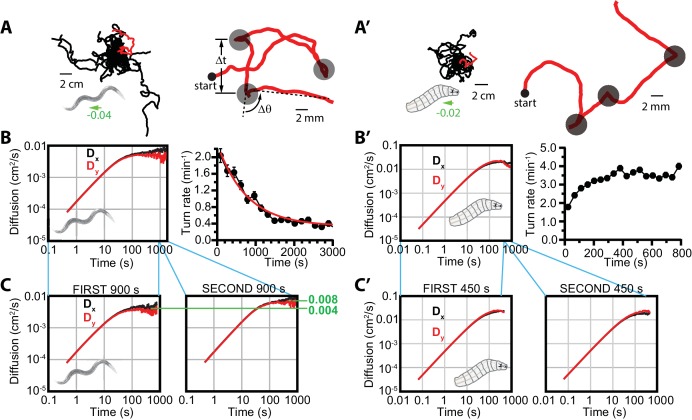
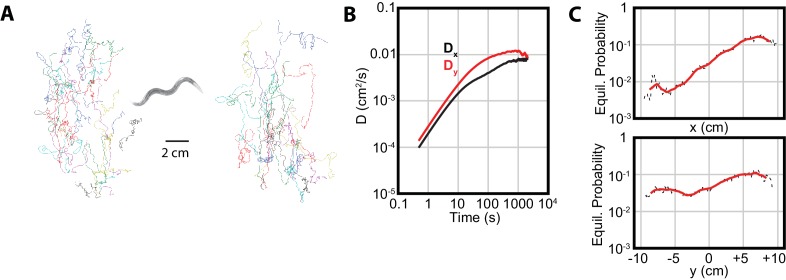
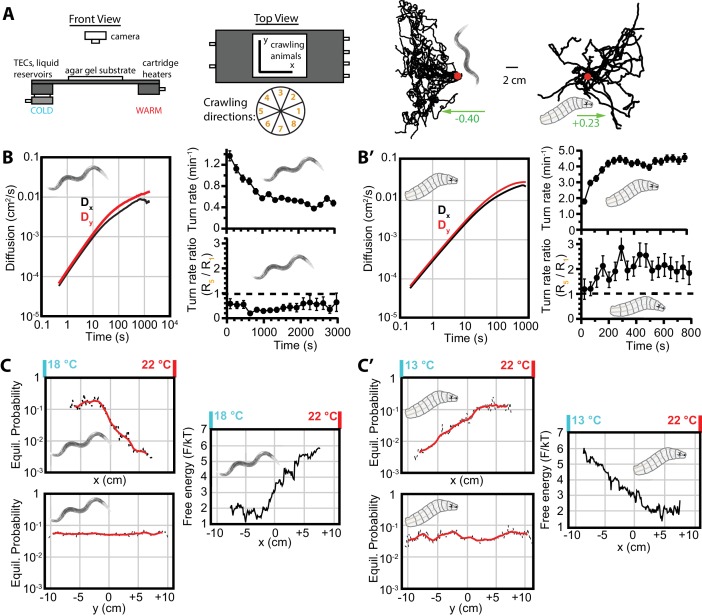
Many organisms-from bacteria to nematodes to insect larvae-navigate their environments by biasing random movements. In these organisms, navigation in isotropic environments can be characterized as an essentially diffusive and undirected process. In stimulus gradients, movement decisions are biased to drive directed navigation toward favorable environments. How does directed navigation in a gradient modulate random exploration either parallel or orthogonal to the gradient? Here, we introduce methods originally used for analyzing protein folding trajectories to study the trajectories of the nematode and the larva in isotropic environments, as well as in thermal and chemical gradients. We find that the statistics of random exploration in any direction are little affected by directed movement along a stimulus gradient. A key constraint on the behavioral strategies of these organisms appears to be the preservation of their capacity to continuously explore their environments in all directions even while moving toward favorable conditions.
许多生物——从细菌到线虫再到昆虫幼虫——通过偏向随机运动来在环境中导航。在这些生物中,各向同性环境中的导航可以被描述为一个本质上是扩散的、无方向的过程。在刺激梯度中,运动决策被偏向以驱动朝向有利环境的定向导航。在梯度中定向导航如何调节与梯度平行或正交的随机探索?在这里,我们引入了最初用于分析蛋白质折叠轨迹的方法来研究线虫和幼虫在各向同性环境以及热和化学梯度中的轨迹。我们发现,沿着刺激梯度进行定向运动对任何方向的随机探索的统计数据几乎没有影响。这些生物的行为策略的一个关键限制似乎是保持它们在向有利条件移动的同时,继续在各个方向上不断探索环境的能力。