Department of Neuropathology, Royal Prince Alfred Hospital, Camperdown, NSW, Australia.
Brain and Mind Centre, University of Sydney, Camperdown, NSW, Australia.
Sci Rep. 2017 Oct 30;7(1):14293. doi: 10.1038/s41598-017-14301-3.
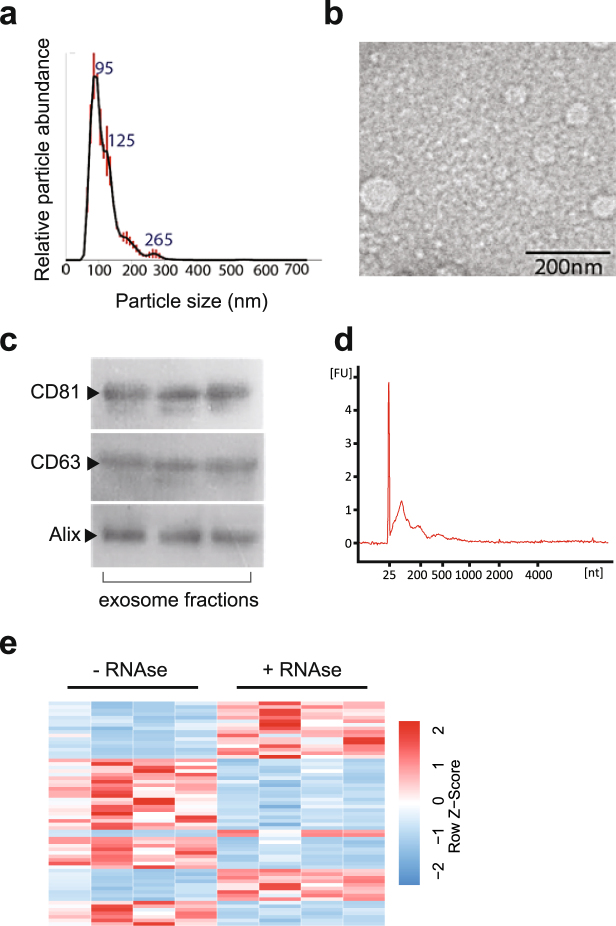
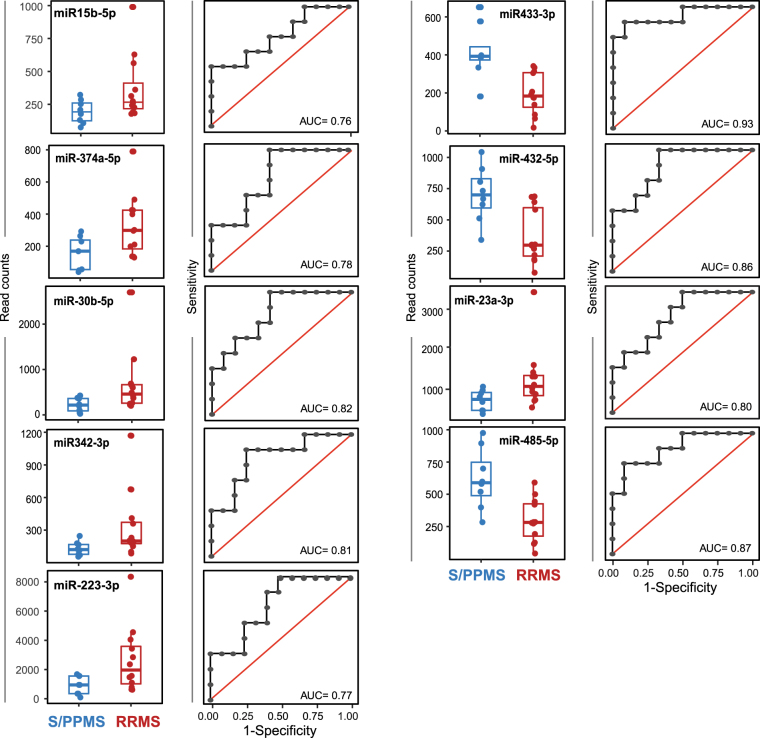
Multiple Sclerosis (MS) is a chronic inflammatory demyelinating disease of the central nervous system (CNS). There is currently no single definitive test for MS. Circulating exosomes represent promising candidate biomarkers for a host of human diseases. Exosomes contain RNA, DNA, and proteins, can cross the blood-brain barrier, and are secreted from almost all cell types including cells of the CNS. We hypothesized that serum exosomal miRNAs could present a useful blood-based assay for MS disease detection and monitoring. Exosome-associated microRNAs in serum samples from MS patients (n = 25) and matched healthy controls (n = 11) were profiled using small RNA next generation sequencing. We identified differentially expressed exosomal miRNAs in both relapsing-remitting MS (RRMS) (miR-15b-5p, miR-451a, miR-30b-5p, miR-342-3p) and progressive MS patient sera (miR-127-3p, miR-370-3p, miR-409-3p, miR-432-5p) in relation to controls. Critically, we identified a group of nine miRNAs (miR-15b-5p, miR-23a-3p, miR-223-3p, miR-374a-5p, miR-30b-5p, miR-433-3p, miR-485-3p, miR-342-3p, miR-432-5p) that distinguished relapsing-remitting from progressive disease. Eight out of nine miRNAs were validated in an independent group (n = 11) of progressive MS cases. This is the first demonstration that microRNAs associated with circulating exosomes are informative biomarkers not only for the diagnosis of MS, but in predicting disease subtype with a high degree of accuracy.
多发性硬化症(MS)是一种中枢神经系统(CNS)的慢性炎症性脱髓鞘疾病。目前尚无针对 MS 的单一明确测试。循环外泌体代表了许多人类疾病有前途的候选生物标志物。外泌体包含 RNA、DNA 和蛋白质,可以穿过血脑屏障,并且几乎所有细胞类型(包括中枢神经系统细胞)都会分泌。我们假设血清外泌体 miRNA 可以提供一种有用的基于血液的 MS 疾病检测和监测方法。使用下一代小 RNA 测序对来自 MS 患者(n=25)和匹配的健康对照者(n=11)的血清样本中外泌体相关 microRNA 进行了分析。我们在 RRMS(miR-15b-5p、miR-451a、miR-30b-5p、miR-342-3p)和进展性 MS 患者血清中鉴定了差异表达的外泌体 miRNA(miR-127-3p、miR-370-3p、miR-409-3p、miR-432-5p)与对照者相比。至关重要的是,我们确定了一组九种 miRNA(miR-15b-5p、miR-23a-3p、miR-223-3p、miR-374a-5p、miR-30b-5p、miR-433-3p、miR-485-3p、miR-342-3p、miR-432-5p)可以区分缓解复发和进展性疾病。九种 miRNA 中的八种在独立的进展性 MS 病例组(n=11)中得到了验证。这是首次证明与循环外泌体相关的 microRNA 不仅是 MS 诊断的信息生物标志物,而且可以高度准确地预测疾病亚型。