Glycoscience Group, National Centre for Biomedical Engineering Science, National University of Ireland Galway, H91 CF50 Galway, Ireland.
School of Natural Sciences, National University of Ireland Galway, H91 CF50 Galway, Ireland.
World J Gastroenterol. 2017 Oct 7;23(37):6817-6832. doi: 10.3748/wjg.v23.i37.6817.
To identify glycosylation-related genes in the HT29 derivative cell line, HT29-MTX-E12, showing differential expression on infection with ().
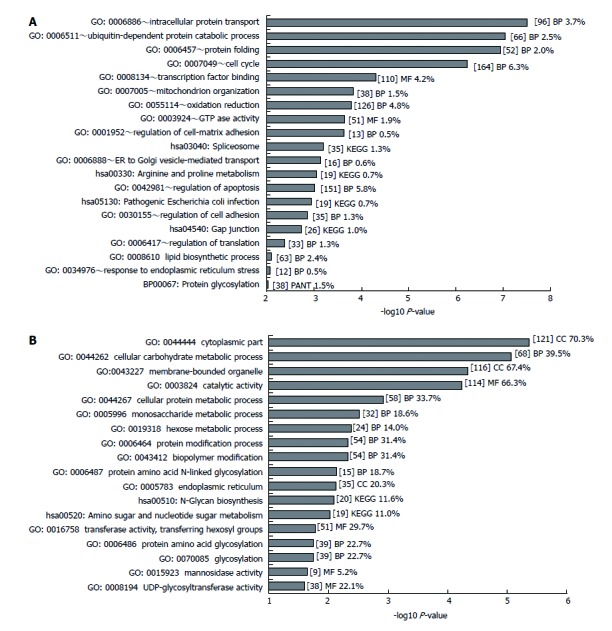
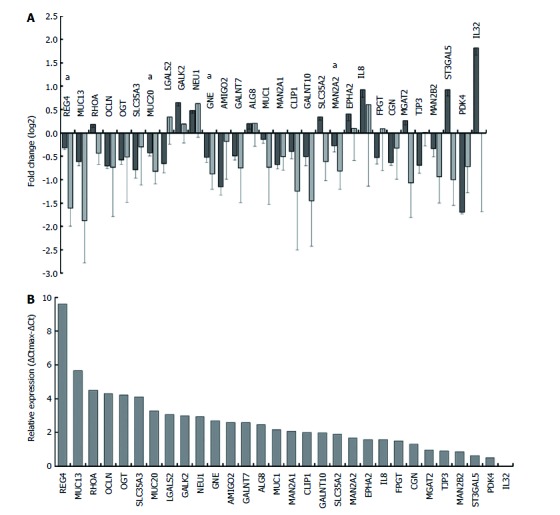
Polarised HT29-MTX-E12 cells were infected for 24 h with strain 26695. After infection RNA was isolated from both infected and non-infected host cells. Sufficient infections were carried out to provide triplicate samples for microarray analysis and for qRT-PCR analysis. RNA was isolated and hybridised to Affymetrix arrays. Analysis of microarray data identified genes significantly differentially expressed upon infection. Genes were grouped into gene ontology functional categories. Selected genes associated with host glycan structure (glycosyltransferases, hydrolases, lectins, mucins) were validated by real-time qRT-PCR analysis.
Infection of host cells was confirmed by the isolation of live bacteria after 24 h incubation and by PCR amplification of bacteria-specific genes from the host cell RNA. do not survive incubation under the adopted culture conditions unless they associate with the adherent mucus layer of the host cell. Microarray analysis identified a total of 276 genes that were significantly differentially expressed ( < 0.05) upon infection and where the fold change in expression was greater than 2. Six of these genes are involved in glycosylation-related processes. Real-time qRT-PCR demonstrated significant downregulation (1.8-fold, < 0.05) of the mucin MUC20. REG4 was heavily expressed and significantly downregulated (3.1-fold, < 0.05) upon infection. Gene ontology analysis was consistent with previous studies on infection.
Gene expression data suggest that infection with causes a decrease in glycan synthesis, resulting in shorter and simpler glycan structures.
鉴定 HT29 衍生物细胞系 HT29-MTX-E12 中与糖基化相关的基因,这些基因在感染 时表现出差异表达。
将极化的 HT29-MTX-E12 细胞用 株 26695 感染 24 小时。感染后,从感染和未感染的宿主细胞中分离 RNA。进行足够的感染,为微阵列分析和 qRT-PCR 分析提供三重复制品。分离 RNA 并与 Affymetrix 芯片杂交。微阵列数据分析鉴定出感染后显著差异表达的基因。将基因分为基因本体论功能类别。与宿主糖结构相关的选定基因(糖基转移酶、水解酶、凝集素、粘蛋白)通过实时 qRT-PCR 分析进行验证。
24 小时孵育后从宿主细胞 RNA 中分离出活细菌并通过细菌特异性基因的 PCR 扩增证实了宿主细胞的感染。除非与宿主细胞的黏附黏液层相关联,否则 在采用的培养条件下不会存活。微阵列分析总共鉴定出 276 个基因在 感染后显著差异表达(<0.05),且表达变化倍数大于 2。其中 6 个基因参与糖基化相关过程。实时 qRT-PCR 显示黏蛋白 MUC20 的表达显著下调(1.8 倍,<0.05)。REG4 大量表达且感染后显著下调(3.1 倍,<0.05)。基因本体论分析与先前关于 感染的研究一致。
基因表达数据表明,感染 导致聚糖合成减少,导致聚糖结构变短变简单。