Whittaker Dominic G, Ni Haibo, Benson Alan P, Hancox Jules C, Zhang Henggui
Biological Physics Group, School of Physics and Astronomy, University of Manchester, Manchester, United Kingdom.
School of Biomedical Sciences, University of Leeds, Leeds, United Kingdom.
Front Physiol. 2017 Oct 4;8:759. doi: 10.3389/fphys.2017.00759. eCollection 2017.
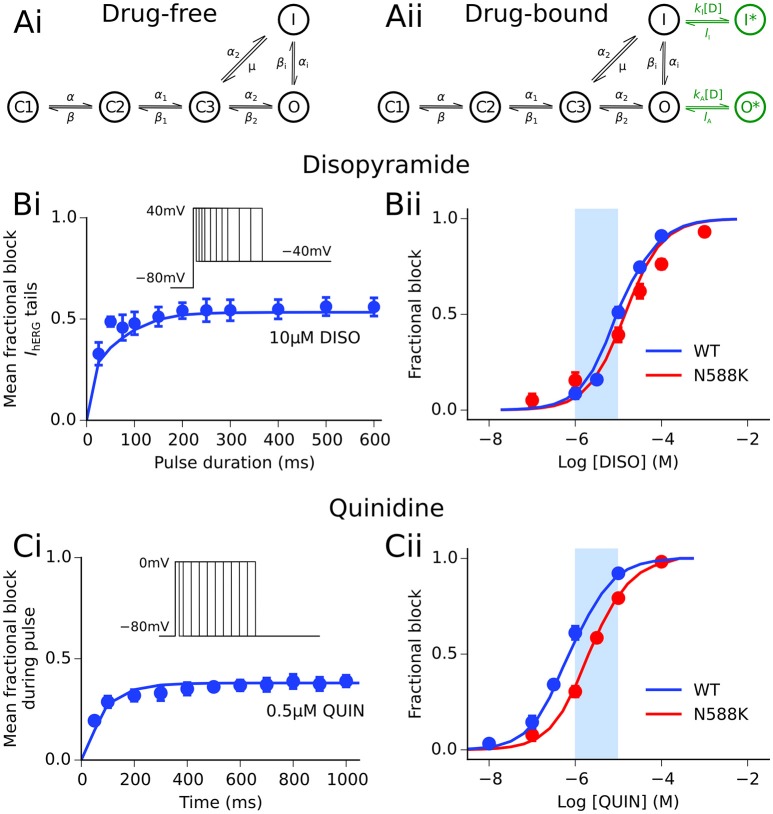
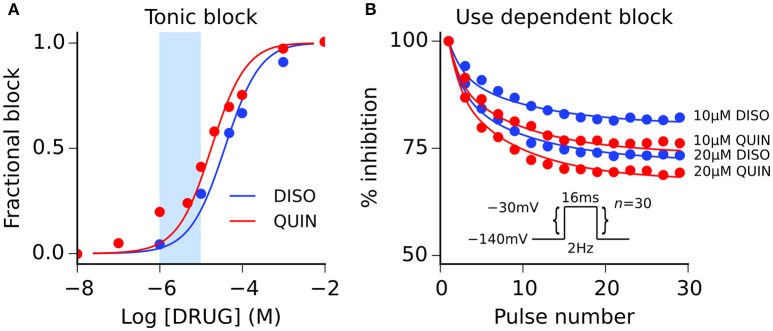
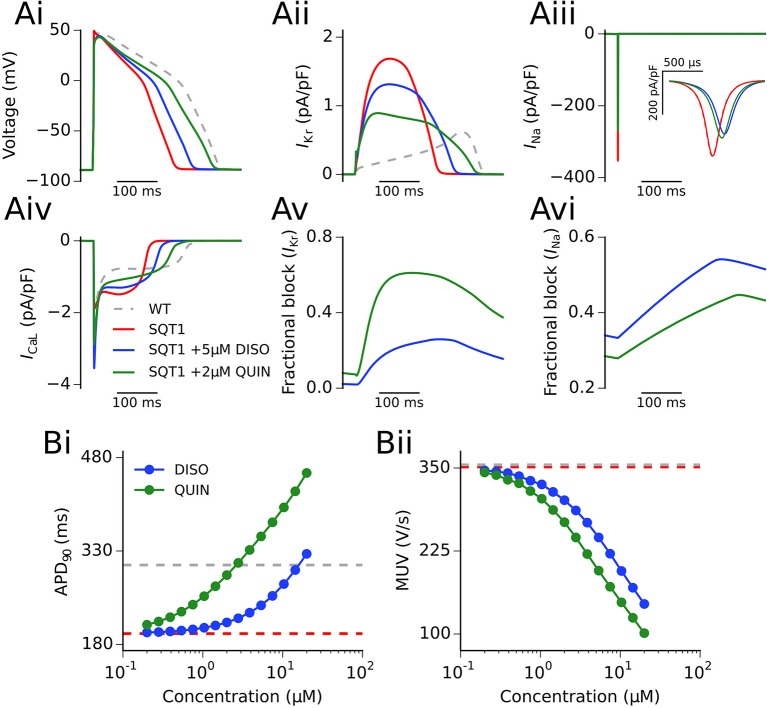
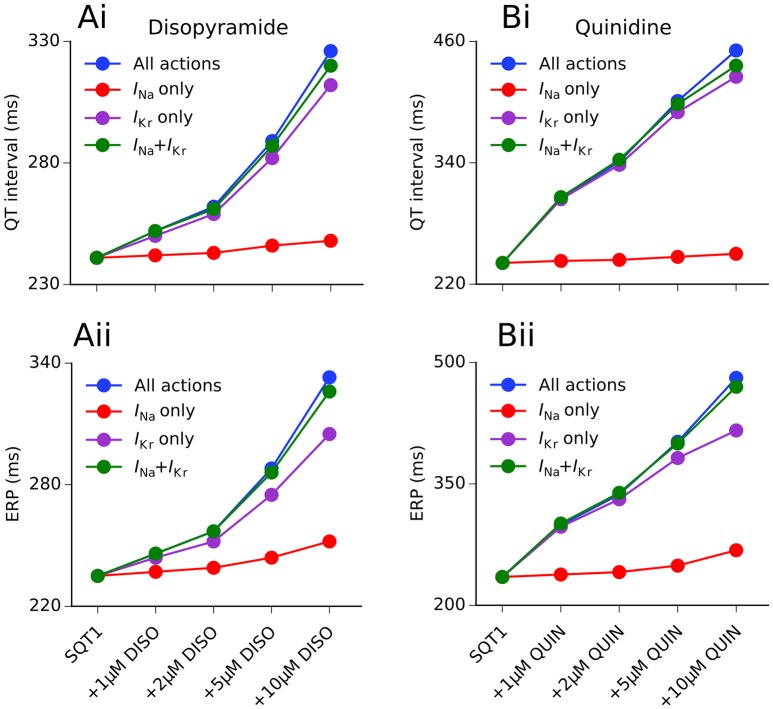
The short QT syndrome (SQTS) is a rare cardiac disorder associated with arrhythmias and sudden death. Gain-of-function mutations to potassium channels mediating the rapid delayed rectifier current, , underlie SQTS variant 1 (SQT1), in which treatment with Na and K channel blocking class Ia anti-arrhythmic agents has demonstrated some efficacy. This study used computational modeling to gain mechanistic insights into the actions of two such drugs, disopyramide and quinidine, in the setting of SQT1. The O'Hara-Rudy (ORd) human ventricle model was modified to incorporate a Markov chain formulation of describing wild type (WT) and SQT1 mutant conditions. Effects of multi-channel block by disopyramide and quinidine, including binding kinetics and altered potency of channel block in SQT1 and state-dependent block of sodium channels, were simulated on action potential and multicellular tissue models. A one-dimensional (1D) transmural ventricular strand model was used to assess prolongation of the QT interval, effective refractory period (ERP), and re-entry wavelength (WL) by both drugs. Dynamics of re-entrant excitation waves were investigated using a 3D human left ventricular wedge model. In the setting of SQT1, disopyramide, and quinidine both produced a dose-dependent prolongation in (i) the QT interval, which was primarily due to block, and (ii) the ERP, which was mediated by a synergistic combination of and block. Over the same range of concentrations quinidine was more effective in restoring the QT interval, due to more potent block of . Both drugs demonstrated an anti-arrhythmic increase in the WL of re-entrant circuits. In the 3D wedge, disopyramide and quinidine at clinically-relevant concentrations decreased the dominant frequency of re-entrant excitations and exhibited anti-fibrillatory effects; preventing formation of multiple, chaotic wavelets which developed in SQT1, and could terminate arrhythmias. This computational modeling study provides novel insights into the clinical efficacy of disopyramide and quinidine in the setting of SQT1; it also dissects ionic mechanisms underlying QT and ERP prolongation. Our findings show that both drugs demonstrate efficacy in reversing the SQT1 phenotype, and indicate that disopyramide warrants further investigation as an alternative to quinidine in the treatment of SQT1.
短QT综合征(SQTS)是一种与心律失常和猝死相关的罕见心脏疾病。介导快速延迟整流电流的钾通道功能获得性突变是SQTS 1型(SQT1)的基础,其中使用Ia类钠通道和钾通道阻滞剂进行治疗已显示出一定疗效。本研究使用计算模型来深入了解两种此类药物(丙吡胺和奎尼丁)在SQT1情况下的作用机制。对奥哈拉-鲁迪(ORd)人心室模型进行了修改,以纳入描述野生型(WT)和SQT1突变状态的马尔可夫链公式。在动作电位和多细胞组织模型上模拟了丙吡胺和奎尼丁的多通道阻滞作用,包括结合动力学以及SQT1中通道阻滞效力的改变和钠通道的状态依赖性阻滞。使用一维(1D)跨壁心室肌束模型评估两种药物对QT间期、有效不应期(ERP)和折返波长(WL)的延长作用。使用三维人体左心室楔形模型研究折返兴奋波的动力学。在SQT1情况下,丙吡胺和奎尼丁均产生剂量依赖性的:(i)QT间期延长,这主要是由于通道阻滞;(ii)ERP延长,这是由通道阻滞和通道阻滞的协同作用介导的。在相同浓度范围内,由于对通道的阻滞作用更强,奎尼丁在恢复QT间期方面更有效。两种药物均显示出折返环路WL的抗心律失常性增加。在三维楔形模型中,临床相关浓度的丙吡胺和奎尼丁降低了折返兴奋的主导频率,并表现出抗纤颤作用;防止了SQT1中出现的多个混沌小波的形成,并可终止心律失常。这项计算模型研究为丙吡胺和奎尼丁在SQT1情况下的临床疗效提供了新的见解;它还剖析了QT和ERP延长背后的离子机制。我们的研究结果表明,两种药物在逆转SQT1表型方面均显示出疗效,并表明丙吡胺作为奎尼丁治疗SQT1的替代药物值得进一步研究。