Withers David R, Hepworth Matthew R
College of Medical and Dental Sciences, Institute of Immunology and Immunotherapy (III), University of Birmingham, Birmingham, United Kingdom.
Manchester Collaborative Centre for Inflammation Research (MCCIR), Division of Infection, Immunity and Respiratory Medicine, Faculty of Biology, Medicine and Health, School of Biological Sciences, Manchester Academic Health Science Centre, University of Manchester, Manchester, United Kingdom.
Front Immunol. 2017 Oct 16;8:1298. doi: 10.3389/fimmu.2017.01298. eCollection 2017.
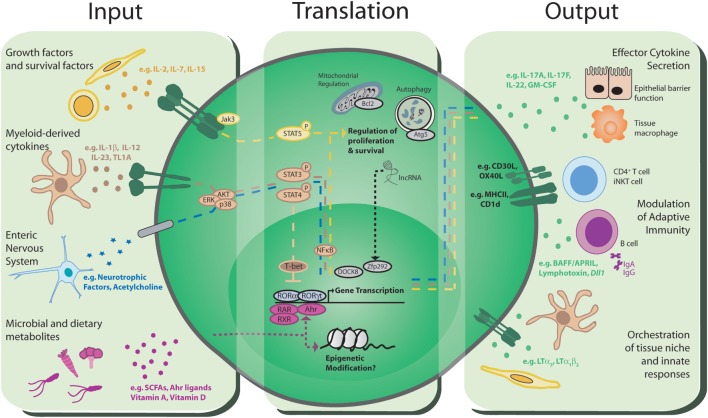
The maintenance of mammalian health requires the generation of appropriate immune responses against a broad range of environmental and microbial challenges, which are continually encountered at barrier tissue sites including the skin, lung, and gastrointestinal tract. Dysregulated barrier immune responses result in inflammation, both locally and systemically in peripheral organs. Group 3 innate lymphoid cells (ILC3) are constitutively present at barrier sites and appear to be highly specialized in their ability to sense a range of environmental and host-derived signals. Under homeostatic conditions, ILC3 respond to local cues to maintain tissue homeostasis and restrict inflammatory responses. In contrast, perturbations in the tissue microenvironment resulting from disease, infection, or tissue damage can drive dysregulated pro-inflammatory ILC3 responses and contribute to immunopathology. The tone of the ILC3 response is dictated by a balance of "exogenous" signals, such as dietary metabolites and commensal microbes, and "endogenous" host-derived signals from stromal cells, immune cells, and the nervous system. ILC3 must therefore have the capacity to simultaneously integrate a wide array of complex and dynamic inputs in order to regulate barrier function and tissue health. In this review, we discuss the concept of ILC3 as a "communications hub" in the intestinal tract and associated lymphoid tissues and address the variety of signals, derived from multiple biological systems, which are interpreted by ILC3 to modulate the release of downstream effector molecules and regulate cell-cell crosstalk. Successful integration of environmental cues by ILC3 and downstream propagation to the broader immune system is required to maintain a tolerogenic and anti-inflammatory tone and reinforce barrier function, whereas dysregulation of ILC3 responses can contribute to the onset or progression of clinically relevant chronic inflammatory diseases.
哺乳动物的健康维持需要针对广泛的环境和微生物挑战产生适当的免疫反应,这些挑战在包括皮肤、肺和胃肠道在内的屏障组织部位持续存在。屏障免疫反应失调会导致局部和外周器官的全身性炎症。3型固有淋巴细胞(ILC3)组成性地存在于屏障部位,并且似乎在感知一系列环境和宿主来源信号的能力方面高度专业化。在稳态条件下,ILC3对局部信号作出反应以维持组织稳态并限制炎症反应。相比之下,疾病、感染或组织损伤导致的组织微环境扰动可驱动ILC3促炎反应失调并导致免疫病理学。ILC3反应的强度由“外源性”信号(如饮食代谢物和共生微生物)与来自基质细胞、免疫细胞和神经系统的“内源性”宿主来源信号之间的平衡决定。因此,ILC3必须有能力同时整合一系列复杂和动态的输入,以调节屏障功能和组织健康。在本综述中,我们讨论了ILC3作为肠道及相关淋巴组织中的“通讯枢纽”的概念,并探讨了来自多个生物系统的各种信号,这些信号由ILC3解读以调节下游效应分子的释放并调节细胞间串扰。ILC3成功整合环境线索并向下游传播至更广泛的免疫系统,对于维持耐受性和抗炎状态以及加强屏障功能是必要的,而ILC3反应失调可能导致临床相关慢性炎症性疾病的发生或进展。