Wegert Jenny, Vokuhl Christian, Ziegler Barbara, Ernestus Karen, Leuschner Ivo, Furtwängler Rhoikos, Graf Norbert, Gessler Manfred
Theodor-Boveri-Institute/Biocenter, Developmental BiochemistryWuerzburg UniversityWuerzburgGermany.
Department of Pathology, Kiel Paediatric Cancer RegistryChristian Albrechts UniversityKielGermany.
J Pathol Clin Res. 2017 Aug 14;3(4):234-248. doi: 10.1002/cjp2.77. eCollection 2017 Oct.
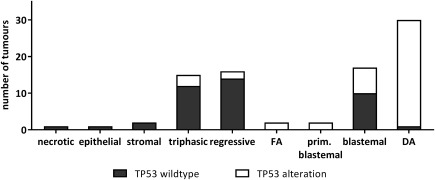
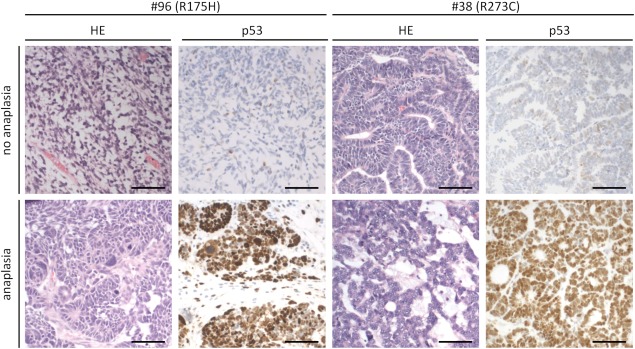
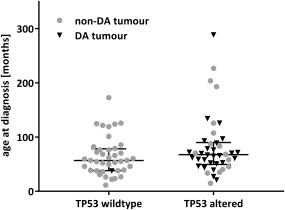
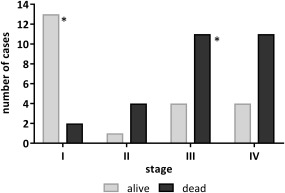
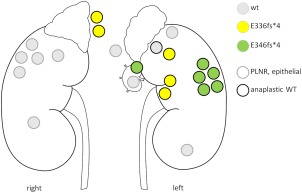
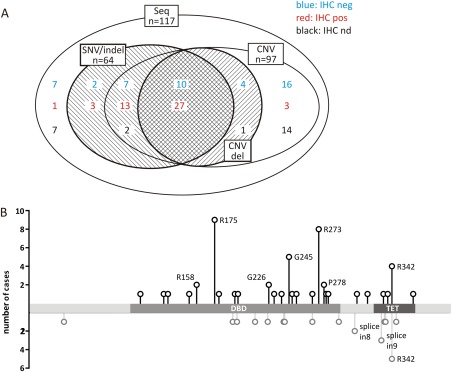
TP53 mutations have been associated with anaplasia in Wilms tumour, which conveys a high risk for relapse and fatal outcome. Nevertheless, TP53 alterations have been reported in no more than 60% of anaplastic tumours, and recent data have suggested their presence in tumours that do not fulfil the criteria for anaplasia, questioning the clinical utility of TP53 analysis. Therefore, we characterized the TP53 status in 84 fatal cases of Wilms tumour, irrespective of histological subtype. We identified TP53 alterations in at least 90% of fatal cases of anaplastic Wilms tumour, and even more when diffuse anaplasia was present, indicating a very strong if not absolute coupling between anaplasia and deregulation of p53 function. Unfortunately, TP53 mutations do not provide additional predictive value in anaplastic tumours since the same mutation rate was found in a cohort of non-fatal anaplastic tumours. When classified according to tumour stage, patients with stage I diffuse anaplastic tumours still had a high chance of survival (87%), but this rate dropped to 26% for stages II-IV. Thus, volume of anaplasia or possible spread may turn out to be critical parameters. Importantly, among non-anaplastic fatal tumours, 26% had TP53 alterations, indicating that TP53 screening may identify additional cases at risk. Several of these non-anaplastic tumours fulfilled some criteria for anaplasia, for example nuclear unrest, suggesting that such partial phenotypes should be under special scrutiny to enhance detection of high-risk tumours via TP53 screening. A major drawback is that these alterations are secondary changes that occur only later in tumour development, leading to striking intratumour heterogeneity that requires multiple biopsies and analysis guided by histological criteria. In conclusion, we found a very close correlation between histological signs of anaplasia and TP53 alterations. The latter may precede development of anaplasia and thereby provide diagnostic value pointing towards aggressive disease.
TP53突变与肾母细胞瘤的间变相关,这意味着复发风险高且预后不良。然而,TP53改变在不超过60%的间变性肿瘤中被报道,并且最近的数据表明它们存在于不符合间变标准的肿瘤中,这对TP53分析的临床实用性提出了质疑。因此,我们对84例致命性肾母细胞瘤病例的TP53状态进行了特征分析,而不考虑组织学亚型。我们在至少90%的间变性肾母细胞瘤致命病例中发现了TP53改变,当存在弥漫性间变时比例更高,这表明间变与p53功能失调之间存在非常强(如果不是绝对)的关联。不幸的是,TP53突变在间变性肿瘤中没有提供额外的预测价值,因为在一组非致命性间变性肿瘤中发现了相同的突变率。根据肿瘤分期分类时,I期弥漫性间变性肿瘤患者仍有较高的生存率(87%),但II - IV期该比率降至26%。因此,间变的范围或可能的扩散可能是关键参数。重要的是,在非间变性致命肿瘤中,26%有TP53改变,这表明TP53筛查可能识别出更多有风险的病例。这些非间变性肿瘤中有几个符合一些间变标准,例如核紊乱,这表明这种部分表型应受到特别审查,以通过TP53筛查加强对高危肿瘤的检测。一个主要缺点是这些改变是仅在肿瘤发展后期出现的继发性变化,导致显著的肿瘤内异质性,这需要多次活检并在组织学标准指导下进行分析。总之,我们发现间变的组织学迹象与TP53改变之间存在非常密切的相关性。后者可能先于间变的发展,从而提供指向侵袭性疾病的诊断价值。