Liu Wei Ping, Wang Xiao Pei, Zheng Wen, Xie Yan, Tu Mei Feng, Lin Ning Jing, Ping Ling Yan, Ying Zhi Tao, Zhang Chen, Deng Li Juan, Ding Ning, Wang Xiao Gan, Song Yu Qin, Zhu Jun
Key Laboratory of Carcinogenesis and Translational Research (Ministry of Education), Department of Lymphoma, Peking University Cancer Hospital and Institute, Beijing, China.
Ann Hematol. 2018 Jan;97(1):133-139. doi: 10.1007/s00277-017-3157-9. Epub 2017 Oct 31.
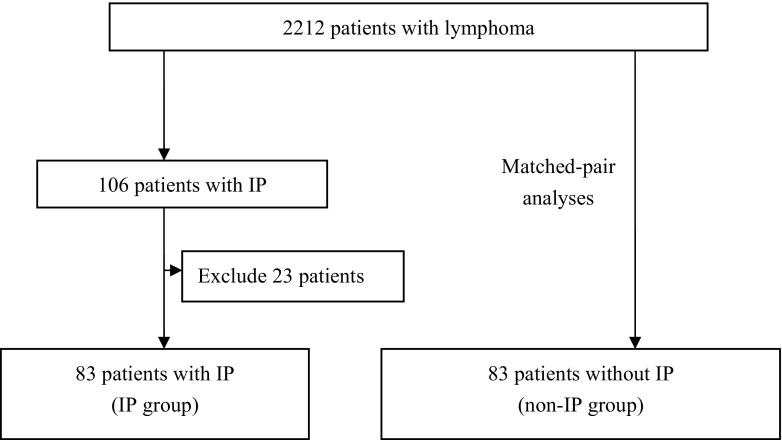
Interstitial pneumonia (IP) is a lethal complication in lymphoma patients undergoing chemotherapy. A total of 2212 consecutive patients diagnosed with lymphoma between 2009 and 2014 were enrolled in the present study. IP was defined as diffuse pulmonary interstitial infiltrate found on computed tomography scans. IP was observed in 106 patients. Of these, 23 patients were excluded from the study. Finally, 83 patients with IP were included in this study. The incidence of IP was 3.9% (7/287) in Hodgkin lymphoma and 2.4% (76/1925) in non-Hodgkin lymphoma (P = 0.210). The median number of chemotherapy cycles before IP was 3. The median time from the cessation of chemotherapy to IP was 17 days. Eighty-two (98.8%) patients recovered after the treatment with glucocorticoids. Sixty-six (79.5%) patients had a delay in chemotherapy, and 14 (16.9%) patients had premature termination of chemotherapy. Sixty-nine patients were re-treated with chemotherapy after remission from IP, of which 22 (31.9%) experienced IP recurrence. The incidence of IP recurrence was significantly higher in patients re-treated with a similar regimen than in those re-treated with an alternative regimen (65.4 vs. 11.6%, P < 0.001). In a multivariate Cox regression analysis, B symptoms and a history of drug allergies were identified as risk factors for IP. In conclusion, IP is a life-threatening complication in lymphoma patients. Glucocorticoid therapy with continuous monitoring of chest radiographic changes may be a favourable strategy for treating IP. However, IP may recur, especially in patients re-treated with a similar chemotherapy regimen.
间质性肺炎(IP)是接受化疗的淋巴瘤患者的一种致命并发症。本研究纳入了2009年至2014年间连续诊断为淋巴瘤的2212例患者。IP定义为计算机断层扫描发现的弥漫性肺间质浸润。106例患者观察到IP。其中,23例患者被排除在研究之外。最终,83例IP患者纳入本研究。霍奇金淋巴瘤中IP的发生率为3.9%(7/287),非霍奇金淋巴瘤中为2.4%(76/1925)(P = 0.210)。IP发生前化疗周期的中位数为3个。从化疗停止到发生IP的中位时间为17天。82例(98.8%)患者经糖皮质激素治疗后康复。66例(79.5%)患者化疗延迟,14例(16.9%)患者化疗提前终止。69例患者IP缓解后再次接受化疗,其中22例(31.9%)发生IP复发。与采用替代方案再次治疗的患者相比,采用相似方案再次治疗的患者IP复发率显著更高(65.4%对11.6%,P < 0.001)。在多因素Cox回归分析中,B症状和药物过敏史被确定为IP的危险因素。总之,IP是淋巴瘤患者的一种危及生命的并发症。持续监测胸部影像学变化的糖皮质激素治疗可能是治疗IP的一种有利策略。然而,IP可能复发,尤其是在采用相似化疗方案再次治疗的患者中。