Lee Byung Wan, Kim Jin Hwa, Ko Seung Hyun, Hur Kyu Yeon, Kim Nan Hee, Rhee Sang Youl, Kim Hyun Jin, Moon Min Kyong, Park Seok O, Choi Kyung Mook
Division of Endocrinology and Metabolism, Department of Internal Medicine, Yonsei University College of Medicine, Seoul, Korea.
Division of Endocrinology and Metabolism, Department of Internal Medicine, Chosun University College of Medicine, Gwangju, Korea.
Diabetes Metab J. 2017 Oct;41(5):367-373. doi: 10.4093/dmj.2017.41.5.367.
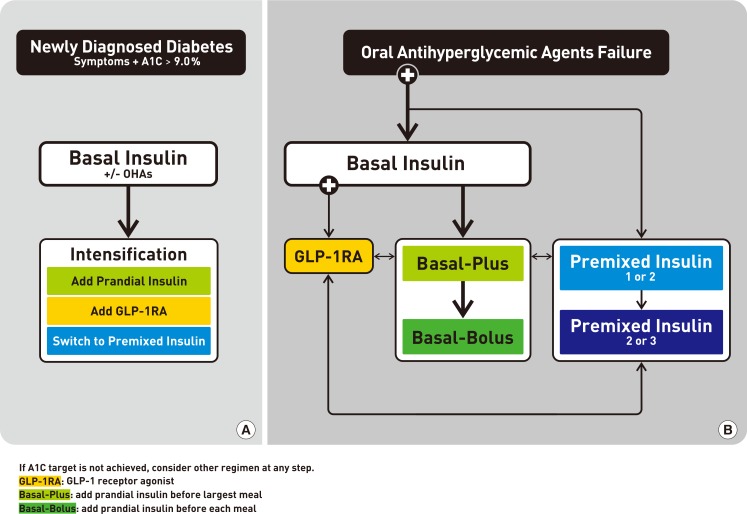
The Korean Diabetes Association (KDA) has regularly updated its Clinical Practice Guidelines. In 2017, the KDA published a position statement on the use of antihyperglycemic agents for patients with type 2 diabetes mellitus (T2DM). Growing evidence from new multinational clinical trials using novel and traditional insulin analogues has also been accumulated. Following global trends, many results of clinical trials, especially concerning the clinical efficacy and safety of insulin therapy, have been published about Korean patients with T2DM. After a systematic search of recent evidence, the KDA updated and modified its clinical practice recommendations regarding the initiation, choice, and intensification of insulin and created an insulin treatment algorithm for the first time to guide physicians caring for adult Korean patients with T2DM.
韩国糖尿病协会(KDA)定期更新其临床实践指南。2017年,KDA发布了一份关于2型糖尿病(T2DM)患者使用降糖药物的立场声明。使用新型和传统胰岛素类似物的新的跨国临床试验也积累了越来越多的证据。随着全球趋势的发展,已经发表了许多关于韩国T2DM患者的临床试验结果,特别是关于胰岛素治疗的临床疗效和安全性。在系统检索近期证据后,KDA更新并修改了其关于胰岛素起始、选择和强化治疗的临床实践建议,并首次创建了胰岛素治疗算法,以指导照顾成年韩国T2DM患者的医生。