Aouidate Adnane, Ghaleb Adib, Ghamali Mounir, Chtita Samir, Choukrad M'barek, Sbai Abdelouahid, Bouachrine Mohammed, Lakhlifi Tahar
MCNSL, School of Sciences, University Moulay Ismail, Meknes, Morocco.
Chem Cent J. 2017 May 19;11(1):41. doi: 10.1186/s13065-017-0269-1.
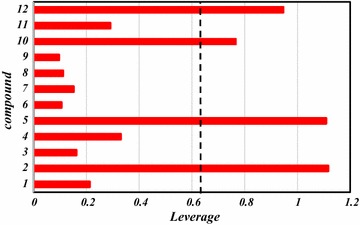
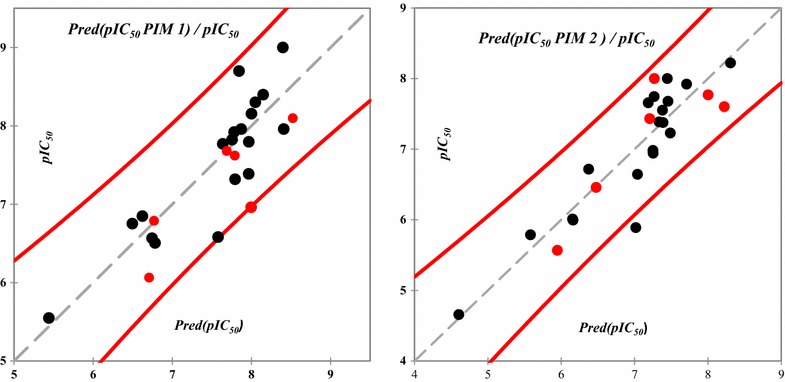
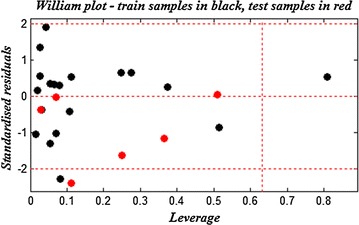
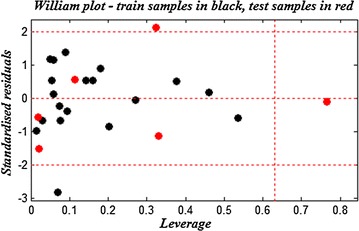
Quantitative structure activity relationship was carried out to study a series of PIM1 and PIM2 inhibitors. The present study was performed on twenty-five substituted 5-(1H-indol-5-yl)-1,3,4-thiadiazols as PIM1 and PIM2 inhibitors having pIC ranging from 5.55 to 9 µM and from 4.66 to 8.22 µM, respectively, using genetic function algorithm for variable selection and multiple linear regression analysis (MLR) to establish unambiguous and simple QSAR models based on topological molecular descriptors.
Results showed that the MLR predict activity in a satisfactory manner for both activities. Consequently, the aim of the current study is twofold, first, a simple linear QSAR model was developed, which could be easily handled by chemist to screen chemical databases, or design for new potent PIM1 and PIM2 inhibitors. Second, the outcomes extracted from the current study were exploited to predict the PIM inhibitory activity of some studied compound analogues.
The goal of this study is to develop easy and convenient QSAR model could be handled by everyone to screen chemical databases or to design newly PIM1 and PIM2 inhibitors derived from 5-(1H-indol-5-yl)-1,3,4-thiadiazol. Graphical abstract Flow chart of the methodology used in this work.
开展了定量构效关系研究以考察一系列PIM1和PIM2抑制剂。本研究针对25种取代的5-(1H-吲哚-5-基)-1,3,4-噻二唑进行,这些化合物作为PIM1和PIM2抑制剂,其pIC值分别在5.55至9 μM以及4.66至8.22 μM范围内,采用遗传函数算法进行变量选择并结合多元线性回归分析(MLR),基于拓扑分子描述符建立明确且简单的QSAR模型。
结果表明,MLR对两种活性的预测效果均令人满意。因此,本研究的目的有两个,其一,开发了一个简单的线性QSAR模型,化学家可轻松利用该模型筛选化学数据库,或设计新型强效PIM1和PIM2抑制剂。其二,利用本研究得出的结果预测一些所研究化合物类似物的PIM抑制活性。
本研究的目标是开发一个简单便捷的QSAR模型,任何人都可利用该模型筛选化学数据库或设计源自5-(1H-吲哚-5-基)-1,3,4-噻二唑的新型PIM1和PIM2抑制剂。图形摘要 本工作中使用的方法流程图。