Division of Medical Virology, Department of Pathology, Faculty of Medicine and Health Sciences, Stellenbosch University, Francie van Zijl Avenue, P.O. Box 241, Cape Town 8000, South Africa.
Department of Medical Microbiology, College of Health Sciences, University of Zimbabwe, P.O. Box A178, Avondale Harare 00263, Zimbabwe.
Viruses. 2017 Oct 31;9(11):324. doi: 10.3390/v9110324.
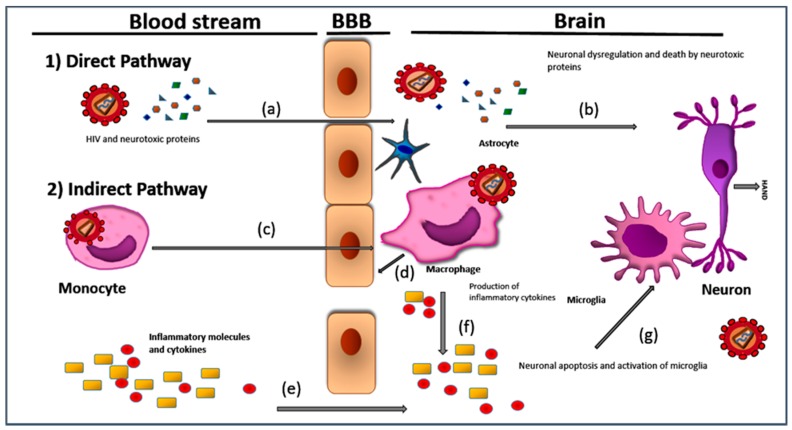
The pathogenesis of HIV-associated neurocognitive disorders is complex and multifactorial. It is hypothesized that the critical events initiating this condition occur outside the brain, particularly in the peripheral blood. Diagnoses of HIV-induced neurocognitive disorders largely rely on neuropsychometric assessments, which are not precise. Total HIV DNA in the peripheral blood mononuclear cells (PBMCs), quantified by PCR, correlate with disease progression, which is a promising biomarker to predict HAND. Numerous PCR assays for HIV DNA in cell compartments are prone to variation due to the lack of standardization and, therefore, their utility in predicting HAND produced different outcomes. This review evaluates the clinical relevance of total HIV DNA in circulating mononuclear cells using different published quantitative PCR (qPCR) protocols. The rationale is to shed light on the most appropriate assays and sample types used to accurately quantify HIV DNA load, which predicts severity of neurocognitive impairment. The role of monocytes as a vehicle for trafficking HIV into the CNS makes it the most suitable sample for determining a HAND associated reservoir. Studies have also shown significant associations between monocyte HIV DNA levels with markers of neurodamage. However, qPCR assays using PBMCs are cheaper and available commercially, thus could be beneficial in clinical settings. There is need, however, to standardise DNA extraction, normalisation and limit of detection.
HIV 相关神经认知障碍的发病机制复杂且多因素。据推测,引发这种疾病的关键事件发生在大脑之外,特别是在外周血中。HIV 引起的神经认知障碍的诊断主要依赖于神经心理评估,但这些评估并不精确。外周血单个核细胞(PBMCs)中通过 PCR 定量的总 HIV DNA 与疾病进展相关,是预测 HAND 的有前途的生物标志物。由于缺乏标准化,用于细胞区室中 HIV DNA 的众多 PCR 检测容易发生变化,因此它们在预测 HAND 方面的作用产生了不同的结果。这篇综述评估了使用不同已发表的定量 PCR(qPCR)方案时,循环单核细胞中总 HIV DNA 的临床相关性。其基本原理是阐明最适合用于准确量化 HIV DNA 载量的检测,因为 HIV DNA 载量可预测神经认知障碍的严重程度。单核细胞作为将 HIV 运送到中枢神经系统的载体,使其成为确定与 HAND 相关的储库的最佳样本。研究还表明,单核细胞 HIV DNA 水平与神经损伤标志物之间存在显著关联。然而,使用 PBMC 的 qPCR 检测更便宜且可商业化获得,因此在临床环境中可能有益。但是,需要标准化 DNA 提取、归一化和检测限。