Corstjens Paul L A M, Hoekstra Pytsje T, de Dood Claudia J, van Dam Govert J
Department of Molecular Cell Biology, Leiden University Medical Center, P.O. Box 9600, 2300, RC, Leiden, The Netherlands.
Department of Parasitology, Leiden University Medical Center, P.O. Box 9600, 2300, RC, Leiden, The Netherlands.
Infect Dis Poverty. 2017 Nov 1;6(1):155. doi: 10.1186/s40249-017-0368-1.
Methodological applications of the high sensitivity genus-specific Schistosoma CAA strip test, allowing detection of single worm active infections (ultimate sensitivity), are discussed for efficient utilization in sample pooling strategies. Besides relevant cost reduction, pooling of samples rather than individual testing can provide valuable data for large scale mapping, surveillance, and monitoring.
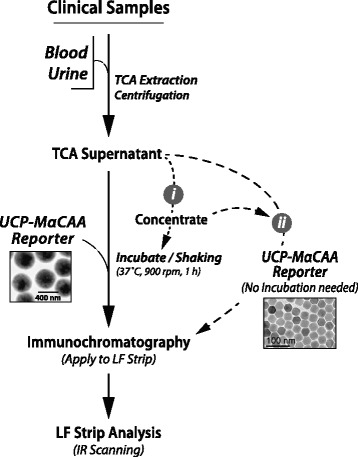
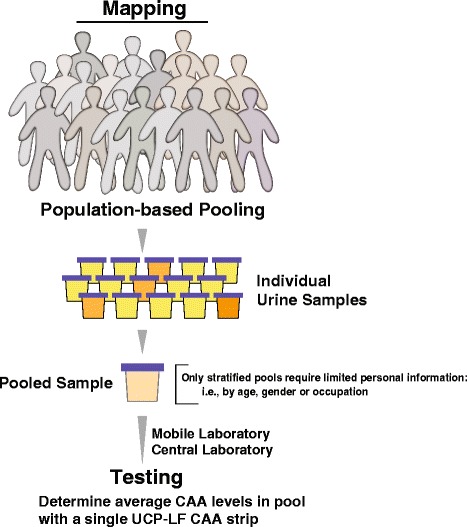
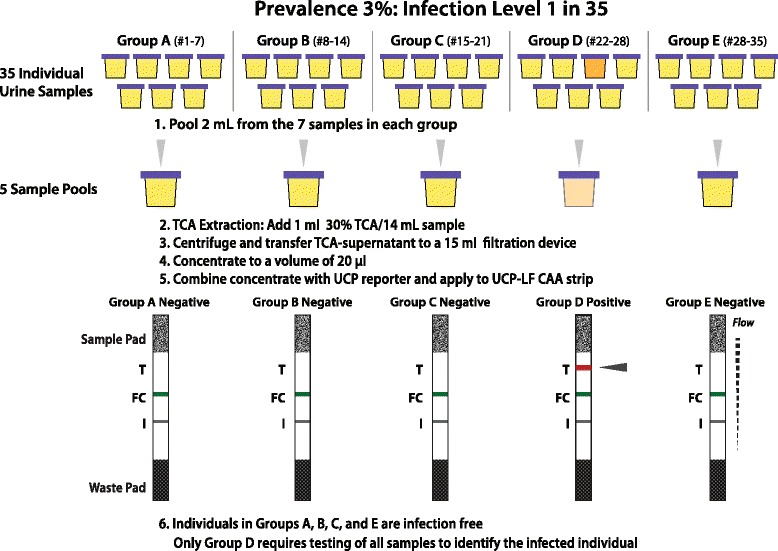
The laboratory-based CAA strip test utilizes luminescent quantitative up-converting phosphor (UCP) reporter particles and a rapid user-friendly lateral flow (LF) assay format. The test includes a sample preparation step that permits virtually unlimited sample concentration with urine, reaching ultimate sensitivity (single worm detection) at 100% specificity. This facilitates testing large urine pools from many individuals with minimal loss of sensitivity and specificity. The test determines the average CAA level of the individuals in the pool thus indicating overall worm burden and prevalence. When requiring test results at the individual level, smaller pools need to be analysed with the pool-size based on expected prevalence or when unknown, on the average CAA level of a larger group; CAA negative pools do not require individual test results and thus reduce the number of tests.
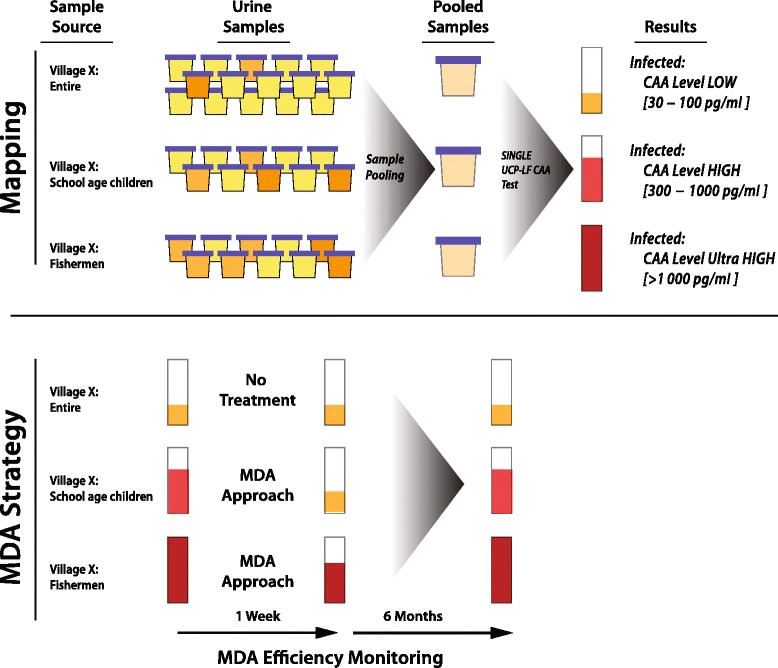
Straightforward pooling strategies indicate that at sub-population level the CAA strip test is an efficient assay for general mapping, identification of hotspots, determination of stratified infection levels, and accurate monitoring of mass drug administrations (MDA). At the individual level, the number of tests can be reduced i.e. in low endemic settings as the pool size can be increased as opposed to prevalence decrease.
At the sub-population level, average CAA concentrations determined in urine pools can be an appropriate measure indicating worm burden. Pooling strategies allowing this type of large scale testing are feasible with the various CAA strip test formats and do not affect sensitivity and specificity. It allows cost efficient stratified testing and monitoring of worm burden at the sub-population level, ideally for large-scale surveillance generating hard data for performance of MDA programs and strategic planning when moving towards transmission-stop and elimination.
讨论了高灵敏度属特异性血吸虫循环阳极抗原(CAA)试纸条检测方法在样本合并策略中的有效应用,该方法可检测单条虫体的活动性感染(极限灵敏度)。除了显著降低成本外,样本合并而非单独检测可为大规模地图绘制、监测和监控提供有价值的数据。
基于实验室的CAA试纸条检测利用发光定量上转换磷光体(UCP)报告颗粒和快速、用户友好的侧向流动(LF)检测形式。该检测包括一个样本制备步骤,可对尿液进行几乎无限制的样本浓缩,在100%特异性时达到极限灵敏度(单条虫体检测)。这便于检测来自许多个体的大量尿液样本池,而灵敏度和特异性损失最小。该检测可确定样本池中个体的平均CAA水平,从而表明总体虫负荷和流行率。当需要个体水平的检测结果时,需要根据预期流行率或在未知情况下根据较大群体的平均CAA水平分析较小的样本池;CAA阴性样本池不需要个体检测结果,从而减少检测数量。
简单的合并策略表明,在亚人群水平上,CAA试纸条检测是一种有效的检测方法,可用于一般地图绘制、热点识别、分层感染水平测定以及大规模药物管理(MDA)的准确监测。在个体水平上,检测数量可以减少,即在低流行地区,样本池大小可以增加,而不是流行率降低。
在亚人群水平上,尿液样本池中测定的平均CAA浓度可作为表明虫负荷的合适指标。采用各种CAA试纸条检测形式,允许进行此类大规模检测的合并策略是可行的,且不影响灵敏度和特异性。它允许在亚人群水平上进行具有成本效益的分层检测和虫负荷监测,理想情况下可用于大规模监测,为MDA项目的实施和向传播阻断及消除迈进时的战略规划生成可靠数据。