Department of Biology, Stanford University, Stanford, CA, 94305, USA.
Nat Commun. 2017 Oct 31;8(1):1040. doi: 10.1038/s41467-017-01043-z.
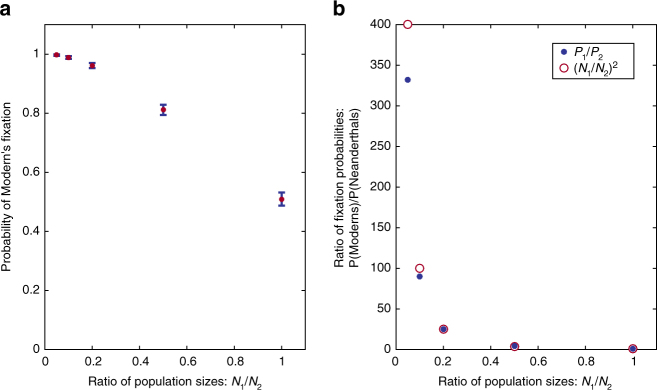
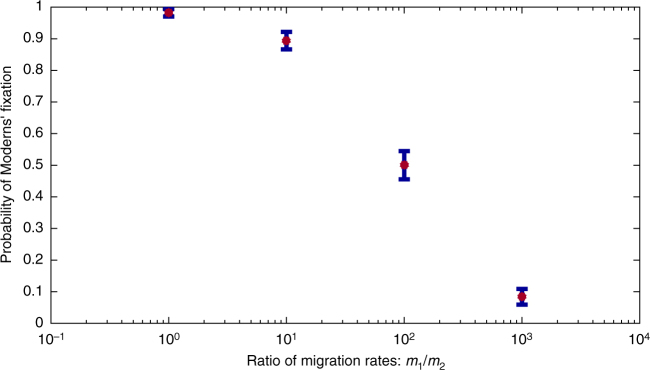
Most hypotheses in the heated debate about the Neanderthals' replacement by modern humans highlight the role of environmental pressures or attribute the Neanderthals' demise to competition with modern humans, who occupied the same ecological niche. The latter assume that modern humans benefited from some selective advantage over Neanderthals, which led to the their extinction. Here we show that a scenario of migration and selectively neutral species drift predicts the Neanderthals' replacement. Our model offers a parsimonious alternative to those that invoke external factors or selective advantage, and represents a null hypothesis for assessing such alternatives. For a wide range of parameters, this hypothesis cannot be rejected. Moreover, we suggest that although selection and environmental factors may or may not have played a role in the inter-species dynamics of Neanderthals and modern humans, the eventual replacement of the Neanderthals was determined by the repeated migration of modern humans from Africa into Eurasia.
大多数关于尼安德特人被现代人取代的激烈争论中的假说都强调了环境压力的作用,或者将尼安德特人的灭绝归因于与现代人的竞争,而现代人占据了相同的生态位。后者假设现代人相对于尼安德特人具有某种选择性优势,从而导致了尼安德特人的灭绝。在这里,我们表明,迁移和选择性中性物种漂变的情景可以预测尼安德特人的取代。我们的模型为那些援引外部因素或选择性优势的模型提供了一种简洁的替代方案,并且是评估此类替代方案的零假设。对于广泛的参数,这个假设不能被拒绝。此外,我们认为,尽管选择和环境因素可能在尼安德特人和现代人的种间动态中发挥了作用,也可能没有发挥作用,但尼安德特人的最终取代是由现代人从非洲反复迁移到欧亚大陆决定的。