Endres Robert G
Department of Life Sciences, Imperial College, London, SW7 2AZ, United Kingdom.
Centre for Integrative Systems Biology and Bioinformatics, Imperial College, London, SW7 2AZ, United Kingdom.
Sci Rep. 2017 Oct 31;7(1):14437. doi: 10.1038/s41598-017-14485-8.
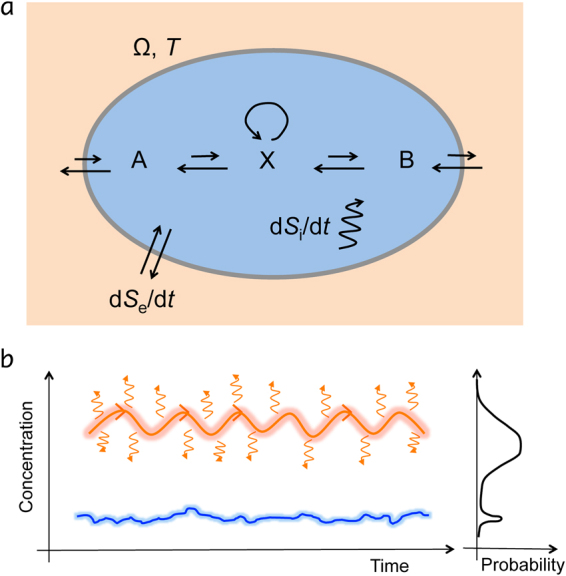
Far-from-equilibrium thermodynamics underpins the emergence of life, but how has been a long-outstanding puzzle. Best candidate theories based on the maximum entropy production principle could not be unequivocally proven, in part due to complicated physics, unintuitive stochastic thermodynamics, and the existence of alternative theories such as the minimum entropy production principle. Here, we use a simple, analytically solvable, one-dimensional bistable chemical system to demonstrate the validity of the maximum entropy production principle. To generalize to multistable stochastic system, we use the stochastic least-action principle to derive the entropy production and its role in the stability of nonequilibrium steady states. This shows that in a multistable system, all else being equal, the steady state with the highest entropy production is favored, with a number of implications for the evolution of biological, physical, and geological systems.
远离平衡态热力学是生命出现的基础,但具体方式一直是个长期悬而未决的谜题。基于最大熵产生原理的最佳候选理论无法得到明确证明,部分原因在于复杂的物理、难以直观理解的随机热力学以及诸如最小熵产生原理等替代理论的存在。在此,我们使用一个简单的、可解析求解的一维双稳化学系统来证明最大熵产生原理的有效性。为了推广到多稳随机系统,我们使用随机最小作用量原理来推导熵产生及其在非平衡稳态稳定性中的作用。这表明,在其他条件相同的多稳系统中,具有最高熵产生的稳态更受青睐,这对生物、物理和地质系统的演化有诸多启示。