Laboratoire d'Imagerie et Modélisation en Neurobiologie et Cancérologie (IMNC), Centre National de la Recherche Scientifique (CNRS); Universités Paris 11 and Paris 7, Campus d'Orsay, 91405, Orsay, France.
Institut Pasteur, Histopathologie Humaine et Modèles Animaux, Institut Pasteur, 28 Rue du Docteur Roux, 75015, Paris, France.
Sci Rep. 2017 Oct 31;7(1):14403. doi: 10.1038/s41598-017-14786-y.
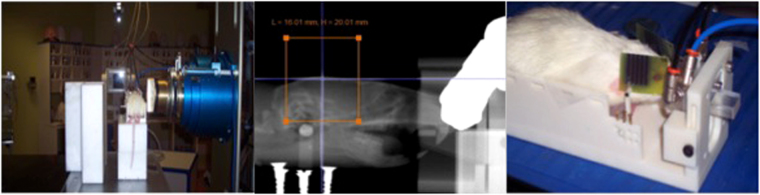
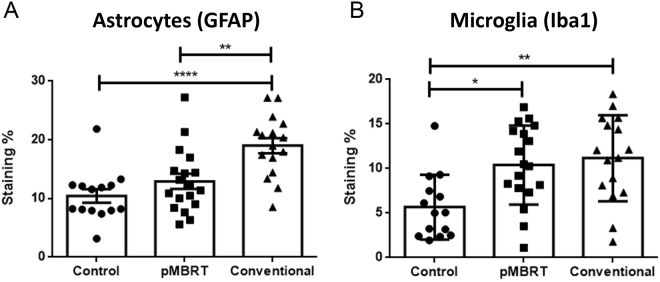
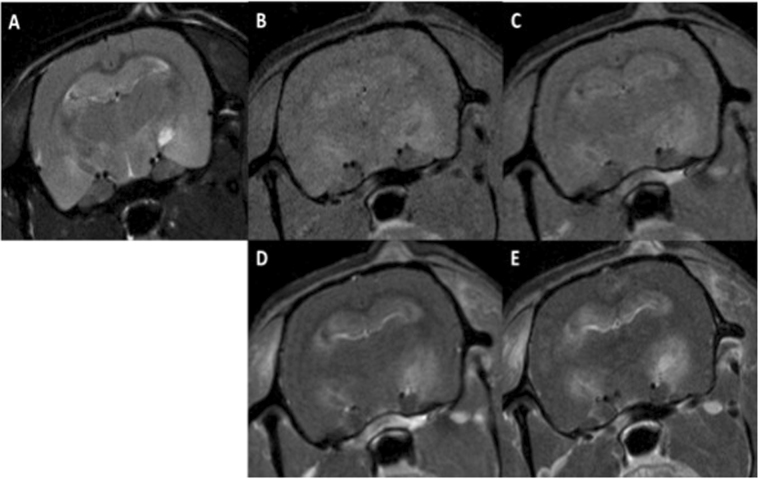
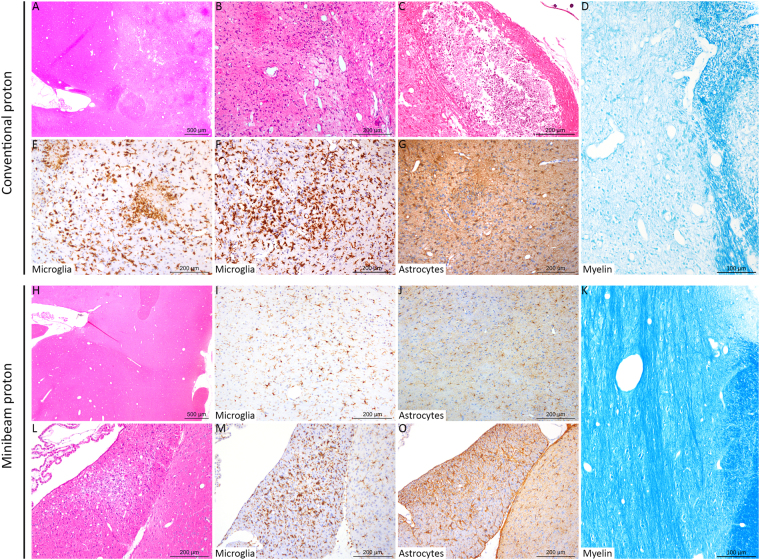
Proton minibeam radiation therapy (pMBRT) is a novel strategy for minimizing normal tissue damage resulting from radiotherapy treatments. This strategy partners the inherent advantages of protons for radiotherapy with the gain in normal tissue preservation observed upon irradiation with narrow, spatially fractionated beams. In this study, whole brains (excluding the olfactory bulb) of Fischer 344 rats (n = 16) were irradiated at the Orsay Proton Therapy Center. Half of the animals received standard proton irradiation, while the other half were irradiated with pMBRT at the same average dose (25 Gy in one fraction). The animals were followed-up for 6 months. A magnetic resonance imaging (MRI) study using a 7-T small-animal MRI scanner was performed along with a histological analysis. Rats treated with conventional proton irradiation exhibited severe moist desquamation, permanent epilation and substantial brain damage. In contrast, rats in the pMBRT group exhibited no skin damage, reversible epilation and significantly reduced brain damage; some brain damage was observed in only one out of the eight irradiated rats. These results demonstrate that pMBRT leads to an increase in normal tissue resistance. This net gain in normal tissue sparing can lead to the efficient treatment of very radio-resistant tumours, which are currently mostly treated palliatively.
质子微束放射治疗(pMBRT)是一种降低放疗副作用的新策略。这种策略结合了质子治疗的固有优势,以及窄束、空间分割照射时观察到的正常组织保存增益。在这项研究中,福氏 344 大鼠(n=16)的全脑(不包括嗅球)在奥赛质子治疗中心接受照射。一半动物接受标准质子照射,另一半动物接受 pMBRT 照射,平均剂量相同(单次 25Gy)。动物被随访 6 个月。使用 7T 小动物 MRI 扫描仪进行磁共振成像(MRI)研究,并进行组织学分析。接受常规质子照射的大鼠表现出严重的湿性脱皮、永久性脱毛和严重的脑损伤。相比之下,pMBRT 组的大鼠没有皮肤损伤、可逆性脱毛和明显减少的脑损伤;在 8 只照射的大鼠中,只有 1 只出现了一些脑损伤。这些结果表明,pMBRT 导致正常组织抗性增加。这种正常组织保护的净增益可以导致非常放射抗性肿瘤的有效治疗,目前这些肿瘤主要是姑息性治疗。