Willis Emily F, Bartlett Perry F, Vukovic Jana
School of Biomedical Sciences, University of Queensland, Brisbane, QLD, Australia.
Queensland Brain Institute, University of Queensland, Brisbane, QLD, Australia.
Front Behav Neurosci. 2017 Oct 17;11:197. doi: 10.3389/fnbeh.2017.00197. eCollection 2017.
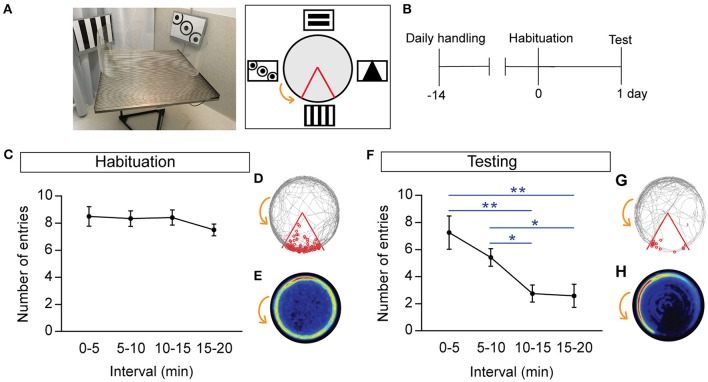
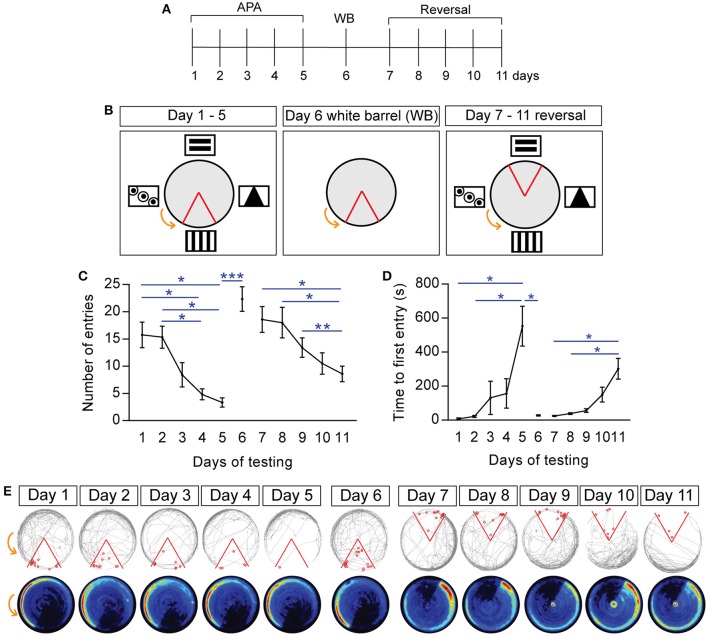
Studies on the role of the hippocampus in higher cognitive functions such as spatial learning and memory in rodents are reliant upon robust and objective behavioral tests. This protocol describes one such test-the active place avoidance (APA) task. This behavioral task involves the mouse continuously integrating visual cues to orientate itself within a rotating arena in order to actively avoid a shock zone, the location of which remains constant relative to the room. This protocol details the step-by-step procedures for a novel paradigm of the hippocampal-dependent APA task, measuring acquisition of spatial learning during a single 20-min trial (i.e., short-term memory), with spatial memory encoding and retrieval (i.e., long-term memory) assessed by trials conducted over consecutive days. Using the APA task, cognitive flexibility can be assessed using the reversal learning paradigm, as this increases the cognitive load required for efficient performance in the task. In addition to a detailed experimental protocol, this paper also describes the range of its possible applications, the expected key results, as well as the analytical methods to assess the data, and the pitfalls/troubleshooting measures. The protocol described herein is highly robust and produces replicable results, thus presenting an important paradigm that enables the assessment of subtle short-term changes in spatial learning and memory, such as those observed for many experimental interventions.
关于海马体在啮齿动物空间学习和记忆等高级认知功能中作用的研究,依赖于可靠且客观的行为测试。本方案描述了一种这样的测试——主动位置回避(APA)任务。这个行为任务要求小鼠持续整合视觉线索,以便在旋转的实验场内确定自身方位,从而主动避开电击区,电击区的位置相对于房间保持不变。本方案详细介绍了一种依赖海马体的APA任务新范式的逐步程序,在单次20分钟试验期间(即短期记忆)测量空间学习的获得情况,连续几天进行的试验评估空间记忆的编码和提取(即长期记忆)。使用APA任务,可以通过反转学习范式评估认知灵活性,因为这增加了在任务中高效表现所需的认知负荷。除了详细的实验方案外,本文还描述了其可能的应用范围、预期的关键结果,以及评估数据的分析方法,还有陷阱/故障排除措施。本文所述方案非常可靠,能产生可重复的结果,因此呈现了一个重要的范式,可用于评估空间学习和记忆中的细微短期变化,比如在许多实验干预中观察到的变化。