Centre for Cancer Registries, Centre for Cancer Control and Information Services, National Cancer Centre.
J Epidemiol. 2018 Feb 5;28(2):61-66. doi: 10.2188/jea.JE20160180. Epub 2017 Oct 28.
Survival rate is used to develop cancer control plans. However, there are limitations and biases when interpreting patient survival rate data. This study aimed to identify and account for potential biases and/or limitations on estimating survival rate to enable more effective control of cancer.
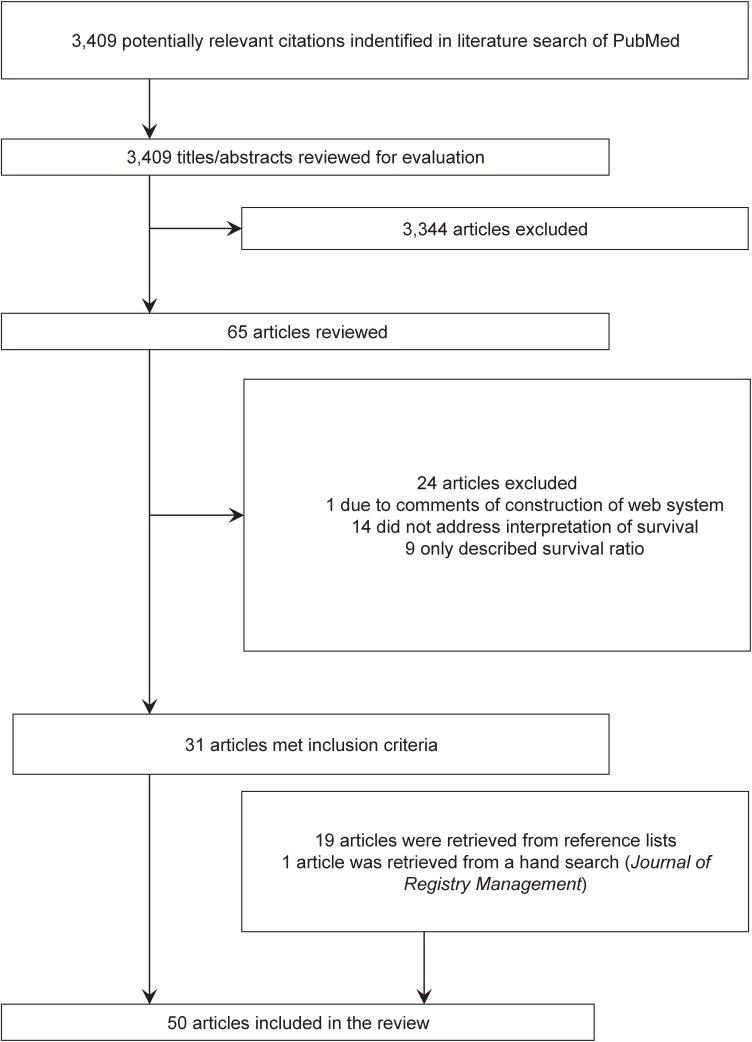
The authors searched PubMed from December 2010 to December 2015 for articles that investigated or described biases in estimating patient survival using cancer registries. Articles that only described the tendency of survival rate and investigated relationships between patient characteristics, treatment, and survival rate were excluded.
In total, 50 articles met the inclusion criteria. The identified potential biases were categorized into three areas, as follows: 1) the quality of registry data (eg, the completeness of cancer patients, accuracy of data, and follow-up rates); 2) limitations related to estimated methods of survival rates (eg, misclassification of cause of death for cause-specific survival rate or a lack of comparability of background mortality for relative survival rate); and 3) the comparability of survival rates among different groups (eg, age-adjustment or patients with multiple cancers).
We concluded that survival rate can be suitable for answering questions related to health policy and research. Several factors should be considered when interpreting survival rates estimated using cancer registries.
生存率被用于制定癌症防控计划。然而,在解释患者生存率数据时存在局限性和偏差。本研究旨在确定并考虑到在估计生存率时可能存在的偏差和/或局限性,以更有效地控制癌症。
作者于 2010 年 12 月至 2015 年 12 月在 PubMed 上检索了使用癌症登记处调查或描述估计患者生存率偏差的文章。仅描述生存率趋势并调查患者特征、治疗与生存率之间关系的文章被排除在外。
共有 50 篇文章符合纳入标准。确定的潜在偏倚分为三个方面:1)登记处数据的质量(例如癌症患者的完整性、数据的准确性和随访率);2)与生存率估计方法相关的局限性(例如,特异性生存率的死因分类错误或相对生存率的背景死亡率缺乏可比性);3)不同组之间生存率的可比性(例如,年龄调整或患有多种癌症的患者)。
我们得出结论,生存率适用于回答与卫生政策和研究相关的问题。在解释使用癌症登记处估计的生存率时,应考虑几个因素。