Navarro José A, Pallás Vicente
Instituto de Biología Molecular y Celular de Plantas, Consejo Superior de Investigaciones Científicas, Universitat Politècnica de València, Valencia, Spain.
Front Plant Sci. 2017 Oct 18;8:1801. doi: 10.3389/fpls.2017.01801. eCollection 2017.
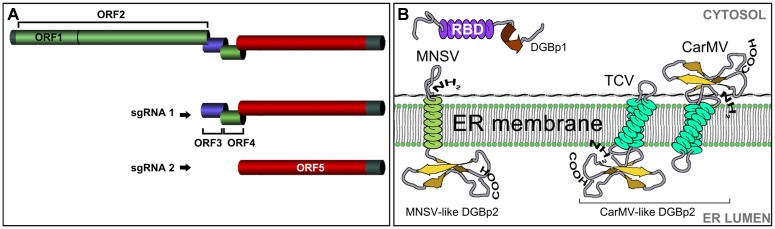
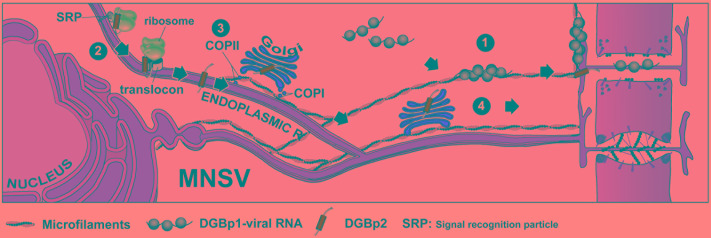
Despite harboring the smallest genomes among plant RNA viruses, carmoviruses have emerged as an ideal model system for studying essential steps of the viral cycle including intracellular and intercellular trafficking. Two small movement proteins, formerly known as double gene block proteins (DGBp1 and DGBp2), have been involved in the movement throughout the plant of some members of carmovirus genera. DGBp1 RNA-binding capability was indispensable for cell-to-cell movement indicating that viral genomes must interact with DGBp1 to be transported. Further investigation on (MNSV) DGBp1 subcellular localization and dynamics also supported this idea as this protein showed an actin-dependent movement along microfilaments and accumulated at the cellular periphery. Regarding DGBp2, subcellular localization studies showed that MNSV and DGBp2s were inserted into the endoplasmic reticulum (ER) membrane but only MNSV DGBp2 trafficked to plasmodesmata (PD) via the Golgi apparatus through a COPII-dependent pathway. DGBp2 function is still unknown but its localization at PD was a requisite for an efficient cell-to-cell movement. It is also known that MNSV infection can induce a dramatic reorganization of mitochondria resulting in anomalous organelles containing viral RNAs. These putative viral factories were frequently found associated with the ER near the PD leading to the possibility that MNSV movement and replication could be spatially linked. Here, we update the current knowledge of the plant endomembrane system involvement in carmovirus intra- and intercellular movement and the tentative model proposed for MNSV transport within plant cells.
尽管香石竹潜隐病毒属病毒拥有植物RNA病毒中最小的基因组,但它们已成为研究病毒循环基本步骤(包括细胞内和细胞间运输)的理想模型系统。两种小移动蛋白,以前称为双基因块蛋白(DGBp1和DGBp2),参与了香石竹潜隐病毒属一些成员在整个植物中的移动。DGBp1的RNA结合能力对于细胞间移动是必不可少的,这表明病毒基因组必须与DGBp1相互作用才能被运输。对甜瓜坏死斑点病毒(MNSV)DGBp1亚细胞定位和动态的进一步研究也支持了这一观点,因为该蛋白显示出沿微丝的肌动蛋白依赖性移动并在细胞周边积累。关于DGBp2,亚细胞定位研究表明,MNSV和番茄斑驳病毒(ToMV)的DGBp2插入内质网(ER)膜,但只有MNSV DGBp2通过依赖COPII的途径经高尔基体运输到胞间连丝(PD)。DGBp2的功能仍然未知,但其在PD处的定位是高效细胞间移动的必要条件。还已知MNSV感染可诱导线粒体发生显著重组,导致含有病毒RNA的异常细胞器出现。这些假定的病毒工厂经常被发现与PD附近的ER相关联,这使得MNSV的移动和复制可能在空间上相互关联。在这里,我们更新了关于植物内膜系统参与香石竹潜隐病毒属细胞内和细胞间移动的当前知识,以及为MNSV在植物细胞内运输提出的暂定模型。