Department of Advanced Biomedical Science, University of Naples Federico II, Via S. Pansini 5, 80131 Naples, Italy.
Department of Public Health, University of Naples Federico II, Via S. Pansini 5, 80131 Naples, Italy.
Biomed Res Int. 2017;2017:7869802. doi: 10.1155/2017/7869802. Epub 2017 Sep 28.
Gastric cancer is the fifth most common cancer and the third cause of cancer death. The clinical outcomes of the patients are still not encouraging with a low rate of 5 years' survival. Often the disease is diagnosed at advanced stages and this obviously negatively affects patients outcomes. A deep understanding of molecular basis of gastric cancer can lead to the identification of diagnostic, predictive, prognostic, and therapeutic biomarkers.
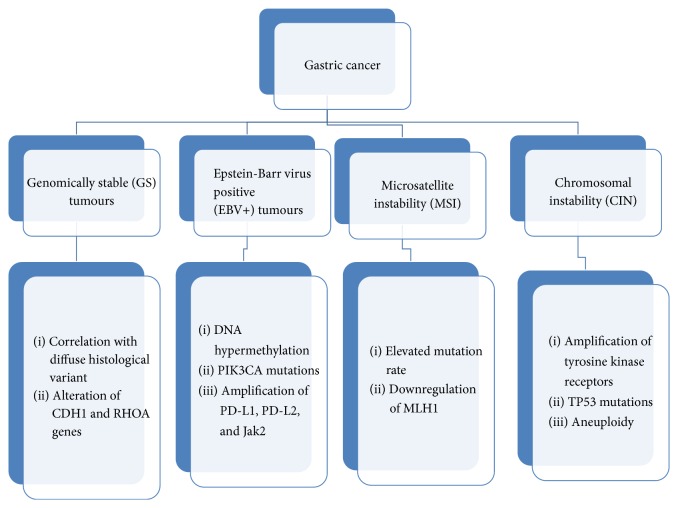
This paper aims to give a global view on the molecular classification and mechanisms involved in the development of the tumour and on the biomarkers for gastric cancer. We discuss the role of E-cadherin, HER2, fibroblast growth factor receptor (FGFR), MET, human epidermal growth factor receptor (EGFR), hepatocyte growth factor receptor (HGFR), mammalian target of rapamycin (mTOR), microsatellite instability (MSI), PD-L1, and TP53. We have also considered in this manuscript new emerging biomarkers as matrix metalloproteases (MMPs), microRNAs, and long noncoding RNAs (lncRNAs).
Identifying and validating diagnostic, prognostic, predictive, and therapeutic biomarkers will have a huge impact on patients outcomes as they will allow early detection of tumours and also guide the choice of a targeted therapy based on specific molecular features of the cancer.
胃癌是全球第五大常见癌症,也是癌症死亡的第三大原因。患者的临床预后仍然不容乐观,5 年生存率较低。疾病常常在晚期才被诊断出来,这显然会对患者的预后产生负面影响。深入了解胃癌的分子基础可以帮助我们识别诊断、预测、预后和治疗的生物标志物。
本文旨在概述胃癌肿瘤发生发展过程中的分子分类和机制,以及胃癌的生物标志物。我们讨论了 E-钙黏蛋白、HER2、成纤维细胞生长因子受体(FGFR)、MET、人表皮生长因子受体(EGFR)、肝细胞生长因子受体(HGFR)、哺乳动物雷帕霉素靶蛋白(mTOR)、微卫星不稳定性(MSI)、PD-L1 和 TP53 的作用。本文还考虑了基质金属蛋白酶(MMPs)、microRNAs 和长链非编码 RNA(lncRNAs)等新出现的生物标志物。
鉴定和验证诊断、预后、预测和治疗的生物标志物将对患者的预后产生巨大影响,因为它们将有助于早期发现肿瘤,并根据癌症的特定分子特征指导靶向治疗的选择。