Lobo Brian C, Baumanis Maraya M, Nelson Rick F
Head and Neck Institute, Cleveland Clinic Foundation Cleveland Ohio U.S.A.
Department of Otolaryngology-Head and Neck Surgery Indiana University School of Medicine Indianapolis Indiana U.S.A.
Laryngoscope Investig Otolaryngol. 2017 Apr 7;2(5):215-224. doi: 10.1002/lio2.75. eCollection 2017 Oct.
To review the safety and efficacy of surgical management for spontaneous cerebrospinal fluid (CSF) leaks of the anterior and lateral skull base.
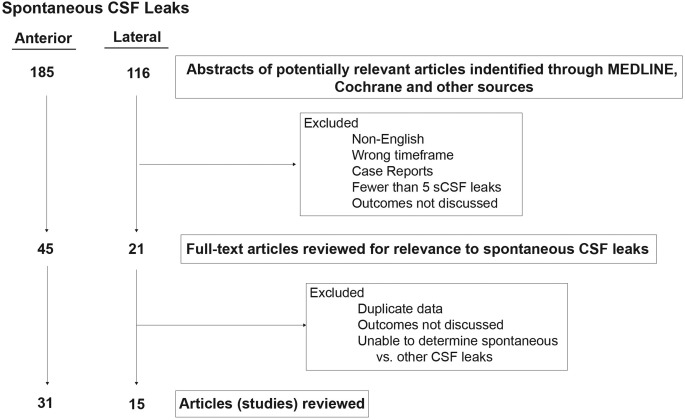
A systematic review of English articles using MEDLINE.
Search terms included spontaneous, CSF, cerebrospinal fluid, endoscopic, middle fossa, transmastoid, leak, rhinorrhea. Independent extraction of articles by 3 authors.
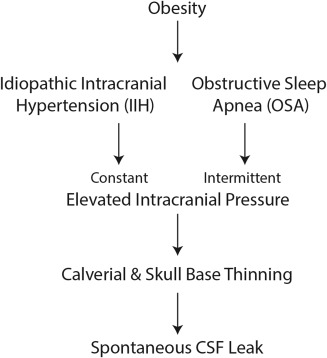
Patients with spontaneous CSF leaks are often obese (average BMI of 38 kg/m) and female (72%). Many patients also have obstructive sleep apnea (∼45%) and many have elevated intracranial pressure when measured by lumbar puncture. In addition to thinning of the skull base, radiographic studies also demonstrate cortical bone thinning. Endoscopic surgical repair of anterior skull base leaks and middle cranial fossa (MCF) approach for repair of lateral skull base leaks are safe and effective with an average short-term failure rate of 9% and 6.5%, respectively. Long-term failure rates are low. One randomized trial failed to show improved success of anterior leak repairs with the use of a lumbar drain (LD) (95% with vs. 92% without; P = 0.2). In a large retrospective cohort of MCF lateral skull base repairs, perioperative LD use was not necessary in >94% of patients.
Spontaneous CSF leaks are associated with female gender, obesity, increased intracranial hypertension, and obstructive sleep apnea. Endoscopic repair of anterior skull base leaks and MCF or transmastoid approaches for lateral skull base leaks have a high success rate of repair. In most cases, intraoperative placement of lumbar drain did not appear to result in improved success rates for either anterior or lateral skull base leaks.
2a, Systematic Review.
回顾前颅底和侧颅底自发性脑脊液漏手术治疗的安全性和有效性。
使用MEDLINE对英文文章进行系统综述。
检索词包括自发性、脑脊液、脑脊髓液、内镜、中颅窝、经乳突、漏、鼻漏。由3位作者独立提取文章。
自发性脑脊液漏患者通常肥胖(平均体重指数为38kg/m²)且以女性为主(72%)。许多患者还患有阻塞性睡眠呼吸暂停(约45%),经腰穿测量,许多患者颅内压升高。除颅底变薄外,影像学研究还显示皮质骨变薄。前颅底漏的内镜手术修复和侧颅底漏的中颅窝(MCF)入路修复安全有效,平均短期失败率分别为9%和6.5%。长期失败率较低。一项随机试验未显示使用腰大池引流(LD)能提高前颅底漏修复的成功率(使用LD为95%,未使用为92%;P = 0.2)。在一大组MCF侧颅底修复的回顾性队列研究中,超过94%的患者围手术期无需使用LD。
自发性脑脊液漏与女性、肥胖、颅内高压增加和阻塞性睡眠呼吸暂停有关。前颅底漏的内镜修复以及侧颅底漏的MCF或经乳突入路修复成功率较高。在大多数情况下,术中放置腰大池引流似乎并未提高前颅底或侧颅底漏的修复成功率。
2a,系统综述。