Dheensa Sandi, Lucassen Anneke, Fenwick Angela
Clinical Ethics and Law, Southampton General Hospital, South Academic Block, University of Southampton, Room AB 203, MP 801, Tremona Road, Southampton, SO16 6YD, 02381 205082, UK.
Wessex Clinical Genetics Service, University Hospital Southampton NHS Foundation Trust, Southampton, UK.
J Genet Couns. 2018 Jun;27(3):689-701. doi: 10.1007/s10897-017-0164-x. Epub 2017 Nov 1.
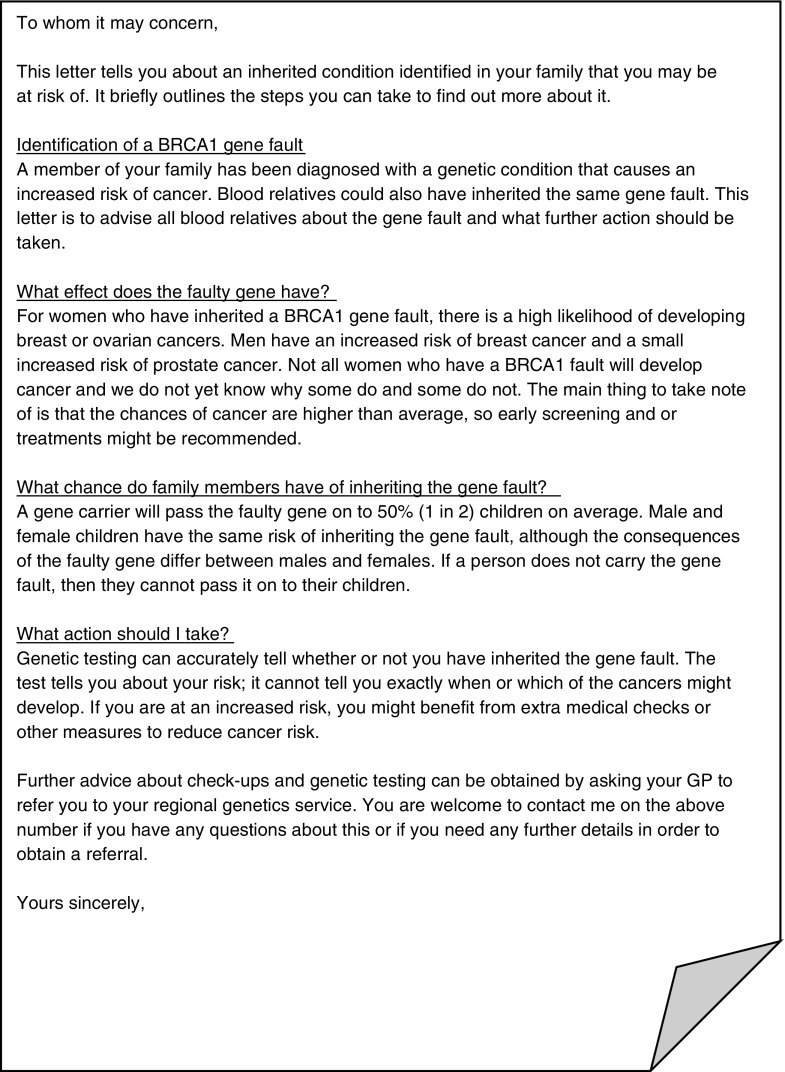
European genetic testing guidelines recommend that healthcare professionals (HCPs) discuss the familial implications of any test with a patient and offer written material to help them share the information with family members. Giving patients these "family letters" to alert any relatives of their risk has become part of standard practice and has gone relatively unquestioned over the years. Communication with at-risk relatives will become an increasingly pressing issue as mainstream and routine practice incorporates broad genome tests and as the number of findings potentially relevant to relatives increases. This study therefore explores problems around the use of family letters to communicate about genetic risk. We conducted 16 focus groups with 80 HCPs, and 35 interviews with patients, recruited from across the UK. Data were analyzed thematically and we constructed four themes: 1) HCPs writing family letters: how to write them and why?, 2) Patients' issues with handing out family letters, 3) Dissemination becomes an uncontrolled form of communication, and 4) When the relative has the letter, is the patient's and HCP's duty discharged? We conclude by suggesting alternative and supplementary methods of communication, for example through digital tools, and propose that in comparison to communication by family letter, direct contact by HCPs might be a more appropriate and successful option.
欧洲基因检测指南建议,医疗保健专业人员(HCPs)应与患者讨论任何检测的家族影响,并提供书面材料,以帮助他们与家庭成员分享信息。给患者这些“家族信”以提醒任何亲属其风险,已成为标准做法的一部分,并且多年来相对未受到质疑。随着主流和常规做法纳入广泛的基因组检测,以及与亲属潜在相关的发现数量增加,与有风险的亲属进行沟通将成为一个日益紧迫的问题。因此,本研究探讨了使用家族信来传达基因风险方面的问题。我们对来自英国各地的80名医疗保健专业人员进行了16次焦点小组讨论,并对35名患者进行了访谈。对数据进行了主题分析,我们构建了四个主题:1)医疗保健专业人员撰写家族信:如何撰写以及为何撰写?2)患者在分发家族信方面的问题,3)传播成为一种不受控制的沟通形式,4)当亲属收到信时,患者和医疗保健专业人员的职责是否解除?我们通过建议替代和补充的沟通方法(例如通过数字工具)得出结论,并提出与通过家族信进行沟通相比,医疗保健专业人员直接联系可能是更合适和成功的选择。