Xian Hang, Xu Li-Wei, Li Cong-Han, Hao Jian-Ming, Wan Wei-Xia, Feng Guo-Dong, Lian Ke-Jian, Li Lin
Orthopedics Department, The 175th Hospital of PLA (Affiliated Southeast Hospital of Xiamen University), Zhangzhou, Fujian Province Hand and Foot Surgery Department, The 11th Hospital of PLA, Yining, Xinjiang Province Rehabilitation Medicine Department, The 175th Hospital of PLA (Affiliated Southeast Hospital of Xiamen University), Zhangzhou, Fujian Province, P.R. China.
Medicine (Baltimore). 2017 Nov;96(44):e8473. doi: 10.1097/MD.0000000000008473.
Spontaneous spinal epidural hematoma (SSEH) is a relatively rare but potentially disabling disease, and the classical presentation of it includes an acute onset of severe, sometimes radiating back or neck pain, followed by signs and symptoms of rapidly evolving nerve root or spinal cord compression.
Here, we report a 26-year-old female patient presented with weakness in bilateral lower extremities, progressing to intense paraplegia and anesthesia without recent medical history of trauma, infection, surgery, or drug use.
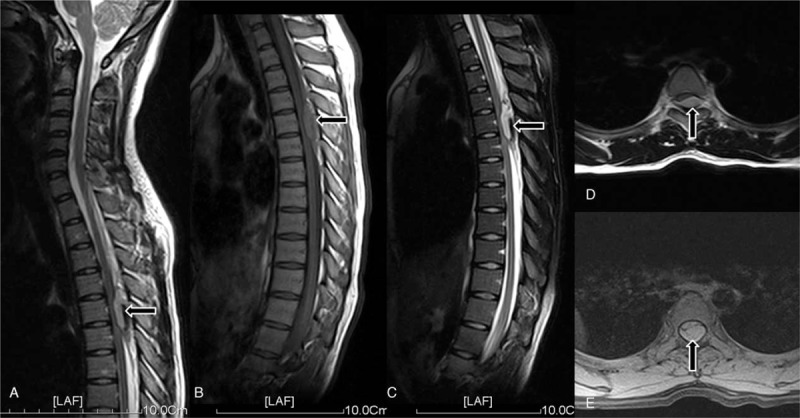
A magnetic resonance imaging (MRI) scan of spinal cord was planned and a posterior epidural hematoma of the thoracic spine was observed.
A posterior decompression and hematoma evacuation was performed after diagnosis immediately. Early rehabilitation program of the specific kind spinal cord injury was formulated and implemented.
The patient finally can handle basic living activities, such as completing wheelchair locomotion, transferring from bed to wheelchair independently after 3 months of rehabilitation.
SSEH is a rarely occurring case in emergency. Acute chest pain and paraplegia could be the initial presentation of acute spinal epidural hemorrhage, but the diagnosis of patient without classical manifestations is still a challenge for doctors. Early diagnosis, prompt decompression, and individualized rehabilitation program can improve the prognosis and outcome.
自发性脊髓硬膜外血肿(SSEH)是一种相对罕见但可能致残的疾病,其典型表现包括急性发作的严重疼痛,有时放射至背部或颈部,随后出现神经根或脊髓受压迅速发展的体征和症状。
在此,我们报告一名26岁女性患者,双下肢无力,逐渐发展为严重截瘫和感觉缺失,近期无外伤、感染、手术或药物使用病史。
计划进行脊髓磁共振成像(MRI)扫描,观察到胸椎后硬膜外血肿。
诊断后立即进行后路减压和血肿清除术。制定并实施了针对特定类型脊髓损伤的早期康复计划。
经过3个月的康复,患者最终能够进行基本生活活动,如完成轮椅移动、独立从床上转移到轮椅上。
SSEH在急诊中是罕见病例。急性胸痛和截瘫可能是急性脊髓硬膜外出血的首发表现,但对于无典型表现的患者进行诊断对医生来说仍是一项挑战。早期诊断、及时减压和个体化康复计划可改善预后和结局。