Department of Endocrinology, Chinese PLA General Hospital, Beijing, China.
Department of Evidence-based Medicine and Clinical Epidemiology, West China Hospital, Sichuan University, Chengdu, China.
Diabetes Obes Metab. 2018 Apr;20(4):1029-1033. doi: 10.1111/dom.13147. Epub 2017 Dec 5.
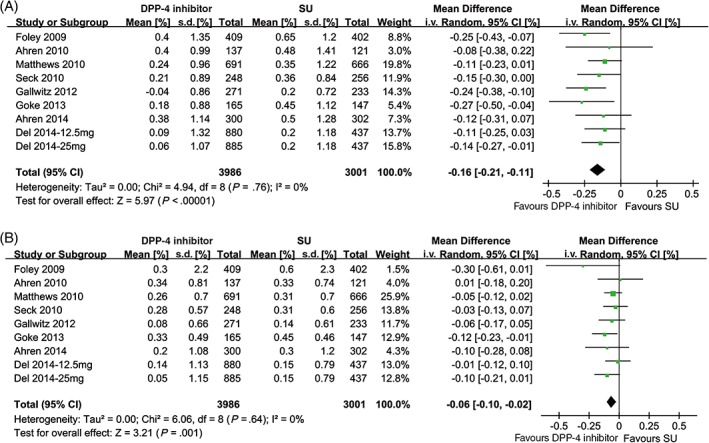
We performed a meta-analysis of randomized controlled trials (RCTs) to compare the long-term glycaemic durability of dipeptidyl-peptidase 4 (DPP-4) inhibitors vs that of sulphonylureas (SUs) in patients with type 2 diabetes mellitus (T2DM), in terms of the changes in glycated haemoglobin (HbA1c) levels from an intermediate time point (26 or 52 weeks) to 104 weeks of treatment. The Medline (PubMed), Embase (Ovid), and CENTER (Cochrane Library) databases were searched for relevant RCTs. Eight RCTs were included. Compared with SUs, DPP-4 inhibitors were associated with significantly smaller increases in the HbA1c level from 24 to 28 weeks to 104 weeks (mean difference [MD]: -0.16%, 95% confidence interval [CI]: -0.21 to -0.11; P < .001) and from 52 weeks to 104 weeks (MD -0.06%, 95% CI -0.10 to -0.02; P = .001). No significant heterogeneities were detected among the included comparisons (I = 0%). These results suggest that long-term treatment with DPP-4 inhibitors confers better durability of glycaemic response than treatment with SUs in patients with T2DM, which may indicate that DPP-4 inhibitors better preserve islet β-cell function compared with SUs.
我们进行了一项荟萃分析随机对照试验(RCT),比较了二肽基肽酶 4(DPP-4)抑制剂和磺酰脲类药物(SUs)在 2 型糖尿病(T2DM)患者中的长期血糖耐久性,以糖化血红蛋白(HbA1c)水平从中间时间点(26 或 52 周)到治疗 104 周的变化为指标。我们在 Medline(PubMed)、Embase(Ovid)和 CENTER(Cochrane Library)数据库中搜索了相关的 RCT。共纳入 8 项 RCT。与 SUs 相比,DPP-4 抑制剂从 24 至 28 周至 104 周(平均差异 [MD]:-0.16%,95%置信区间 [CI]:-0.21 至 -0.11;P<.001)和从 52 周至 104 周(MD:-0.06%,95%CI:-0.10 至 -0.02;P=.001),HbA1c 水平的升高显著减少。纳入的比较无显著异质性(I²=0%)。这些结果表明,与 SUs 相比,DPP-4 抑制剂长期治疗可提供更好的血糖反应耐久性,这可能表明与 SUs 相比,DPP-4 抑制剂可更好地保护胰岛β细胞功能。