Yoo Yung Ju, Yang Hee Kyung, Kim Namju, Hwang Jeong-Min
Department of Ophthalmology, Kangwon National University Hospital, Kangwon National University Graduate School of Medicine, Chuncheon, Korea.
Department of Ophthalmology, Seoul National University College of Medicine, Seoul National University Bundang Hospital, Seongnam, Korea.
PLoS One. 2017 Nov 2;12(11):e0184945. doi: 10.1371/journal.pone.0184945. eCollection 2017.
To investigate the factors affecting recovery of diplopia and limited ocular motility in pediatric patients who underwent surgery for orbital wall fracture.
Retrospective observational case series.
In this retrospective observational case series, 150 pediatric patients (1-18 years old) who were diagnosed with orbital medial wall or floor fracture and underwent corrective surgery between 2004 and 2016 at Seoul National University Bundang Hospital were included. The medical records of patients with orbital medial wall or floor fracture were reviewed, including sex, age, diplopia, ocular motility, preoperative computed tomographic finding, and surgical outcomes. Factors affecting recovery of diplopia and ocular motility limitation were analyzed.
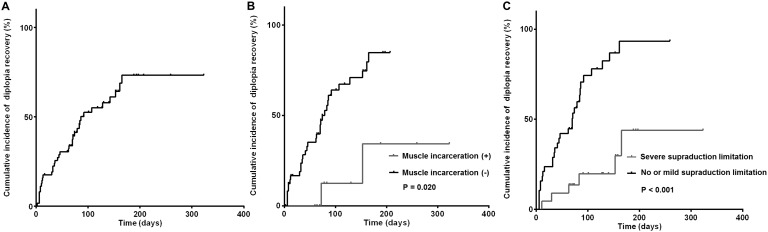
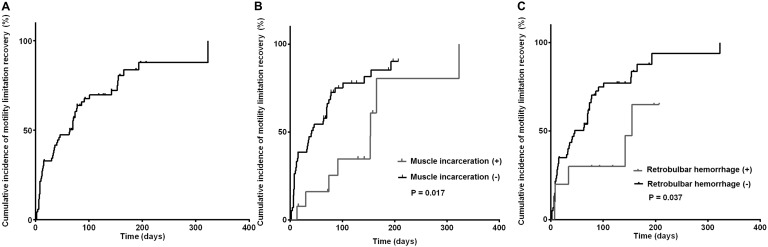
Of the 150 patients (134 boys; mean age, 14.4 years) who underwent corrective surgery for orbital wall fracture, preoperative binocular diplopia was found in 76 (50.7%) patients and limited ocular motility in 81 (54.0%). Presence of muscle incarceration or severe supraduction limitation delayed the recovery of diplopia. In case of ocular motility limitation, presence of muscle incarceration and retrobulbar hemorrhage were related with the delayed resolution. Multivariate analysis revealed supraduction limitation (Hazard ratio [HR] = 1.74, 95% confidence interval [CI] = 1.19-2.55), larger horizontal orbital floor defects (HR = 1.22, 95% CI = 1.07-1.38), and shorter time interval to first visit (HR = 0.73) as negative prognostic factors for the recovery of diplopia. In addition, muscle incarceration (HR = 3.53, 95% CI = 1.54-8.07) and retrobulbar hemorrhage (HR = 3.77, 95% CI = 1.45-9.82) were found as negative prognostic factors for the recovery of motility limitation.
Presence of muscle incarceration and retrobulbar hemorrhage, horizontal length of floor fracture, supraduction limitation, and time interval from trauma to first visit were correlated with the surgical outcomes in pediatric orbital wall fracture patients. These results strengthen that the soft tissue damage associated with bony fracture affects the orbital functional unit. When managing children with orbital wall fracture, meticulous physical examination and thorough preoperative computed tomography based evaluation will help physicians to identify damage of orbital functional unit.
探讨影响小儿眼眶壁骨折手术患者复视恢复及眼球运动受限的因素。
回顾性观察病例系列。
在这个回顾性观察病例系列中,纳入了2004年至2016年在首尔国立大学盆唐医院被诊断为眼眶内侧壁或眶底骨折并接受矫正手术的150例儿科患者(1 - 18岁)。回顾了眼眶内侧壁或眶底骨折患者的病历,包括性别、年龄、复视、眼球运动、术前计算机断层扫描结果和手术结果。分析了影响复视恢复和眼球运动受限的因素。
在150例接受眼眶壁骨折矫正手术的患者(134例男孩;平均年龄14.4岁)中,术前76例(50.7%)患者存在双眼复视,81例(54.0%)患者存在眼球运动受限。肌肉嵌顿或严重上转受限的存在延迟了复视的恢复。对于眼球运动受限,肌肉嵌顿和球后出血的存在与恢复延迟有关。多因素分析显示上转受限(风险比[HR]=1.74,95%置信区间[CI]=1.19 - 2.55)、较大的水平眶底缺损(HR = 1.22,95% CI = 1.07 - 1.38)以及首次就诊时间间隔较短(HR = 0.73)是复视恢复的负性预后因素。此外,肌肉嵌顿(HR = 3.53,95% CI = 1.54 - 8.07)和球后出血(HR = 3.77,95% CI = 1.45 - 9.82)被发现是眼球运动受限恢复的负性预后因素。
肌肉嵌顿和球后出血的存在、眶底骨折的水平长度、上转受限以及受伤至首次就诊的时间间隔与小儿眼眶壁骨折患者的手术结果相关。这些结果强化了与骨折相关的软组织损伤会影响眼眶功能单位这一观点。在处理小儿眼眶壁骨折时,细致的体格检查和基于术前计算机断层扫描的全面评估将有助于医生识别眼眶功能单位的损伤。