Department of Pediatrics, Harvard Medical School, and Lurie Center for Autism, Massachusetts General Hospital for Children, Boston, MA 02129, United States.
Department of Pediatrics, Harvard Medical School, and Lurie Center for Autism, Massachusetts General Hospital for Children, Boston, MA 02129, United States.
Curr Opin Neurobiol. 2017 Dec;47:146-155. doi: 10.1016/j.conb.2017.10.007. Epub 2017 Nov 6.
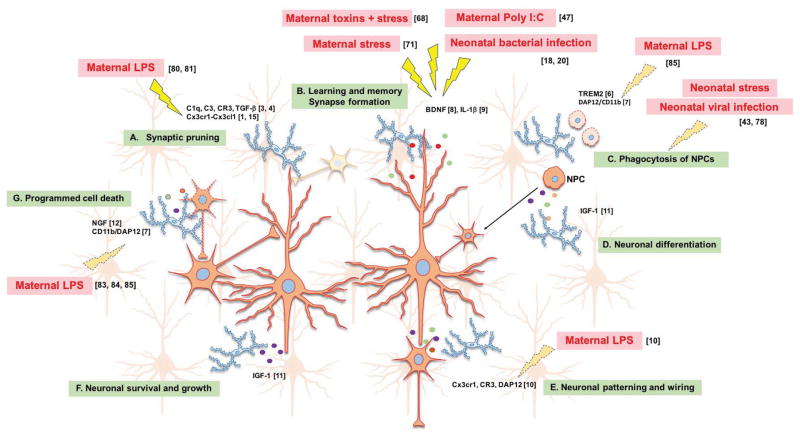
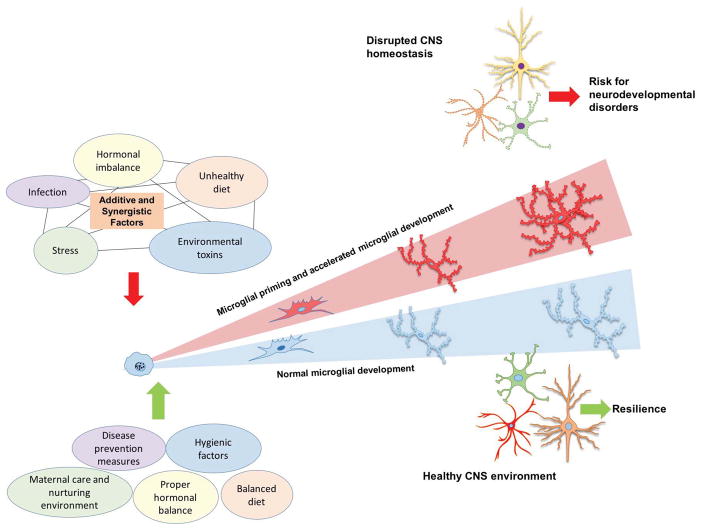
The immune system is our interface with the environment, and immune molecules such as cytokines and chemokines and the cells that produce them within the brain, notably microglia, are critical for normal brain development. This recognition has in recent years led to the working hypothesis that inflammatory events during pregnancy or the early postnatal period, for example, in response to infection, may disrupt the normal developmental trajectory of microglia and consequently their interactions with neurons, thereby contributing to the risk for neurological disorders. The current article outlines recent findings on the impact of diverse, pervasive environmental challenges, beyond infection, including air pollution and maternal stress; and their impact on microglial development and its broad implications for neural pathologies.
免疫系统是我们与环境的接口,而细胞因子和趋化因子等免疫分子以及大脑中产生这些分子的细胞,特别是小胶质细胞,对于正常的大脑发育至关重要。近年来,这一认识促使人们提出了一个工作假说,即妊娠期间或出生后早期的炎症事件,例如感染,可能会破坏小胶质细胞的正常发育轨迹,并因此影响它们与神经元的相互作用,从而增加患神经疾病的风险。本文概述了最近的研究结果,这些结果涉及除感染以外的各种普遍存在的环境挑战,包括空气污染和母体应激,以及它们对小胶质细胞发育的影响及其对神经病理学的广泛影响。