Tobis Sławomir, Cylkowska-Nowak Mirosława, Wieczorowska-Tobis Katarzyna, Pawlaczyk Mariola, Suwalska Aleksandra
Laboratory of Occupational Therapy, Department of Geriatric Medicine and Gerontology, University of Medical Sciences, Poznan, Poland.
Laboratory of Geriatrics, Department of Palliative Care, University of Medical Sciences, Poznan, Poland.
Occup Ther Int. 2017 Feb 7;2017:9592405. doi: 10.1155/2017/9592405. eCollection 2017.
The question arises how recent developments in robotics can contribute to the care for older people. The study is part of the EU-funded ENRICHME project.
The aim of the study was to investigate opinions of occupational therapy students (OTS), as future professional caregivers, on the use of robots in care for older people.
It included 26 OTS from Poznan University of Medical Sciences. To collect data, the Users' Needs, Requirements, and Abilities Questionnaire (UNRAQ) was developed.
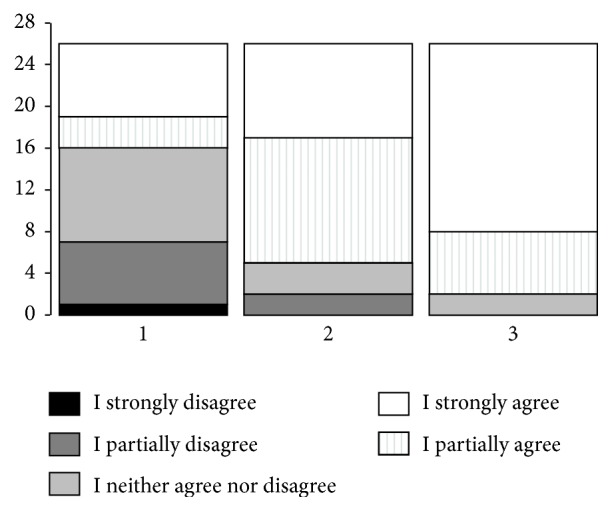
OTS perceived the robot as "a useful device" and "an assistant" rather than "a companion" ( < 0.01). In their opinion, the most important functions of the robot were related to health aspects (emergency alarms, health parameters monitoring, physical activity and memory training, and reminders about medication, drinks, etc.), scored positively by 23-26 OTS. Functions such as mood detection, encouraging to contact with friends, and monitoring of food consumption were accepted by 16-17 OTS. Two statements concerning social functions (accompanying in everyday activities and decreasing the sense of loneliness) were rated positively by less the than half of the participants.
A module concerning technology use, including robotics, should constitute an important part of the curricula of both academic and continuous education of OTS.
机器人技术的最新发展如何有助于老年人护理这一问题随之而来。该研究是欧盟资助的ENRICHME项目的一部分。
本研究旨在调查职业治疗专业学生(OTS)作为未来的专业护理人员,对在老年人护理中使用机器人的看法。
研究纳入了波兹南医科大学的26名职业治疗专业学生。为收集数据,开发了用户需求、要求和能力问卷(UNRAQ)。
职业治疗专业学生将机器人视为“有用的设备”和“助手”,而非“伙伴”(P<0.01)。在他们看来,机器人最重要的功能与健康方面相关(紧急警报、健康参数监测、身体活动和记忆训练以及药物、饮品等提醒),23至26名职业治疗专业学生对此给予了积极评价。情绪检测、鼓励与朋友联系以及食物摄入监测等功能得到了16至17名职业治疗专业学生的认可。关于社交功能的两项陈述(陪伴日常活动和减轻孤独感)得到积极评价的参与者不到一半。
包括机器人技术在内的技术使用模块应成为职业治疗专业学生学术教育和继续教育课程的重要组成部分。