Gomez-Del-Campo Maria, Connor David J, Trentacoste Eduardo R
CEIGRAM, Universidad Politécnica de Madrid, Madrid, Spain.
Faculty of Veterinary and Agricultural Sciences, The University of Melbourne, Melbourne, VIC, Australia.
Front Plant Sci. 2017 Oct 18;8:1790. doi: 10.3389/fpls.2017.01790. eCollection 2017.
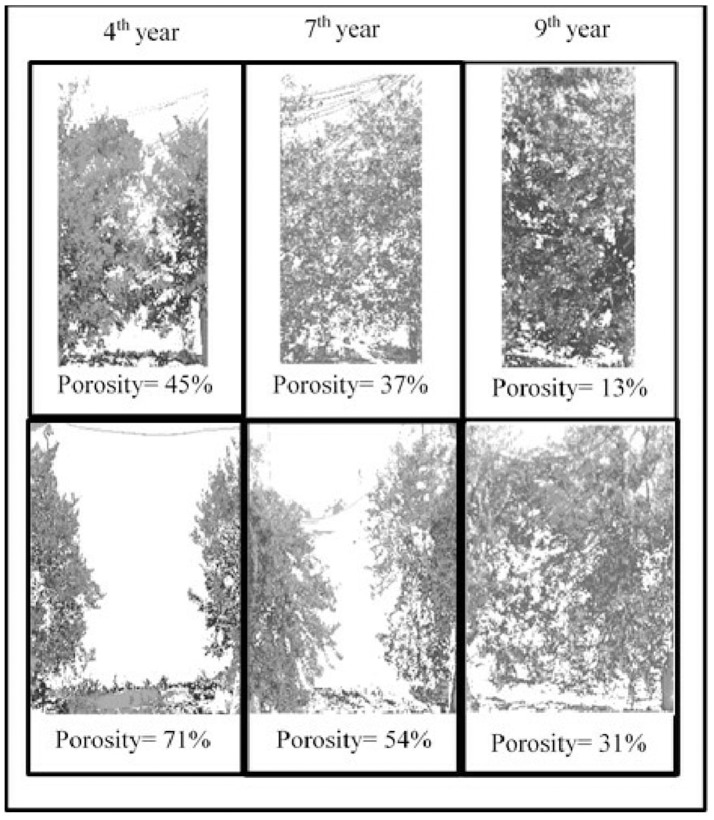
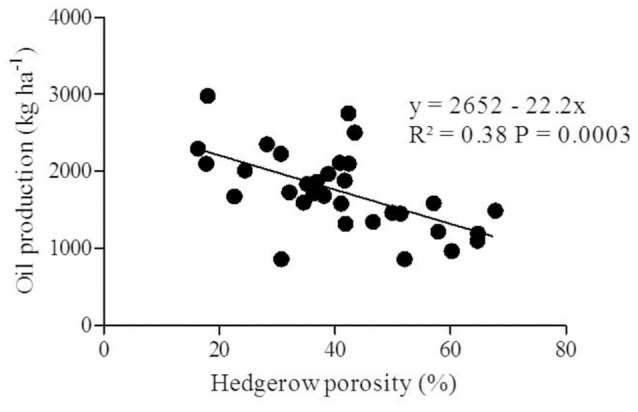
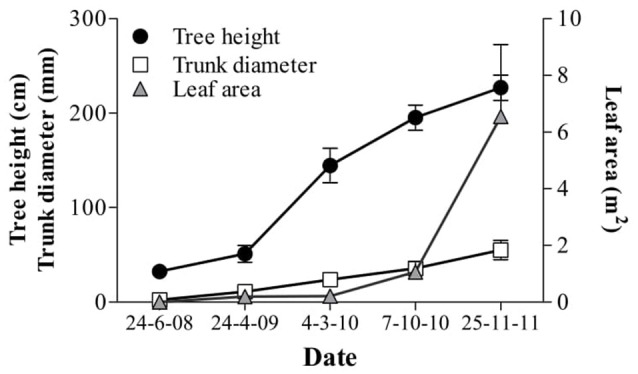
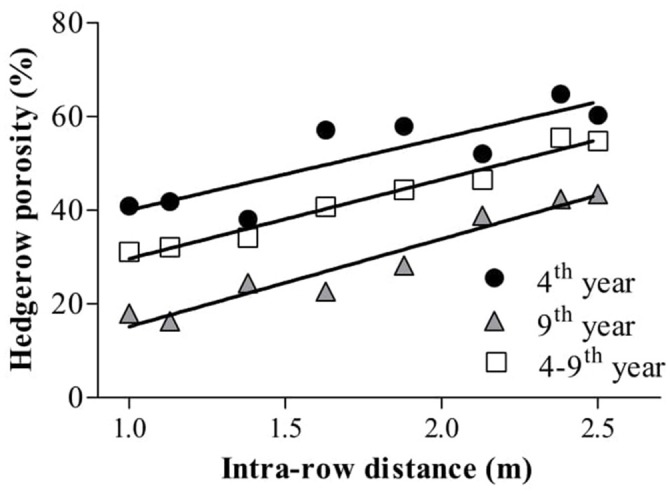
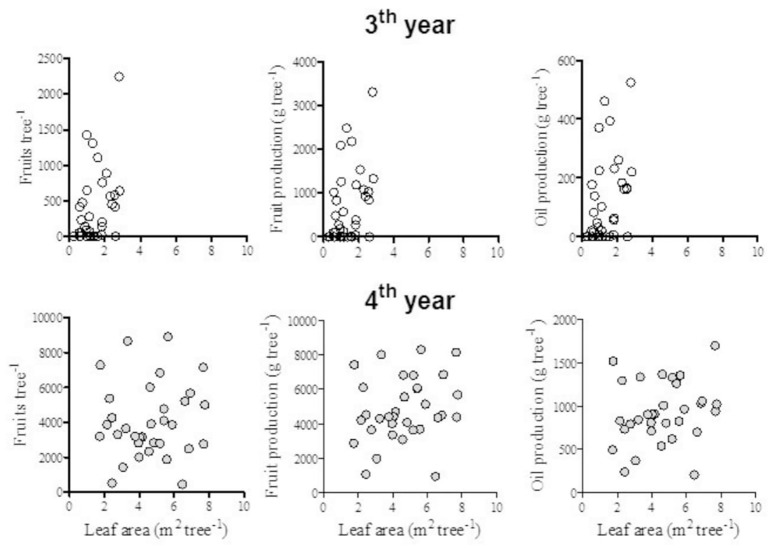
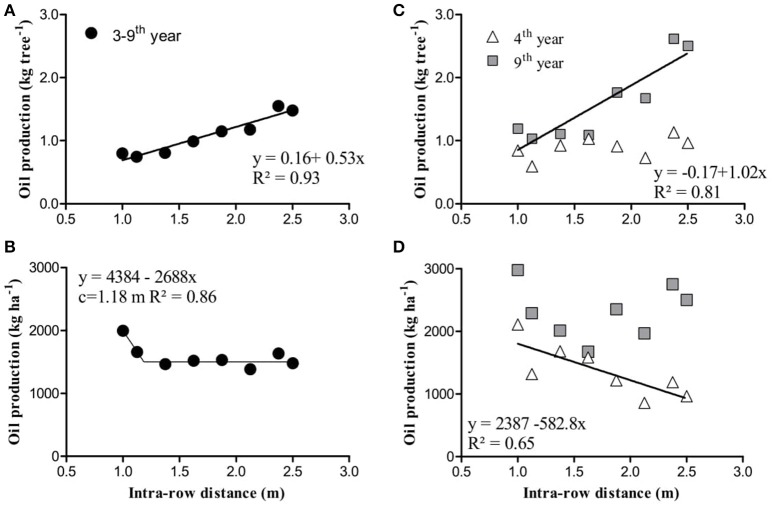
Intra-row spacing is known to determine early productivity of super-high density olive orchards depending on growing conditions, cultivar growth characteristics, planting geometry and subsequent pruning management but few experiments have been carried out in this olive hedgerow orchard design. In 2008 an experiment of 4-m spaced hedgerows was established with 8 intra-row spacings (from 1.0 to 2.5 m) in Toledo (Spain) resulting in orchards of density ranging from 2,500 to 1,000 trees ha. Tree growth was evaluated as height, trunk diameter and leaf area during the first 4 years. Hedgerow porosity was calculated from the 4th until the 9th year. In the 8th year hedgerow height, width, leaf area and branch angles were measured. Olives were harvested from 3rd to 9th year for measurements of fruit characteristics and productivity. Tree growth was not affected by intra-row spacing during the first 4 years. In the 8th year leaf area, external surface area and volume per tree were significantly greater in the more spaced trees; but hedgerow characteristics of leaf area per hectare, number of effective leaf layers horizontally through the hedgerow, and leaf density were not affected. In the more spaced trees insertion angles of branches to the vertical were significantly greater, mainly in the lower canopy. Intra-row spacing did not affect fruit characteristics. Oil production ha decreased linearly with spacing during the first 4 harvests while production per tree increased significantly with spacing after the 3rd harvest. As a result, oil production ha from the seven harvests combined only increased for tree spacing less than 1.2 m; wider spacing had no effect. Annual oil production ha increased linearly as porosity was reduced by greater tree density and canopy development along the seasons.
行内间距已知会根据生长条件、品种生长特性、种植几何形状和后续修剪管理来决定超高密度橄榄园的早期生产力,但在这种橄榄绿篱果园设计中进行的实验很少。2008年,在西班牙托莱多建立了一个行距为4米的绿篱实验,有8种行内间距(从1.0米到2.5米),形成了密度从每公顷2500棵到1000棵树的果园。在最初的4年里,对树木生长进行了高度、树干直径和叶面积的评估。从第4年到第9年计算绿篱孔隙率。在第8年测量了绿篱高度、宽度、叶面积和枝条角度。在第3年到第9年收获橄榄,以测量果实特性和生产力。在最初的4年里,树木生长不受行内间距影响。在第8年,间距较大的树木单株叶面积、外表面积和体积显著更大;但每公顷叶面积、水平穿过绿篱的有效叶层数和叶密度等绿篱特征不受影响。在间距较大的树木中,枝条与垂直方向的插入角度显著更大,主要在树冠下部。行内间距不影响果实特性。在前4次收获期间,每公顷产油量随间距呈线性下降,而在第3次收获后,单株产量随间距显著增加。因此,7次收获的综合每公顷产油量仅在树间距小于1.2米时增加;间距更大则没有影响。随着季节中树木密度和树冠发育增加导致孔隙率降低,每年每公顷产油量呈线性增加。