Hattori Yoshiyuki, Kikuchi Takuto, Nakamura Mari, Ozaki Kei-Ichi, Onishi Hiraku
Department of Drug Delivery Research, Hoshi University, Tokyo 142-8501, Japan.
Education and Research Center for Fundamental Pharmaceutical Sciences, Osaka University of Pharmaceutical Sciences, Takatsuki, Osaka 569-1094, Japan.
Oncol Lett. 2017 Nov;14(5):5157-5166. doi: 10.3892/ol.2017.6830. Epub 2017 Aug 25.
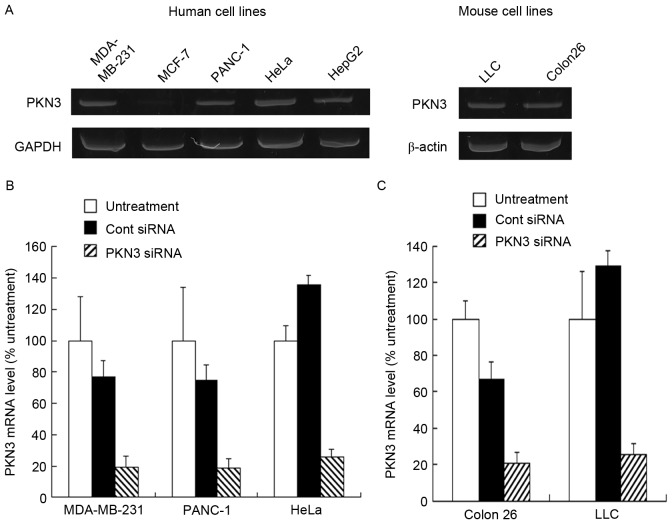
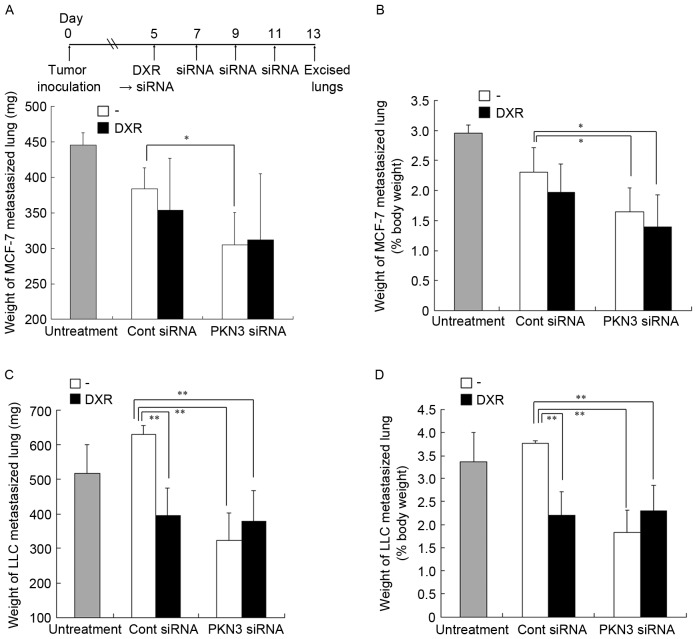
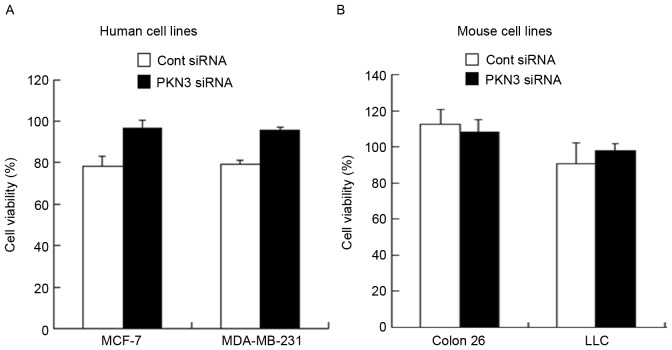
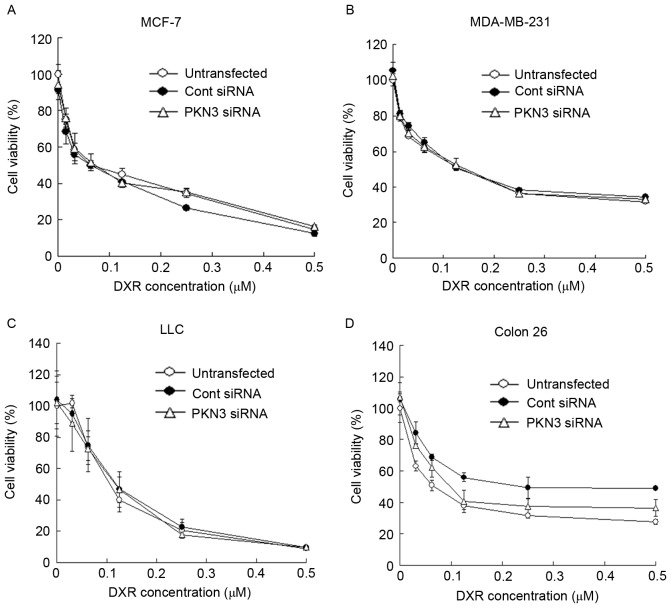
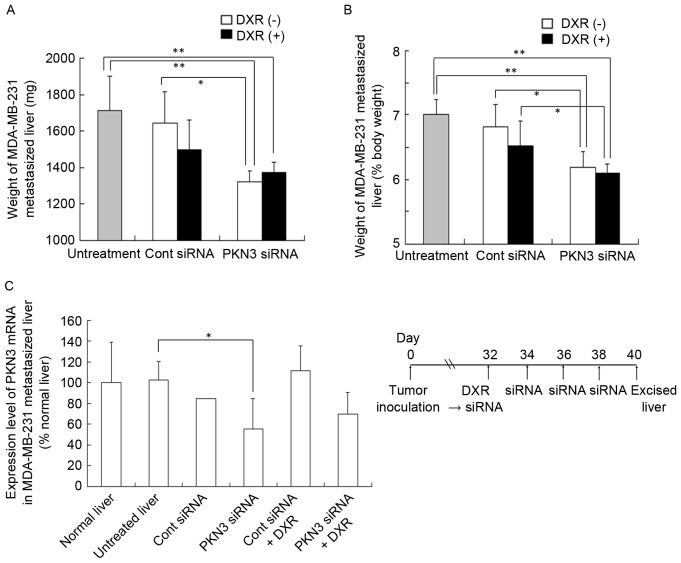
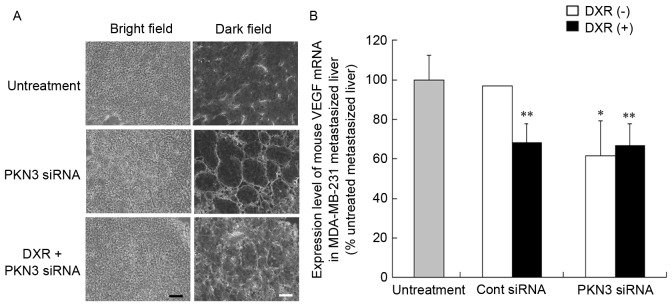
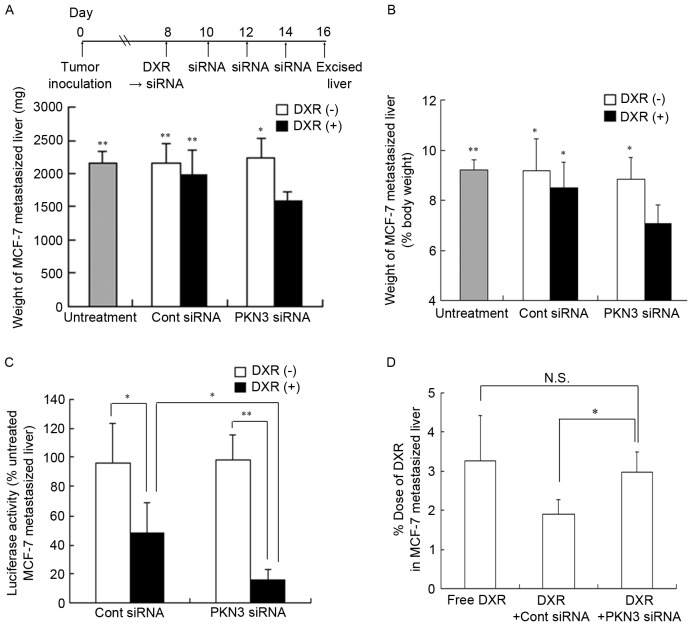
It has been reported that suppression of protein kinase N3 (PKN3) expression in vascular and lymphatic endothelial cells results in the inhibition of tumor progression and lymph node metastasis formation. The present study investigated whether combination therapy of small interfering RNA (siRNA) against PKN3 and doxorubicin (DXR) could increase therapeutic efficacy against liver and lung metastases. transfection of PKN3 siRNA into PKN3-positive MDA-MB-231, LLC, and Colon 26 cells and PKN3-negative MCF-7 cells did not inhibit cell growth and did not increase sensitivity to DXR. However, following treatment, PKN3 siRNA suppressed the growth of liver MDA-MB-231 and lung LLC and MCF-7 metastases, although combination therapy with DXR did not increase the therapeutic efficacy. By contrast, in liver MCF-7 metastases, PKN3 siRNA or DXR alone did not exhibit significant inhibition of tumor growth, but their combination significantly improved therapeutic efficacy. Treatment of liver MDA-MB-231 metastases with PKN3 siRNA induced a change in vasculature structure via suppression of PKN3 mRNA expression. PKN3 siRNA may induce antitumor effects in lung and liver metastases by suppression of PKN3 expression in stroma cells, such as endothelial cells. From these findings, PKN3 siRNA alone or in combination with DXR may reduce the tumor growth of liver and lung metastases regardless of PKN3 expression in tumor cells.
据报道,抑制血管和淋巴管内皮细胞中的蛋白激酶N3(PKN3)表达可导致肿瘤进展和淋巴结转移形成受到抑制。本研究调查了针对PKN3的小干扰RNA(siRNA)与阿霉素(DXR)联合治疗是否能提高对肝转移和肺转移的治疗效果。将PKN3 siRNA转染到PKN3阳性的MDA-MB-231、LLC和结肠26细胞以及PKN3阴性的MCF-7细胞中,并未抑制细胞生长,也未增加对DXR的敏感性。然而,治疗后,PKN3 siRNA抑制了肝MDA-MB-231、肺LLC和MCF-7转移灶的生长,尽管与DXR联合治疗并未提高治疗效果。相比之下,在肝MCF-7转移灶中,单独使用PKN3 siRNA或DXR对肿瘤生长均未表现出显著抑制作用,但两者联合使用显著提高了治疗效果。用PKN3 siRNA治疗肝MDA-MB-231转移灶可通过抑制PKN3 mRNA表达诱导脉管系统结构改变。PKN3 siRNA可能通过抑制基质细胞(如内皮细胞)中的PKN3表达在肺和肝转移中诱导抗肿瘤作用。基于这些发现,无论肿瘤细胞中PKN3的表达情况如何,单独使用PKN3 siRNA或与DXR联合使用都可能减少肝和肺转移灶的肿瘤生长。