a Department of Surgical Oncology , The University of Texas MD Anderson Cancer Center , Houston , TX , USA.
b The University of Texas Health Science Center at Houston , Graduate School of Biomedical Sciences , Houston , TX , USA.
Cancer Biol Ther. 2017 Oct 3;18(10):816-826. doi: 10.1080/15384047.2017.1373230. Epub 2017 Nov 3.
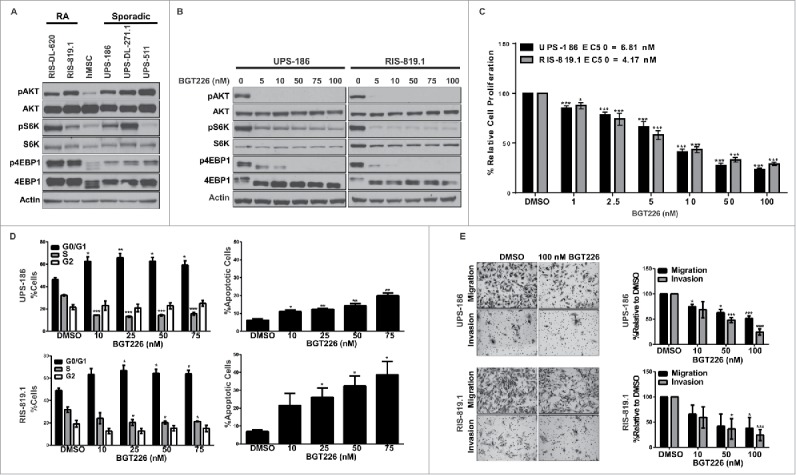
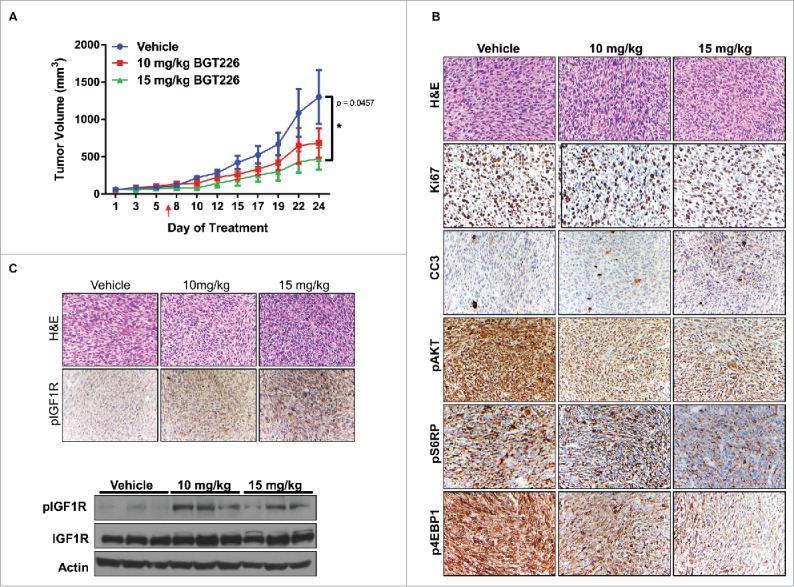
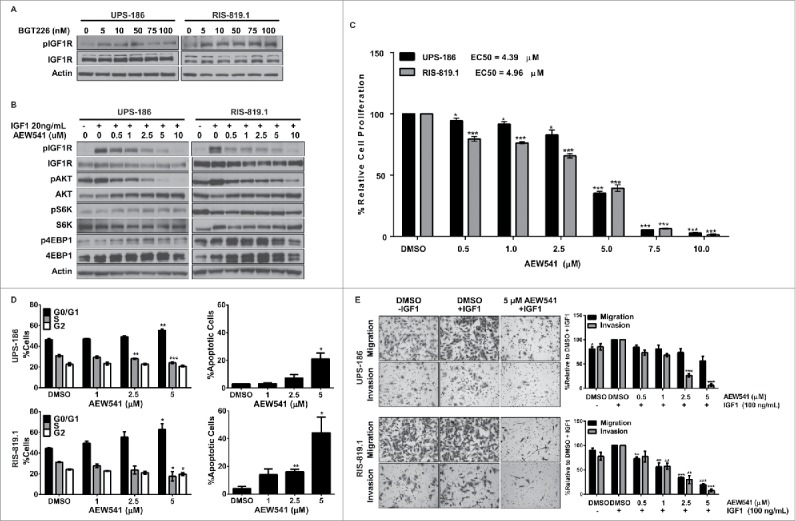
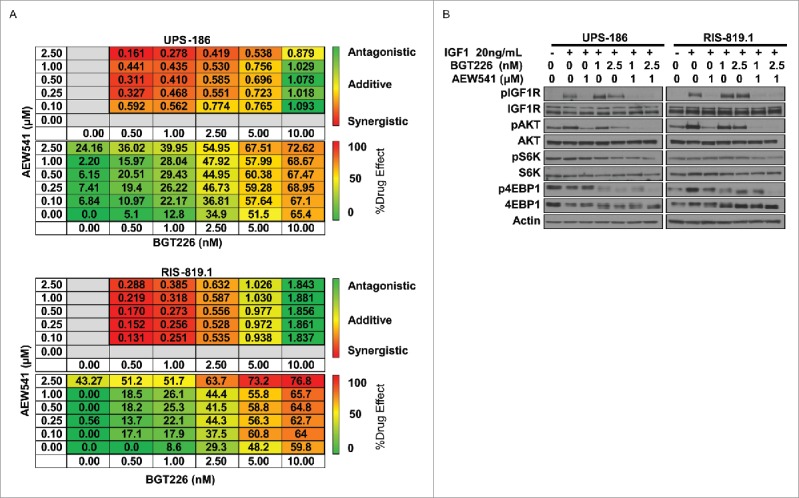
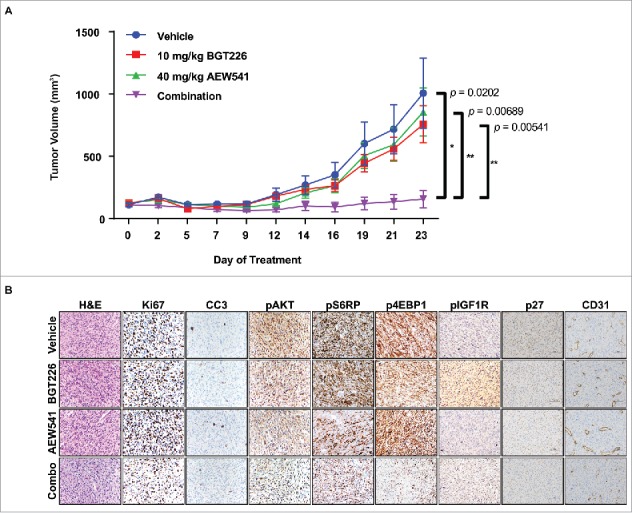
Undifferentiated pleomorphic sarcomas (UPSs) are aggressive mesenchymal malignancies with no definitive cell of origin or specific recurrent genetic hallmarks. These tumors are largely chemoresistant; thus, identification of potential therapeutic targets is necessary to improve patient outcome. Previous studies demonstrated that high expression of activated protein kinase B (AKT) in patients with UPS corresponds to poor disease-specific survival. Here, we demonstrate that inhibiting phosphatidylinositol-3-kinase/mammalian target of rapamycin (PI3K/mTOR) signaling using a small molecule inhibitor reduced UPS cell proliferation and motility and xenograft growth; however, increased phosphorylation of insulin-like growth factor 1 receptor (IGF1R) indicated the potential for adaptive resistance following treatment through compensatory receptor activation. Co-treatment with a dual PI3K/mTOR inhibitor and an anti-IGF1R kinase inhibitor reduced in vivo tumor growth rates despite a lack of antiproliferative effects in vitro. Moreover, this combination treatment significantly decreased UPS cell migration and invasion, which is linked to changes in p27 subcellular localization. Our results demonstrate that targeted inhibition of multiple components of the IGF1R/PI3K/mTOR pathway was more efficacious than single-agent therapy and suggest that co-targeting this pathway could be a beneficial therapeutic strategy for patients with UPS.
未分化多形性肉瘤(UPSs)是一种侵袭性间叶恶性肿瘤,没有明确的细胞起源或特定的复发性遗传特征。这些肿瘤对化疗具有很大的耐药性;因此,有必要确定潜在的治疗靶点以改善患者的预后。先前的研究表明,UPS 患者中活化蛋白激酶 B(AKT)的高表达与较差的疾病特异性生存相关。在这里,我们证明使用小分子抑制剂抑制磷酸肌醇-3-激酶/雷帕霉素靶蛋白(PI3K/mTOR)信号通路可降低 UPS 细胞的增殖和迁移能力,并抑制异种移植瘤的生长;然而,胰岛素样生长因子 1 受体(IGF1R)的磷酸化增加表明在通过代偿性受体激活进行治疗后存在适应性耐药的可能性。尽管体外无明显的增殖抑制作用,但双重 PI3K/mTOR 抑制剂和抗 IGF1R 激酶抑制剂的联合治疗可显著降低体内肿瘤生长速度。此外,这种联合治疗还显著降低了 UPS 细胞的迁移和侵袭能力,这与 p27 亚细胞定位的变化有关。我们的研究结果表明,靶向抑制 IGF1R/PI3K/mTOR 通路的多个组成部分比单一药物治疗更有效,并表明联合靶向该通路可能是 UPS 患者的一种有益的治疗策略。