a Arsanis Biosciences, Helmut-Qualtinger-Gasse 2, Campus Vienna Biocenter , Vienna , Austria.
Virulence. 2018 Jan 1;9(1):231-247. doi: 10.1080/21505594.2017.1391447. Epub 2017 Dec 26.
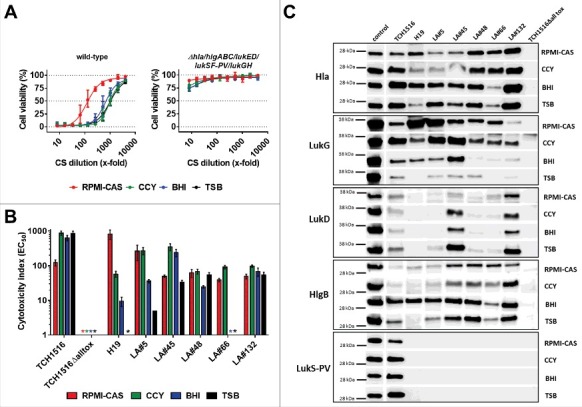
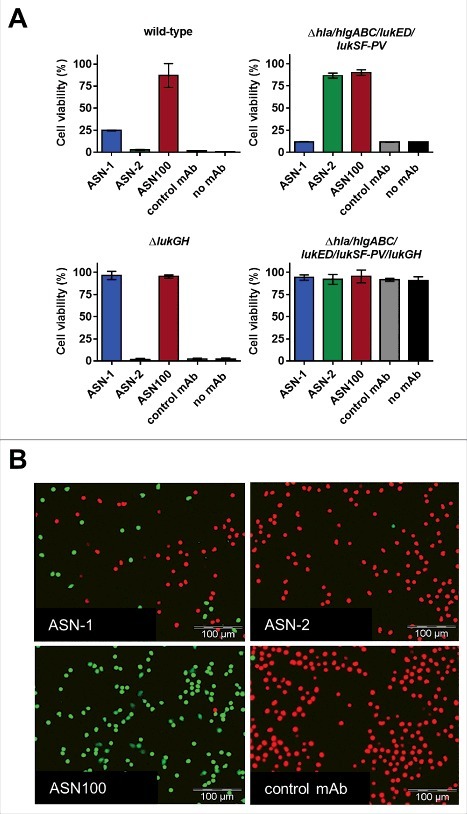
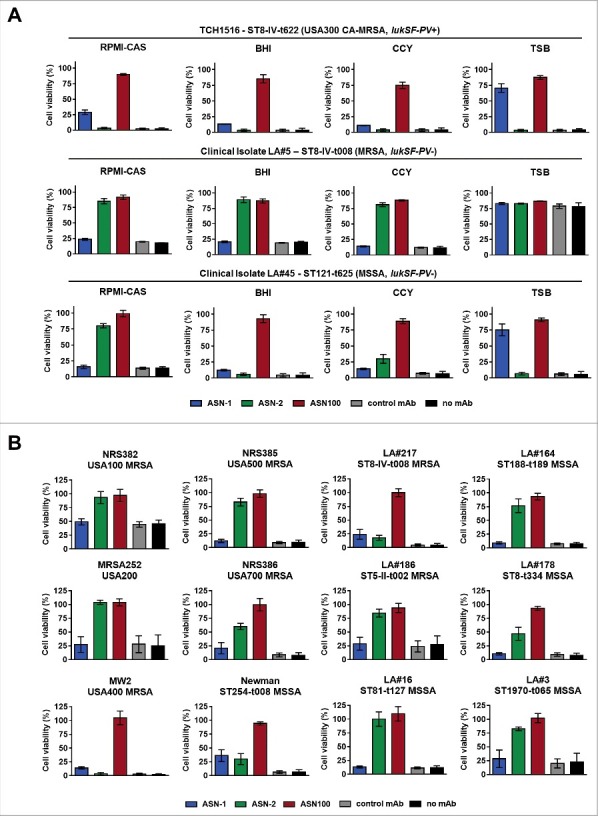
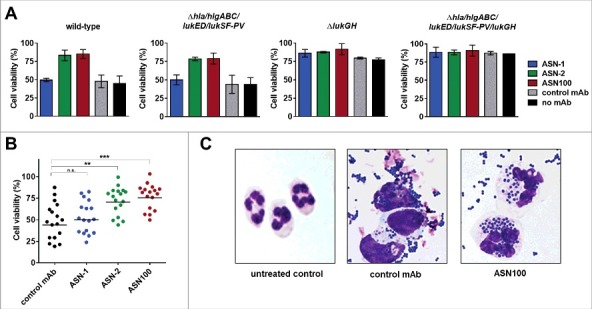
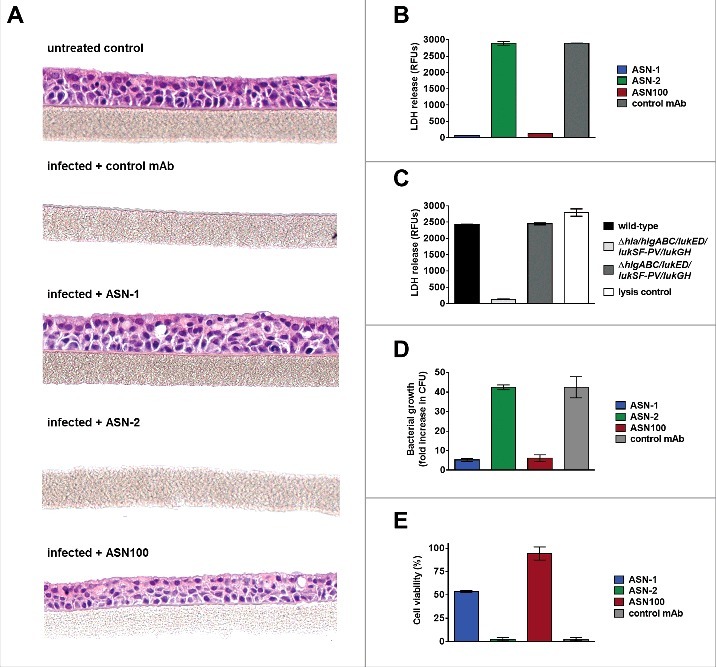
Pathogenesis of Staphylococcus aureus is increasingly recognized to be driven by powerful toxins. Staphylococcus aureus employs up to six pore-forming toxins to subvert the human host defense and to promote bacterial invasion: alpha-hemolysin that disrupts epithelial and endothelial barriers and five leukocidins that lyse phagocytes involved in bacterial clearance. Previously, we described two human monoclonal antibodies (mAbs), ASN-1 that neutralizes alpha-hemolysin and four leukocidins (LukSF-PV, LukED, HlgAB, HlgCB), and ASN-2 that inactivates the 5 leukocidin, LukGH. In this study we tested the individual and combined effects of ASN-1 and ASN-2 in multiple in vitro models employing relevant human target cells. We found that diverse S. aureus isolates with different genetic backgrounds (based on MLST- and spa-typing) and antibiotic sensitivity (both MRSA and MSSA) displayed greatly different cytotoxin expression patterns influenced by the type of growth medium used. Both mAbs were required to fully prevent the lysis of human neutrophils exposed to the mixture of recombinant cytotoxins or native toxins present in the culture supernatants of S. aureus isolates. Flow cytometry confirmed the protective effects of ASN-1 + ASN-2 (known as ASN100) on granulocytes, monocytes, NK-cells and T-lymphocytes. ASN-1 alone preserved the integrity of a 3D-primary culture of human tracheal/bronchial mucociliary epithelial tissue infected with S. aureus. We conclude that simultaneous inhibition of alpha-hemolysin and five leukocidins by ASN100 blocks cytolytic activity of S. aureus towards human target cells in vitro.
金黄色葡萄球菌的发病机制越来越被认为是由强大的毒素驱动的。金黄色葡萄球菌使用多达六种形成孔的毒素来颠覆人体宿主防御并促进细菌入侵:破坏上皮和内皮屏障的α-溶血素和裂解参与细菌清除的吞噬细胞的五种白细胞毒素(LukSF-PV、LukED、HlgAB、HlgCB)。此前,我们描述了两种人源单克隆抗体 (mAb),ASN-1 中和α-溶血素和四种白细胞毒素(LukSF-PV、LukED、HlgAB、HlgCB),以及 ASN-2 失活 5 种白细胞毒素,LukGH。在这项研究中,我们使用相关的人类靶细胞在多个体外模型中测试了 ASN-1 和 ASN-2 的单独和联合作用。我们发现,具有不同遗传背景(基于 MLST 和 spa 分型)和抗生素敏感性(包括 MRSA 和 MSSA)的不同金黄色葡萄球菌分离株显示出不同的细胞毒素表达模式,这受到所用生长培养基类型的影响。只有两种 mAb 都被需要完全防止暴露于重组细胞毒素混合物或金黄色葡萄球菌分离株培养上清液中存在的天然毒素的人嗜中性粒细胞裂解。流式细胞术证实了 ASN-1+ASN-2(称为 ASN100)对粒细胞、单核细胞、NK 细胞和 T 淋巴细胞的保护作用。ASN-1 单独保留了感染金黄色葡萄球菌的 3D 人气管/支气管黏膜纤毛上皮组织的三维原代培养物的完整性。我们得出结论,ASN100 同时抑制α-溶血素和五种白细胞毒素可阻断金黄色葡萄球菌对体外人类靶细胞的细胞溶解活性。