Qin Shu-Wen, Chan Ta-Chien, Cai Jian, Zhao Na, Miao Zi-Ping, Chen Yi-Juan, Liu She-Lan
Department of Infectious Diseases, Zhejiang Provincial Center for Disease Control and Prevention, Hangzhou 310051, China.
Center for Geographic Information Science, Research Center for Humanities and Social Sciences, Academia Sinica, Taipei 115, Taiwan.
Int J Environ Res Public Health. 2017 Nov 3;14(11):1341. doi: 10.3390/ijerph14111341.
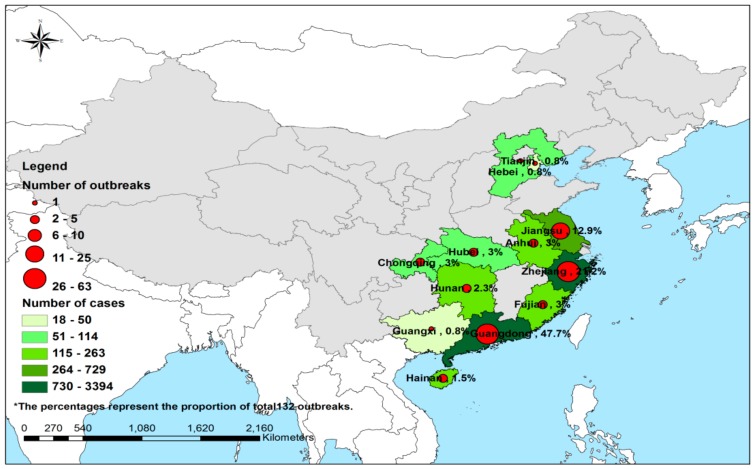
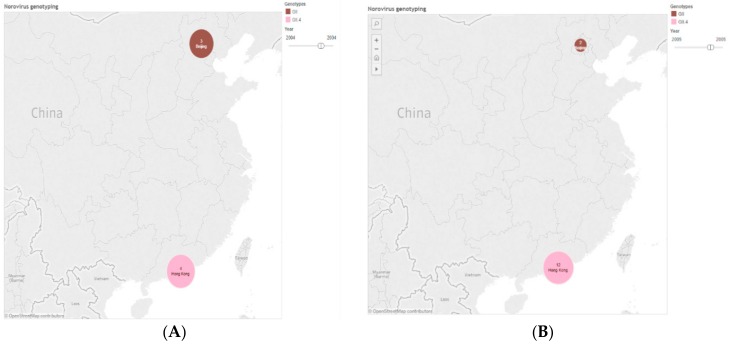
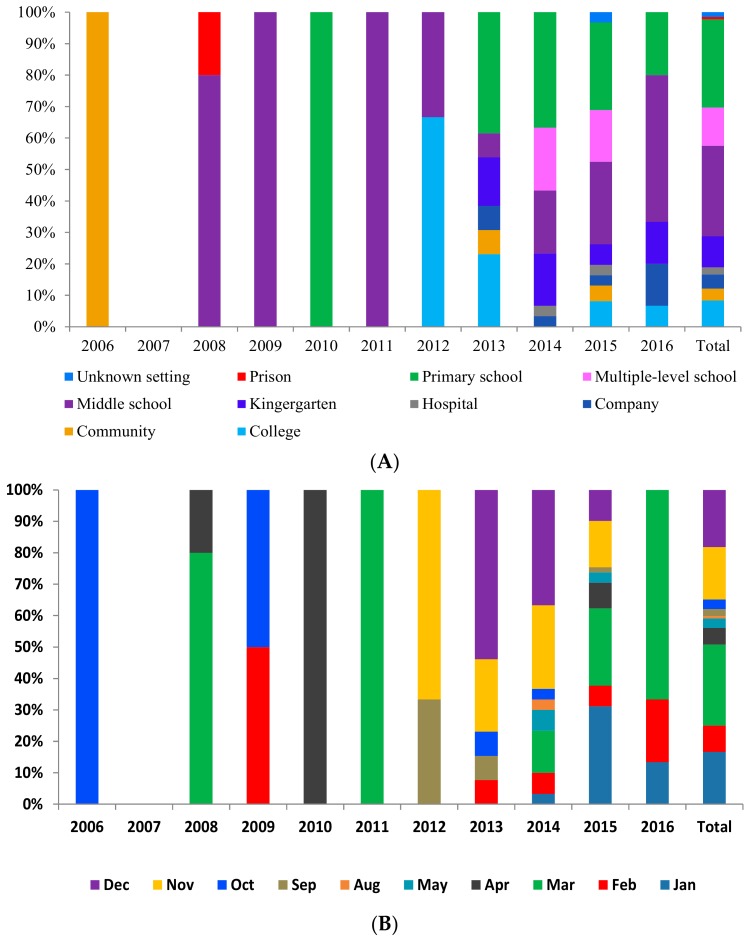
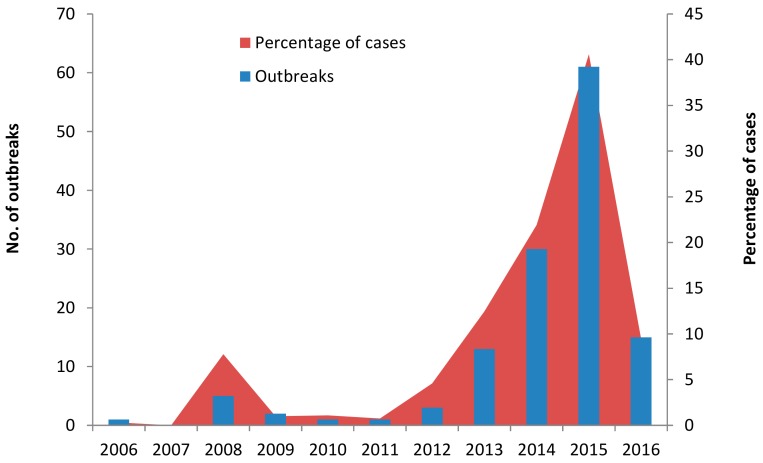
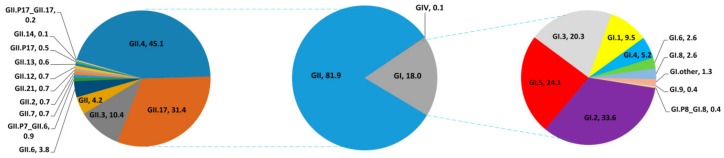
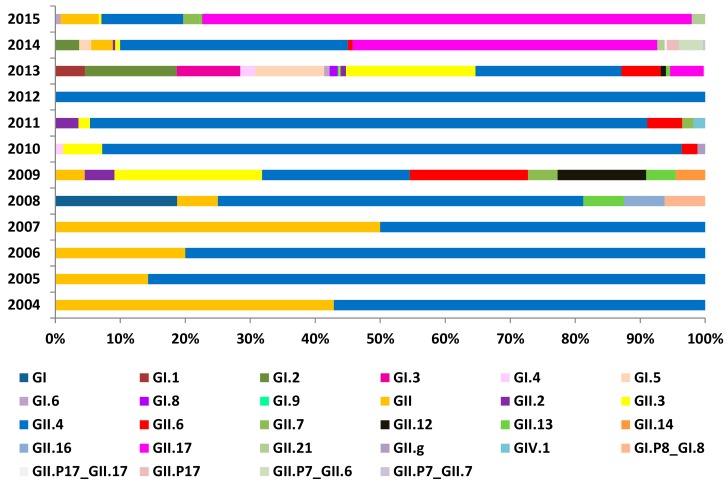
There are periodical norovirus-associated acute gastroenteritis outbreaks around the world. This study aimed to analyze the molecular and epidemiological features of norovirus infections in China during 2006-2016. We extracted epidemiological data from 132 norovirus outbreaks and the norovirus genotyping for 1291 sequences in China over the past ten years. A total of 132 norovirus outbreaks (8133 cases) were reported in China, where the east and south regions were most affected [47.7% (63/132)]. The highest number of outbreaks occurred in 2015. A seasonal pattern has been observed, with a peak from November to the following March. Most of the outbreaks occurred in middle and primary schools, accounting for 28.8% (38/132), and 28.0% (37/132) of outbreaks, respectively. The dominant age group was 10 to 19 years old, responsible for 75.7% (933/1232) of cases. Generally, the dominant genotypes was GII, for 81.9% (1058/1291) of sequences. G II.4 was the predominant genotype in China from 2004 to 2014. However, the GII.17 became more prevalent starting in 2014. Norovirus-associated acute gastroenteritis increased sharply in recent years caused by the emergence of GII.17, but epidemiological features have not changed during 2006-2016. Vigilant surveillance should be strengthened to promptly detect any variation.
全球范围内时有与诺如病毒相关的急性肠胃炎疫情爆发。本研究旨在分析2006年至2016年期间中国诺如病毒感染的分子特征和流行病学特征。我们提取了过去十年中国132起诺如病毒疫情的流行病学数据以及1291个序列的诺如病毒基因分型。中国共报告了132起诺如病毒疫情(8133例病例),其中东部和南部地区受影响最为严重[47.7%(63/132)]。疫情爆发数量最多的年份是2015年。已观察到季节性模式,11月至次年3月为高峰期。大多数疫情发生在中小学,分别占疫情总数的28.8%(38/132)和28.0%(37/132)。主要年龄组为10至19岁,占病例总数的75.7%(933/1232)。一般来说,优势基因型为GII,占序列总数的81.9%(1058/1291)。2004年至2014年期间,G II.4是中国的主要基因型。然而,从2014年开始,GII.17变得更为普遍。近年来,由于GII.17的出现,与诺如病毒相关的急性肠胃炎急剧增加,但2006年至2016年期间流行病学特征并未改变。应加强监测,及时发现任何变化。