Na Young-Soon, Ryu Min-Hee, Yoo Changhoon, Lee Ju-Kyung, Park Jung Min, Lee Chae-Won, Lee Sun Young, Shin Young-Kyoung, Ku Ja-Lok, Ahn Sung-Min, Kang Yoon-Koo
Asan Institute for Life Science, Asan Medical Center, Seoul, Korea.
Department of Oncology, Asan Medical Center, University of Ulsan College of Medicine, Seoul, Korea.
Oncotarget. 2017 Sep 11;8(44):76712-76721. doi: 10.18632/oncotarget.20816. eCollection 2017 Sep 29.
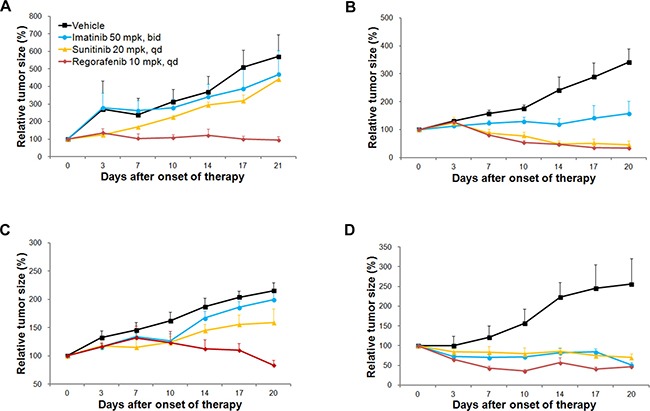
Gastrointestinal stromal tumors (GISTs) with or platelet-derived growth factor receptor alpha () oncogenic driver gene mutations, respond to tyrosine kinase inhibitors (TKIs) including imatinib, sunitinib, and regorafenib. However, most patients develop TKI resistance; therefore, novel agents are required. We established three TKI-resistant GIST patient-derived xenograft (PDX) models for effective drug development. These were PDX models harboring primary and secondary and additional mutations; exon 11 (p.Y570_L576del), exon 17 (p.D816E), and (p.T321fs) mutations in GIST-RX1 from a patient who was unresponsive to imatinib, sunitinib, and sorafenib, and exon 11 (p.K550_splice) and exon 14 (p.T670I) mutations in GIST-RX2 and exon 9 (p.502_503insYA) and exon 17 (p.D820E) mutations in GIST-RX4 from patients with imatinib and imatinib/sunitinib resistance, respectively. The histological features and mutation statuses of GIST PDXs were consistent with those of the original patient tumors, and the models showed TKI sensitivity comparable to clinical responses. Imatinib inhibited the KIT pathway in imatinib-sensitive GIST-T1 but not GIST-RX1, RX2, and RX4. These GIST PDX models will be useful for studying TKI resistance mechanisms and evaluating novel targeted agents in GIST.
携带KIT或血小板衍生生长因子受体α(PDGFRA)致癌驱动基因突变的胃肠道间质瘤(GIST)对包括伊马替尼、舒尼替尼和瑞戈非尼在内的酪氨酸激酶抑制剂(TKI)有反应。然而,大多数患者会产生TKI耐药性;因此,需要新型药物。我们建立了三种源自GIST患者的TKI耐药异种移植(PDX)模型,用于有效的药物开发。这些模型包括携带原发性和继发性KIT及其他突变的PDX模型;来自一名对伊马替尼、舒尼替尼和索拉非尼均无反应的患者的GIST-RX1中存在第11外显子(p.Y570_L576del)、第17外显子(p.D816E)和KIT(p.T321fs)突变,来自分别对伊马替尼和伊马替尼/舒尼替尼耐药患者的GIST-RX2中存在第11外显子(p.K550_splice)和第14外显子(p.T670I)突变,以及GIST-RX4中存在第9外显子(p.502_503insYA)和第17外显子(p.D820E)突变。GIST PDX的组织学特征和突变状态与原始患者肿瘤一致,并且这些模型显示出与临床反应相当的TKI敏感性。伊马替尼抑制伊马替尼敏感的GIST-T1中的KIT通路,但不抑制GIST-RX1、RX2和RX4中的KIT通路。这些GIST PDX模型将有助于研究GIST中的TKI耐药机制并评估新型靶向药物。