Huang Chuan-Feng, Wang Wei-Na, Sun Cheng-Cao, Wang Yu-Qing, Li Ling, Li Yin, Li De-Jia
Department of Occupational and Environmental Health, School of Public Health, Wuhan University, Wuhan, Hubei 430071, P.R. China.
Department of Pharmacology, Basic Medical School, Nanyang Medical College, Nanyang, Henan 473003, P.R. China.
Exp Ther Med. 2017 Nov;14(5):4174-4180. doi: 10.3892/etm.2017.5097. Epub 2017 Sep 1.
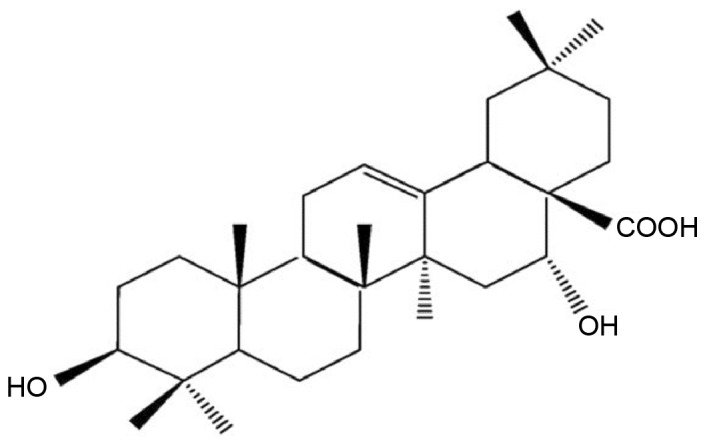
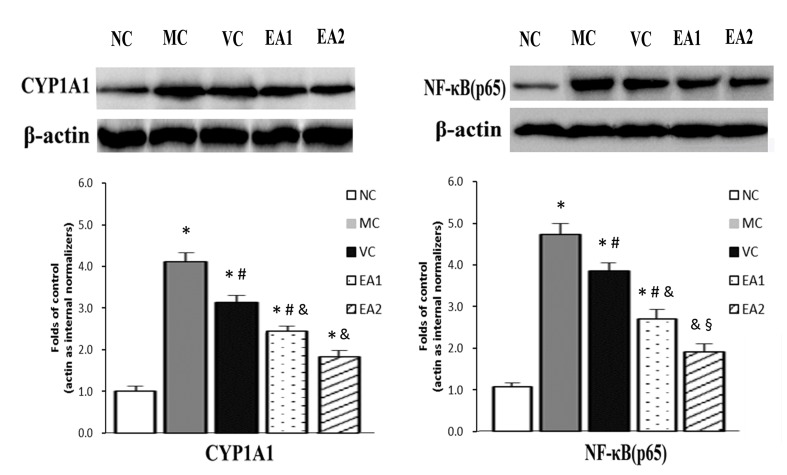
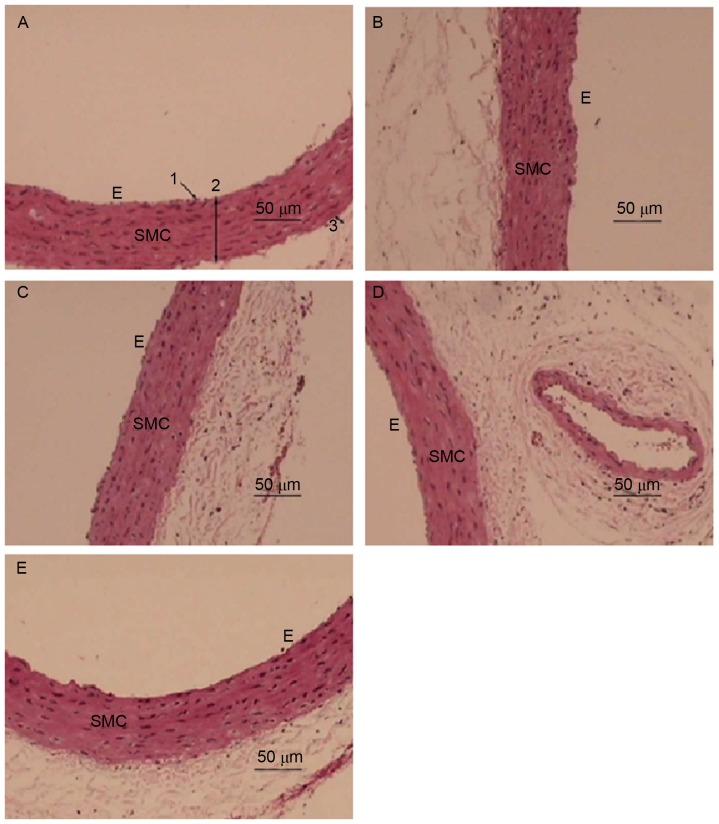
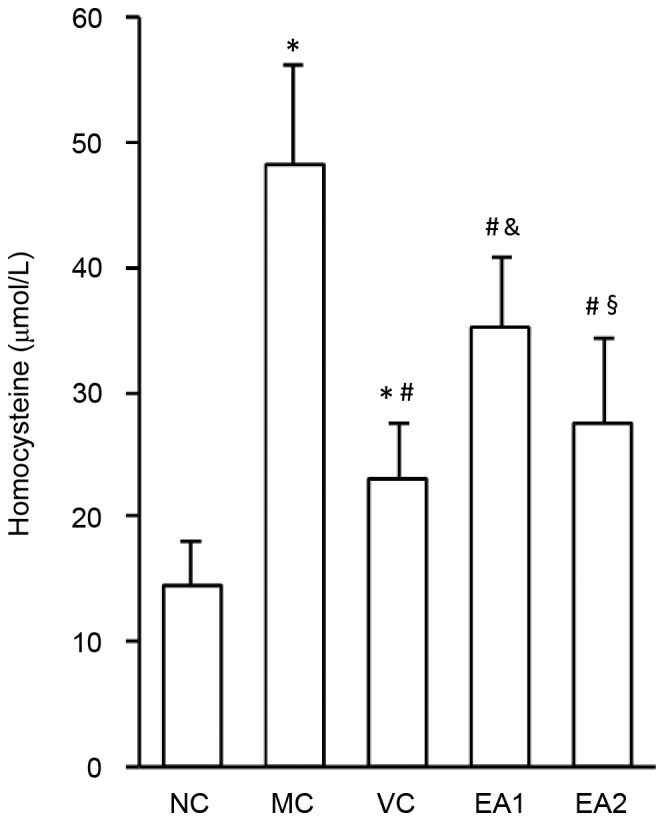
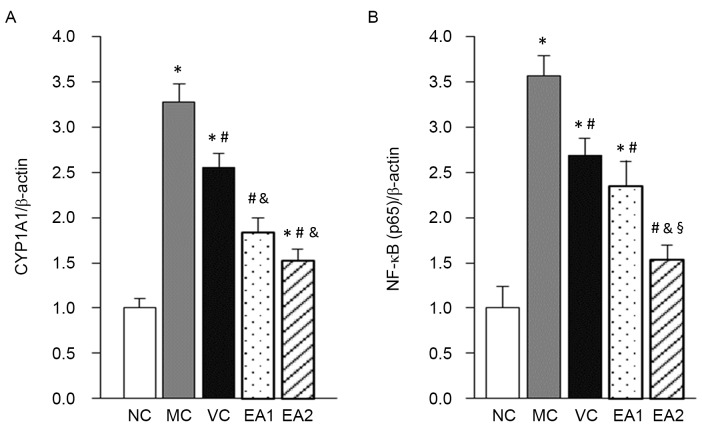
The present study investigated the role of echinocystic acid (EA) on the expression of nuclear factor (NF)-κB and cytochrome P450 1A1 (CYP1A1), and aortic morphology, in a rat model of hyperhomocysteinemia (Hhcy). A total of 50 Sprague Dawley rats were randomly divided into five groups as follows: Normal control (NC), model control (MC), vitamin control (VC; folic acid 1 mg/kg + vitamin B2 2 mg/kg + vitamin B12 10u g/kg), EA1 (20 mg/kg EA) and EA2 (40 mg/kg EA). Plasma homocysteine (Hcy) levels were determined via high performance liquid chromatography, and the morphology of the aorta was investigated using hematoxylin and eosin staining. Furthermore, aortic mRNA and protein levels of NF-κB and CYP1A1 were measured using reverse transcription-quantitative polymerase chain reaction analysis and western blotting, respectively. Plasma Hcy levels, and aortic mRNA and protein levels of NF-κB and CYP1A1, were significantly lower in the EA-treated group compared with the MC group (all P<0.05). However, the aortic morphology remained normal, including the endothelial cells of the inner layer, and smooth muscle cells of the media layer and adventitia. In conclusion, the results of the present study indicate that EA has a protective role on vascular endothelial cells in Hhcy through decreasing plasma Hcy, and thus NF-κB and CYP1A1 expression.
本研究在高同型半胱氨酸血症(Hhcy)大鼠模型中,研究了echinocystic acid(EA)对核因子(NF)-κB和细胞色素P450 1A1(CYP1A1)表达以及主动脉形态的影响。总共50只Sprague Dawley大鼠被随机分为以下五组:正常对照组(NC)、模型对照组(MC)、维生素对照组(VC;叶酸1 mg/kg + 维生素B2 2 mg/kg + 维生素B12 10μg/kg)、EA1组(20 mg/kg EA)和EA2组(40 mg/kg EA)。通过高效液相色谱法测定血浆同型半胱氨酸(Hcy)水平,并用苏木精-伊红染色研究主动脉形态。此外,分别采用逆转录-定量聚合酶链反应分析和蛋白质印迹法检测主动脉中NF-κB和CYP1A1的mRNA和蛋白水平。与MC组相比,EA治疗组的血浆Hcy水平以及主动脉中NF-κB和CYP1A1的mRNA和蛋白水平均显著降低(均P<0.05)。然而,主动脉形态保持正常,包括内层的内皮细胞、中层的平滑肌细胞和外膜。总之,本研究结果表明,EA通过降低血浆Hcy以及NF-κB和CYP1A1的表达,对Hhcy中的血管内皮细胞具有保护作用。