Guo Yi, Li Jun-Xiang, Mao Tang-You, Zhao Wei-Han, Liu Li-Juan, Wang Yun-Liang
Department of Gastroenterology, Dongfang Hospital, Beijing University of Chinese Medicine, Beijing 100078, P.R. China.
Graduate School, Beijing University of Chinese Medicine, Beijing 100029, P.R. China.
Exp Ther Med. 2017 Nov;14(5):4279-4287. doi: 10.3892/etm.2017.5076. Epub 2017 Aug 30.
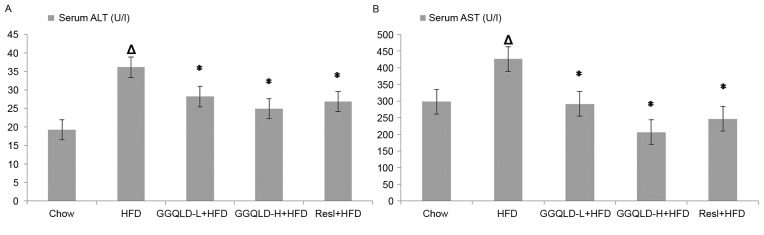
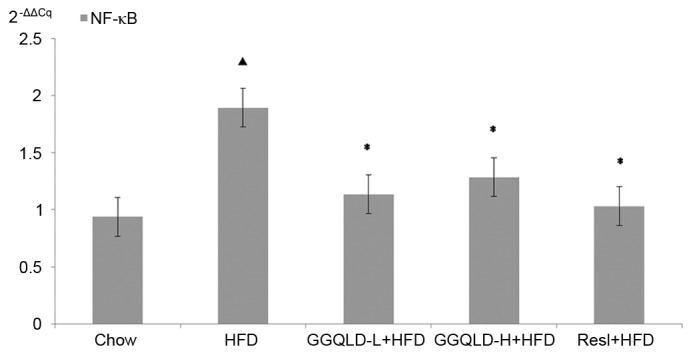
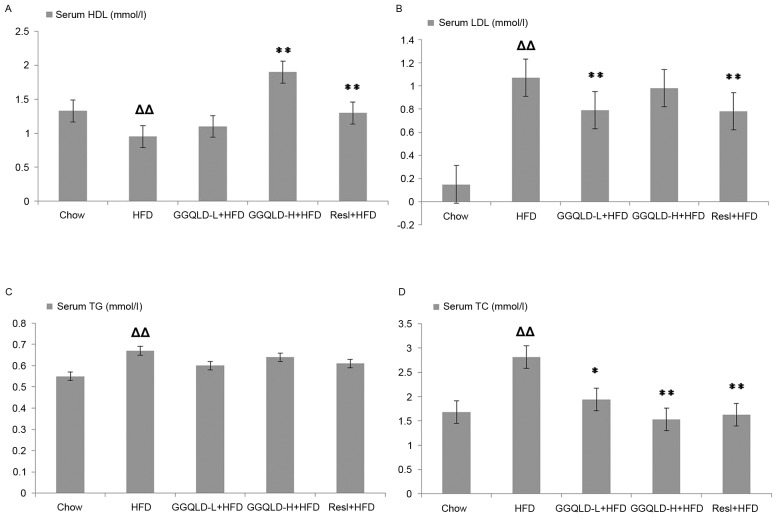
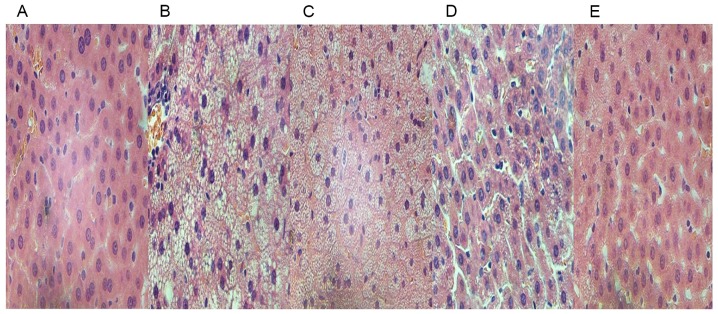
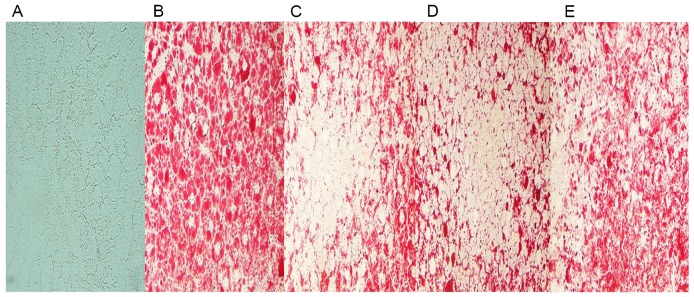
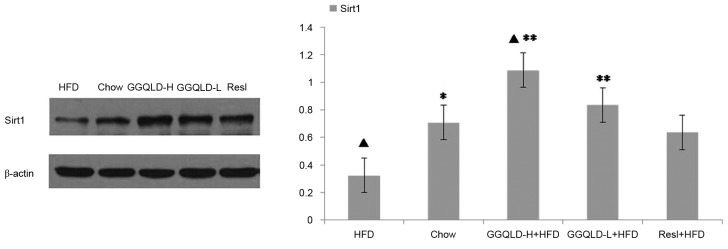
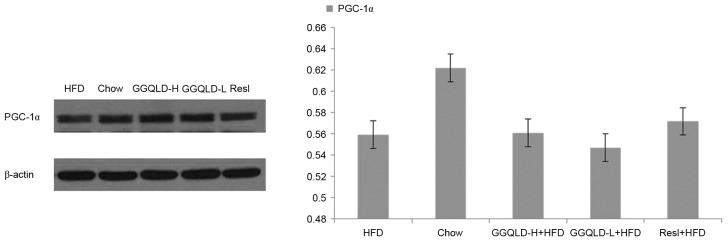
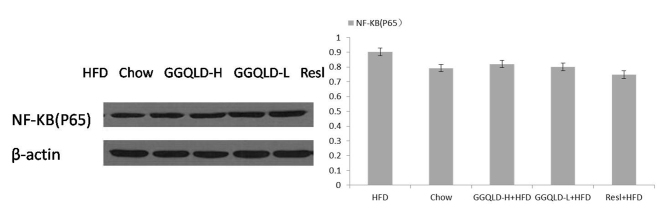
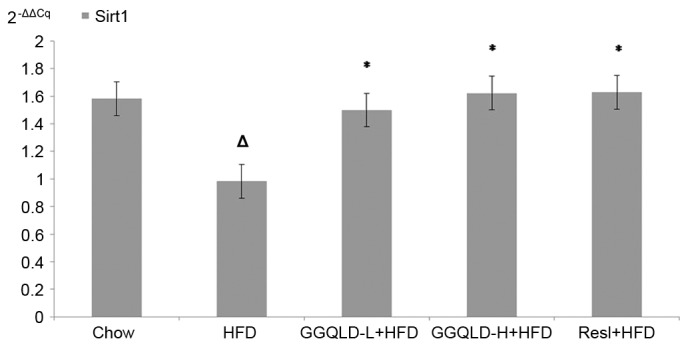
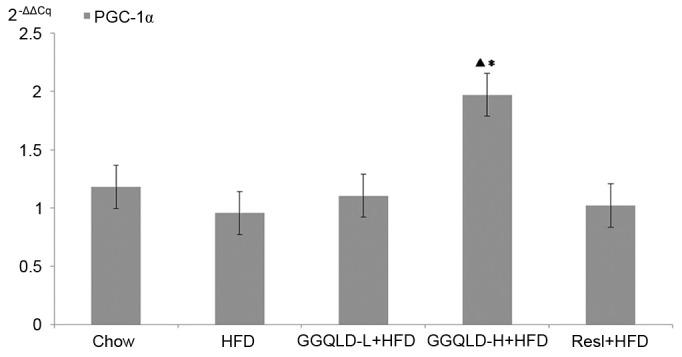
The present study aimed to explore the mechanism of action of Gegen Qinlian decoction (GGQLD) in experimental non-alcoholic fatty liver disease (NAFLD). A total of 30 rats were randomly divided into five groups: The chow, model, high- and low-dose GGQLD (GGQLD-H and GGQLD-L, respectively) and resveratrol (Resl) groups, and were treated with saline, GGQLD and Resl when a model of high-fat diet (HFD)-induced NAFLD was established. Blood lipid and liver enzymes were detected following treatment for 8 weeks and liver tissue pathology was observed using Oil Red O and haematoxylin and eosin staining. Furthermore, the liver protein and mRNA expression of sirtuin (Sirt)1, peroxisome proliferator-activated receptor-γ coactivator (PGC)-1α and nuclear factor κ-light-chain-enhancer of activated B cells (NF-κB) were measured using western blotting and reverse transcription-quantitative polymerase chain reaction. Compared with the chow group, the model group demonstrated significantly increased serum alanine aminotransferase (ALT) and aspartate aminotransferase (AST) levels (P<0.01). GGQLD doses and Resl attenuated the elevated serum ALT and AST levels. GGQLD-H and Resl significantly increased the serum high-density lipoprotein cholesterol level compared with that in the model group (P<0.01), while GGQLD-L and Resl significantly decreased serum low-density lipoprotein cholesterol levels (P<0.01). The GGQLDs and Resl groups revealed an evident improvement in Sirt1 protein and mRNA expression. Although GGQLD and Resl significantly decreased NF-κB gene expression compared with the model group (P<0.01), the effect on NF-κB protein expression was not significant. Furthermore, the PGC-1α gene and protein expression in the HFD rat group slightly decreased compared to the levels in the chow group, but the decrease was insignificant. However, an evident increase in PGC-1α mRNA expression was observed in the GGQLD-H group compared with the model group (P<0.01). Histological staining revealed that GGQLD and Resl decreased the lipid droplets in hepatocytes and normalized steatosis in rats fed with a HFD. The results indicated that GGQLD treatment may be a potent strategy for managing NAFLD by managing lipid metabolism and inflammatory and histological abnormalities by triggering the Sirt1 pathway.
本研究旨在探讨葛根芩连汤(GGQLD)在实验性非酒精性脂肪性肝病(NAFLD)中的作用机制。总共30只大鼠被随机分为五组:正常饮食组、模型组、高剂量和低剂量GGQLD组(分别为GGQLD-H和GGQLD-L)以及白藜芦醇(Resl)组,在建立高脂饮食(HFD)诱导的NAFLD模型时,分别用生理盐水、GGQLD和Resl进行处理。治疗8周后检测血脂和肝酶,并使用油红O和苏木精-伊红染色观察肝组织病理学变化。此外,采用蛋白质免疫印迹法和逆转录-定量聚合酶链反应检测肝脏中沉默信息调节因子(Sirt)1、过氧化物酶体增殖物激活受体γ共激活因子(PGC)-1α和核因子κB(NF-κB)的蛋白和mRNA表达。与正常饮食组相比,模型组血清丙氨酸氨基转移酶(ALT)和天冬氨酸氨基转移酶(AST)水平显著升高(P<0.01)。GGQLD各剂量组和Resl可减轻血清ALT和AST水平的升高。与模型组相比,GGQLD-H和Resl显著提高血清高密度脂蛋白胆固醇水平(P<0.01),而GGQLD-L和Resl显著降低血清低密度脂蛋白胆固醇水平(P<0.01)。GGQLD各剂量组和Resl组Sirt1蛋白和mRNA表达均有明显改善。虽然与模型组相比,GGQLD和Resl显著降低NF-κB基因表达(P<0.01),但对NF-κB蛋白表达的影响不显著。此外,与正常饮食组相比,HFD大鼠组PGC-1α基因和蛋白表达略有下降,但下降不显著。然而,与模型组相比,GGQLD-H组PGC-1α mRNA表达明显升高(P<0.01)。组织学染色显示,GGQLD和Resl可减少HFD喂养大鼠肝细胞内的脂滴,并使肝脂肪变性恢复正常。结果表明,GGQLD治疗可能是通过触发Sirt1途径调控脂质代谢、炎症反应和组织学异常来治疗NAFLD的有效策略。