Romano Daniel R, Pharris Matthew C, Patel Neal M, Kinzer-Ursem Tamara L
Weldon School of Biomedical Engineering, Purdue University, West Lafayette, IN, United States of America.
PLoS Comput Biol. 2017 Nov 6;13(11):e1005820. doi: 10.1371/journal.pcbi.1005820. eCollection 2017 Nov.
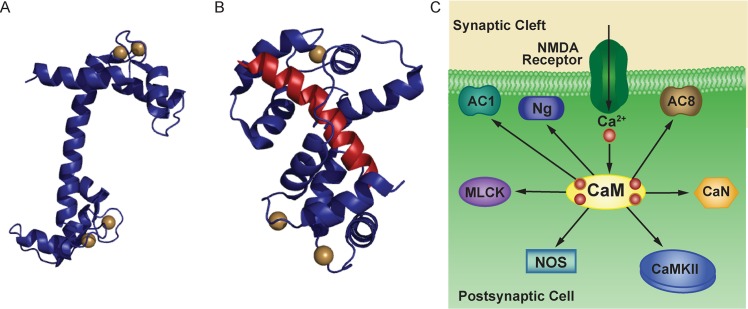
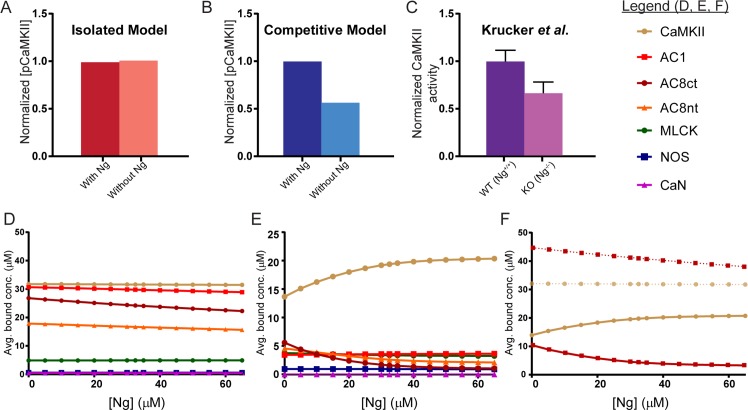
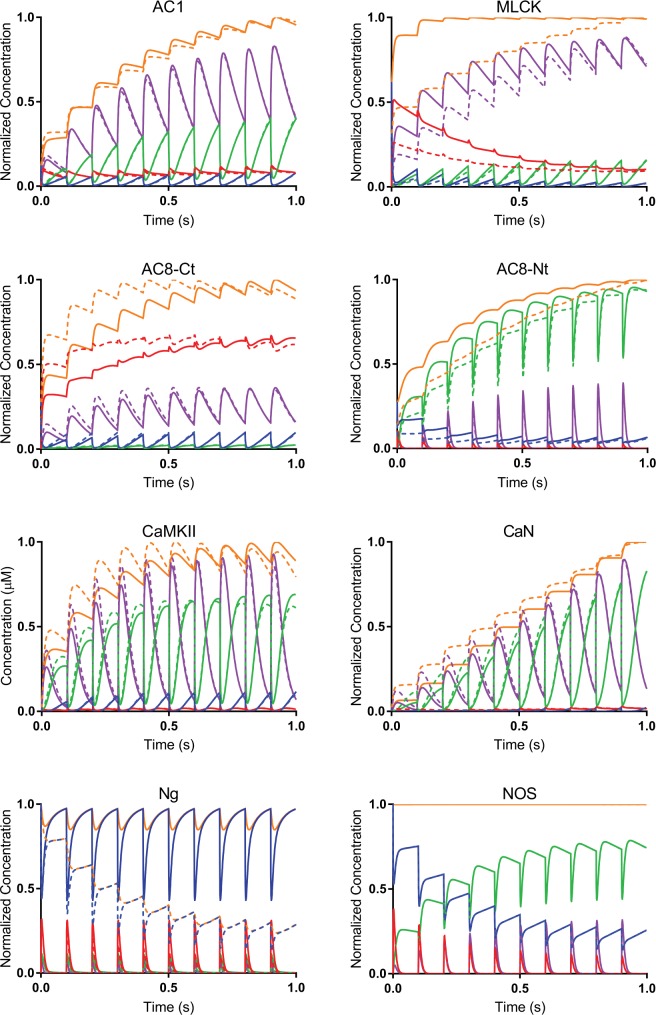
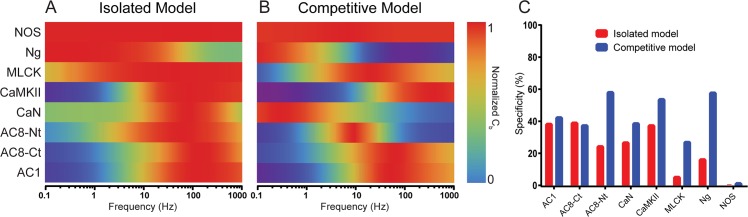
A number of neurological disorders arise from perturbations in biochemical signaling and protein complex formation within neurons. Normally, proteins form networks that when activated produce persistent changes in a synapse's molecular composition. In hippocampal neurons, calcium ion (Ca2+) flux through N-methyl-D-aspartate (NMDA) receptors activates Ca2+/calmodulin signal transduction networks that either increase or decrease the strength of the neuronal synapse, phenomena known as long-term potentiation (LTP) or long-term depression (LTD), respectively. The calcium-sensor calmodulin (CaM) acts as a common activator of the networks responsible for both LTP and LTD. This is possible, in part, because CaM binding proteins are "tuned" to different Ca2+ flux signals by their unique binding and activation dynamics. Computational modeling is used to describe the binding and activation dynamics of Ca2+/CaM signal transduction and can be used to guide focused experimental studies. Although CaM binds over 100 proteins, practical limitations cause many models to include only one or two CaM-activated proteins. In this work, we view Ca2+/CaM as a limiting resource in the signal transduction pathway owing to its low abundance relative to its binding partners. With this view, we investigate the effect of competitive binding on the dynamics of CaM binding partner activation. Using an explicit model of Ca2+, CaM, and seven highly-expressed hippocampal CaM binding proteins, we find that competition for CaM binding serves as a tuning mechanism: the presence of competitors shifts and sharpens the Ca2+ frequency-dependence of CaM binding proteins. Notably, we find that simulated competition may be sufficient to recreate the in vivo frequency dependence of the CaM-dependent phosphatase calcineurin. Additionally, competition alone (without feedback mechanisms or spatial parameters) could replicate counter-intuitive experimental observations of decreased activation of Ca2+/CaM-dependent protein kinase II in knockout models of neurogranin. We conclude that competitive tuning could be an important dynamic process underlying synaptic plasticity.
许多神经系统疾病源于神经元内生化信号传导和蛋白质复合物形成的紊乱。正常情况下,蛋白质形成网络,激活时会使突触的分子组成产生持久变化。在海马神经元中,钙离子(Ca2+)通过N-甲基-D-天冬氨酸(NMDA)受体的通量激活Ca2+/钙调蛋白信号转导网络,该网络会增强或减弱神经元突触的强度,这两种现象分别称为长时程增强(LTP)和长时程抑制(LTD)。钙传感器钙调蛋白(CaM)是负责LTP和LTD的网络的共同激活剂。这在一定程度上是可能的,因为CaM结合蛋白通过其独特的结合和激活动力学被“调整”到不同的Ca2+通量信号。计算模型用于描述Ca2+/CaM信号转导的结合和激活动力学,并可用于指导有针对性的实验研究。尽管CaM与100多种蛋白质结合,但实际限制导致许多模型只包含一两种CaM激活的蛋白质。在这项工作中,由于CaM相对于其结合伙伴的丰度较低,我们将Ca2+/CaM视为信号转导途径中的一种限制资源。基于这一观点,我们研究了竞争性结合对CaM结合伙伴激活动力学的影响。使用Ca2+、CaM和七种高表达的海马CaM结合蛋白的显式模型,我们发现对CaM结合的竞争起到了一种调节机制的作用:竞争者的存在会改变并锐化CaM结合蛋白的Ca2+频率依赖性。值得注意的是,我们发现模拟竞争可能足以重现体内钙调神经磷酸酶对CaM依赖性磷酸酶的频率依赖性。此外,仅竞争(无反馈机制或空间参数)就可以复制在神经颗粒素基因敲除模型中Ca2+/CaM依赖性蛋白激酶II激活降低的反直觉实验观察结果。我们得出结论,竞争性调节可能是突触可塑性背后的一个重要动态过程。