Zhang Hui, Lü Jiao-Jiao, Huang Qiang-Min, Liu Lin, Liu Qing-Guang, Eric Opoku-Antwi
Department of Sport Rehabilitation, School of Sport Science, Shanghai University of Sport, Shanghai, China.
Department of Pain Rehabilitation, Hudong Hospital, Shanghai, China.
Acupunct Med. 2017 Dec;35(6):445-451. doi: 10.1136/acupmed-2016-011212. Epub 2017 Nov 6.
To investigate the histopathological nature of myofascial trigger points (MTrPs) or spots (MTrSs) at different stages of recovery from injury in a rat model.
Forty Sprague-Dawley rats were randomly divided into two groups: a control group (CG) and experimental group (EG). The CG was further randomly subdivided into CG1 and CG2 subgroups. The CG2 was used for palpating the taut band and CG1 as a blank. EG was subdivided into three groups according to recovery times: 4 weeks (4W), 8 weeks (8W) and 12 weeks (12W); these groups consisted of eight rats each. All CG rats received no intervention, whereas the intervention in EG rats was by a blunt strike to the vastus medialis and eccentric exercise for 8 weeks. The taut bands with spontaneous electrical activity were then detected in the muscle to guide a muscle biopsy. The histopathological findings were investigated under optical and electron microscopes in all groups.
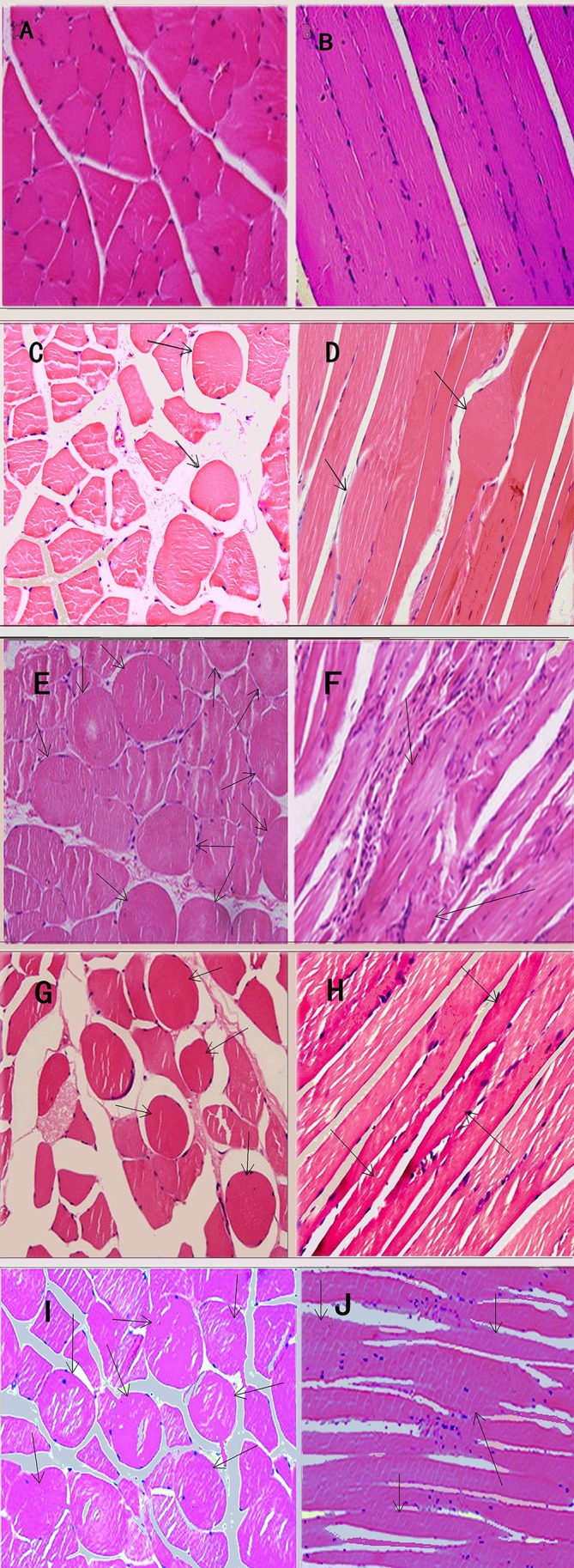
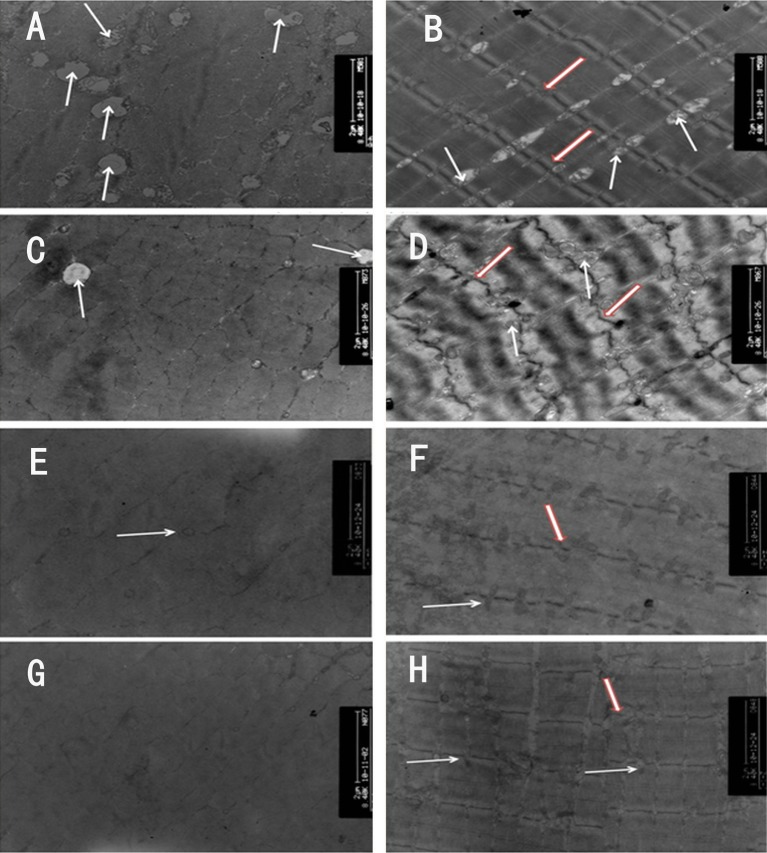
Under optical microscopy, the differently augmented sizes of round fibres (contracture knots) with deep staining in the transverse section and fusiform shapes in a longitudinal view were clearly seen in CG2 and EGs with a large diameter; the number of contracture knots was significantly more in EGs than in CGs. Under an electron microscope, the mitochondria in EGs significantly decreased with abnormal structures. The sarcomeres were significantly shortened in the 8W and 12W EGs.
An injury can cause activation of MTrSs in a muscle and an activated level of MTrPs depending on the number of contracture knots in muscle with impaired energy production.
在大鼠模型中研究肌筋膜触发点(MTrPs)或触发斑(MTrSs)在损伤恢复不同阶段的组织病理学性质。
40只Sprague-Dawley大鼠随机分为两组:对照组(CG)和实验组(EG)。CG进一步随机细分为CG1和CG2亚组。CG2用于触诊紧张带,CG1作为空白组。EG根据恢复时间分为三组:4周(4W)、8周(8W)和12周(12W);每组各有8只大鼠。所有CG组大鼠未接受干预,而EG组大鼠通过对股内侧肌进行钝击并进行8周离心运动进行干预。然后在肌肉中检测具有自发电活动的紧张带以指导肌肉活检。在光学显微镜和电子显微镜下对所有组的组织病理学结果进行研究。
在光学显微镜下,在CG2组和大直径的EG组中,明显可见横切面上圆形纤维(挛缩结)大小不同程度增大且染色深,纵切面上呈梭形;EG组中的挛缩结数量明显多于CG组。在电子显微镜下,EG组中的线粒体明显减少且结构异常。在8W和12W的EG组中,肌节明显缩短。
损伤可导致肌肉中MTrSs的激活以及取决于能量产生受损的肌肉中挛缩结数量的MTrPs激活水平。