HIV Department, 'Dr Victor Babes' Hospital for Infectious and Tropical Diseases, Bucharest, Romania.
Department of Psychiatry.
AIDS. 2018 Jan 14;32(2):217-225. doi: 10.1097/QAD.0000000000001687.
Sex differences in cognition of HIV positive (HIV) patients are controversial. We aimed to investigate the relationship between cognition, HIV status, and sex, in a highly homogenous cohort of young Romanians parenterally infected during early childhood.
In total, 250 HIV participants were compared with age-matched HIV negative (HIV) controls (n = 72) in a cross-sectional study. After standardized neurocognitive, psychological testing and medical evaluation, linear regression was used to assess the effect of sex and HIV on neurocognitive outcomes.
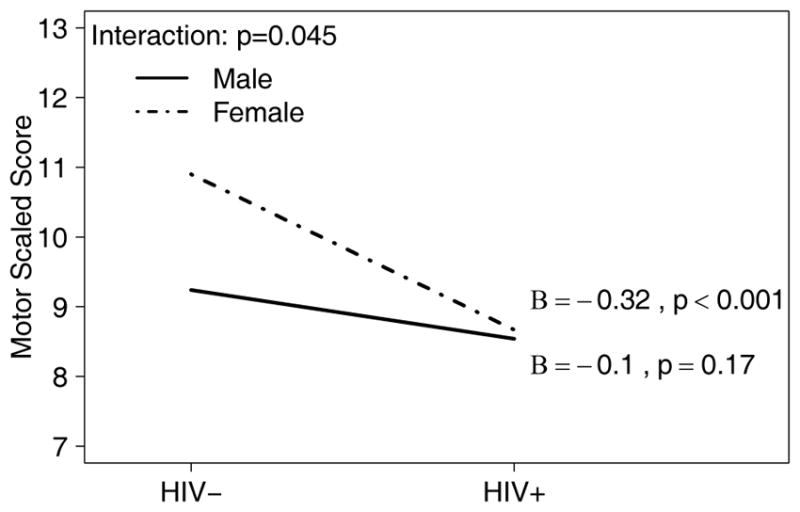
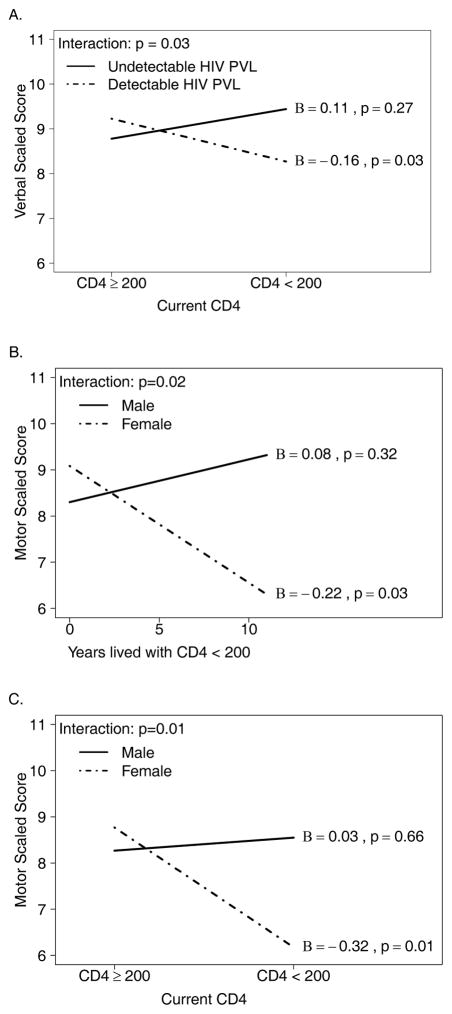
Study participants were on average 23 years old with balanced sex distribution (% women = 52% vs. 43%). HIV were more educated (12.7 vs. 11.6 years, P = 0.002).HIV status was associated with a lower global performance (β = -0.22, P < 0.001), after controlling for age and education. HIV women had better previous and current HIV-associated markers. The effect of HIV on global cognition did not differ between sexes in most cognitive domains (β = 0.07, P = 0.14). An interaction between sex, HIV status, and cognitive functioning was found in the psychomotor domain. HIV women had worse motor skills than HIV women (β = -0.32, P < 0.001) suggesting a specific effect of HIV on motor functioning in women only. Moreover, current CD4 less than 200 cells/μl (P = 0.013) and longer time lived with CD4 less than 200 cells/μl (P = 0.023) were negatively correlated with the motor scaled score in women (β = -0.22, P = 0.034).
Despite less advanced disease in women, long-term HIV infection has an equally detrimental effect on cognitive performances of both sexes, in all cognitive domains, except the psychomotor domain where women are preferentially affected.
HIV 阳性(HIV)患者认知能力的性别差异存在争议。我们旨在研究认知能力、HIV 状态和性别的关系,该研究在一个高度同质的罗马尼亚群体中进行,这些人在儿童早期通过注射途径感染了 HIV。
在这项横断面研究中,我们将 250 名 HIV 参与者与年龄匹配的 HIV 阴性(HIV)对照组(n=72)进行了比较。在进行了标准化的神经认知、心理测试和医学评估后,我们使用线性回归来评估性别和 HIV 对神经认知结果的影响。
研究参与者的平均年龄为 23 岁,性别分布均衡(女性%=52% vs. 43%)。HIV 患者受教育程度更高(12.7 年 vs. 11.6 年,P=0.002)。在控制年龄和教育程度后,HIV 状态与整体表现较差相关(β=-0.22,P<0.001)。HIV 女性具有更好的既往和当前与 HIV 相关的标志物。在大多数认知领域,HIV 对全球认知的影响在性别之间没有差异(β=0.07,P=0.14)。在运动领域发现了性别、HIV 状态和认知功能之间的交互作用。HIV 女性的运动技能比 HIV 女性差(β=-0.32,P<0.001),这表明 HIV 对女性的运动功能有特定的影响。此外,当前 CD4 细胞数小于 200 个/μl(P=0.013)和 CD4 细胞数小于 200 个/μl 的时间更长(P=0.023)与女性的运动评分呈负相关(β=-0.22,P=0.034)。
尽管女性的疾病进展程度较低,但长期 HIV 感染对两性的所有认知领域的认知表现都有同样的不利影响,除了运动领域,女性在这个领域受到的影响更大。