Wu Zhuyu, Li Yaojun, Zhang Guojun
Department of Respiratory Medicine, The First Affiliated Hospital of Zhengzhou University, Zhengzhou, Henan 450000, P.R. China.
Department of Respiratory Medicine, Luohe Central Hospital, Luohe, Henan 462000, P.R. China.
Oncol Lett. 2017 Nov;14(5):6017-6023. doi: 10.3892/ol.2017.6990. Epub 2017 Sep 18.
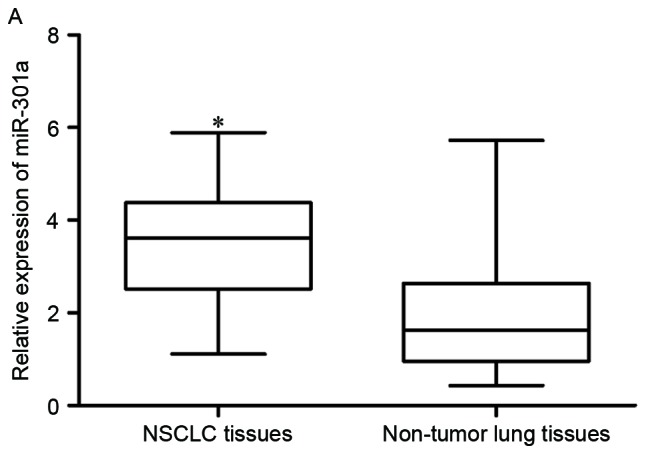
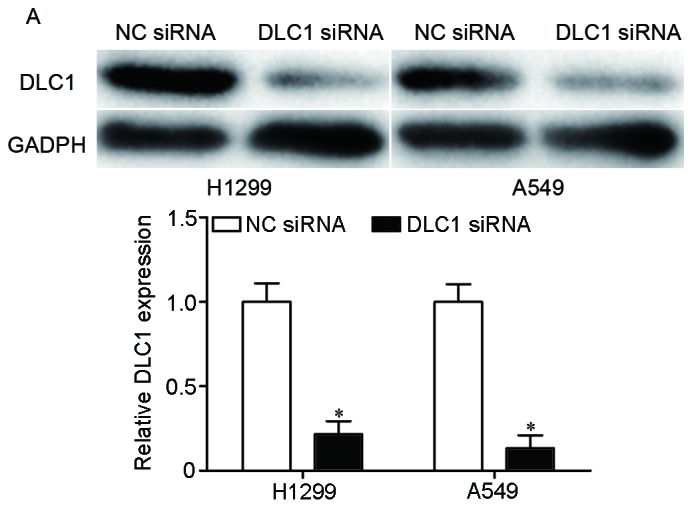
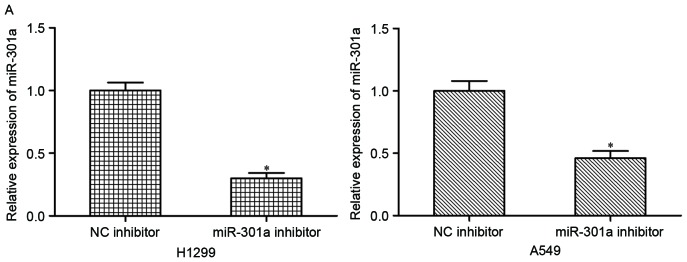
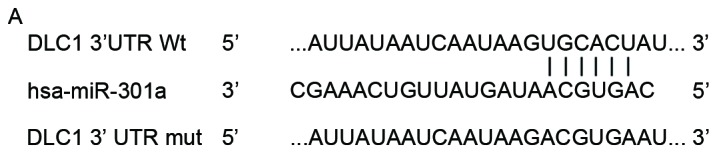
Increasing evidence has indicated that the abnormal expression of microRNAs contributes to tumorigenesis and tumor development. Understanding the roles of microRNAs in non-small cell lung cancer (NSCLC) might provide valuable information for therapeutic strategies in the therapy for patients with NSCLC. In the present study, significant upregulation of microRNA (miR)-301a was observed in NSCLC tissues and cell lines compared with normal adjacent tissues and a normal human bronchial epithelial cell line. The inhibition of miR-301a suppressed proliferation, migration and invasion of NSCLC cells. Functional analyses indicated that DLC1 was a direct target of miR-301a in NSCLC. Inhibiting miR-301a expression decreased DLC1 expression at mRNA and protein levels. Moreover, DLC1 knockdown partially reversed the inhibition of proliferation, migration and invasion induced by miR-301a knockdown in NSCLC cells. Therefore, these findings may provide novel insights into the molecular mechanisms of miR-301a in proliferation, migration and invasion of NSCLC cells. The findings also indicated that miR-301a may act as a novel potential therapeutic target for patients with NSCLC.
越来越多的证据表明,微小RNA的异常表达促进肿瘤发生和肿瘤发展。了解微小RNA在非小细胞肺癌(NSCLC)中的作用可能为NSCLC患者的治疗策略提供有价值的信息。在本研究中,与癌旁正常组织和正常人支气管上皮细胞系相比,在NSCLC组织和细胞系中观察到微小RNA(miR)-301a显著上调。抑制miR-301a可抑制NSCLC细胞的增殖、迁移和侵袭。功能分析表明,DLC1是NSCLC中miR-301a的直接靶标。抑制miR-301a表达可降低DLC1在mRNA和蛋白质水平的表达。此外,敲低DLC1可部分逆转NSCLC细胞中因敲低miR-301a所诱导的增殖、迁移和侵袭抑制。因此,这些发现可能为miR-301a在NSCLC细胞增殖、迁移和侵袭中的分子机制提供新的见解。这些发现还表明,miR-301a可能成为NSCLC患者一种新的潜在治疗靶点。