Nickerson J A, Krochmalnic G, Wan K M, Penman S
Department of Biology, Massachusetts Institute of Technology, Cambridge, MA 02139.
Proc Natl Acad Sci U S A. 1989 Jan;86(1):177-81. doi: 10.1073/pnas.86.1.177.
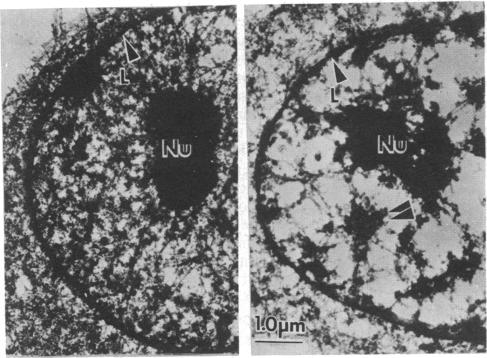
The maintenance of normal chromatin morphology requires ongoing RNA synthesis. We have examined the role of RNA in chromatin organization, using selective detergent extraction of cells, RNA synthesis inhibitors, and enzymatic digestion of nuclear RNA. Comparison of extracted and unextracted cells showed that the important features of chromatin architecture were largely unchanged by the extraction procedure. Normally, chromatin was distributed in small heterochromatic regions and dispersed euchromatic strands. Ribonucleoprotein granules were dispersed throughout the euchromatic regions. Exposure to actinomycin led to the redistribution of chromatin into large clumps, leaving large empty spaces and a dense clustering of the remaining ribonucleoprotein granules. When the nuclei of extracted cells were digested with RNase A, there was a rearrangement of chromatin similar to but more pronounced than that seen in cells exposed to actinomycin. The inhibitor 5,6-dichloro-1-beta-D-ribofuranosylbenzimidizole also inhibits RNA synthesis but by a different mechanism that leaves no nascent RNA chains. The drug had little effect on chromatin after brief exposure but resembled actinomycin in its effect at longer times. We also examined the structure of the nuclear matrix to which most heteronuclear RNA remains associated. Pretreatment of cells with actinomycin or digestion of the nuclear matrix with RNase A caused the matrix fibers to collapse and aggregate. The experiments show a parallel decay of chromatin and of nuclear matrix organization with the depletion of nuclear RNA and suggest that RNA is a structural component of the nuclear matrix, which in turn may organize the higher order structure of chromatin.
正常染色质形态的维持需要持续的RNA合成。我们利用细胞的选择性去污剂提取、RNA合成抑制剂以及核RNA的酶促消化,研究了RNA在染色质组织中的作用。对提取和未提取细胞的比较表明,染色质结构的重要特征在提取过程中基本未变。正常情况下,染色质分布在小的异染色质区域和分散的常染色质链中。核糖核蛋白颗粒分散在整个常染色质区域。暴露于放线菌素会导致染色质重新分布成大的团块,留下大的空隙以及剩余核糖核蛋白颗粒的密集聚集。当用核糖核酸酶A消化提取细胞的细胞核时,染色质会发生重排,类似于但比暴露于放线菌素的细胞中更明显。抑制剂5,6-二氯-1-β-D-呋喃核糖基苯并咪唑也抑制RNA合成,但通过不同的机制,不会留下新生RNA链。该药物在短暂暴露后对染色质影响不大,但在较长时间后其作用类似于放线菌素。我们还研究了大多数异核RNA仍与之相关的核基质的结构。用放线菌素预处理细胞或用核糖核酸酶A消化核基质会导致基质纤维塌陷和聚集。实验表明,随着核RNA的耗尽,染色质和核基质组织会平行衰退,这表明RNA是核基质的结构成分,而核基质反过来可能会组织染色质的高级结构。