Department of Evolutionary Anthropology, Duke University, Durham, NC, 27708, USA.
Fuqua School of Business, Duke University, Durham, NC, 27708, USA.
Sci Rep. 2017 Nov 7;7(1):14733. doi: 10.1038/s41598-017-15320-w.
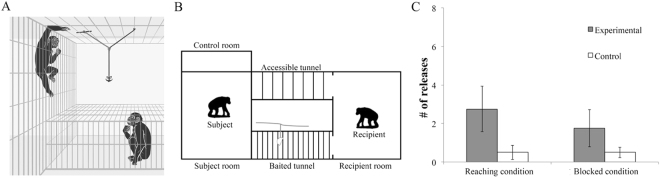
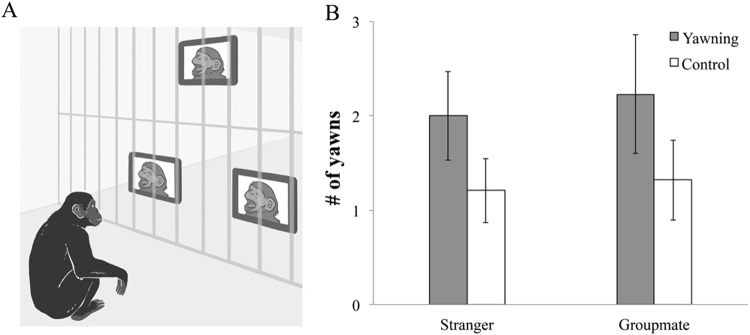
Modern humans live in an "exploded" network with unusually large circles of trust that form due to prosociality toward unfamiliar people (i.e. xenophilia). In a set of experiments we demonstrate that semi-free ranging bonobos (Pan paniscus) - both juveniles and young adults - also show spontaneous responses consistent with xenophilia. Bonobos voluntarily aided an unfamiliar, non-group member in obtaining food even when he/she did not make overt requests for help. Bonobos also showed evidence for involuntary, contagious yawning in response to videos of yawning conspecifics who were complete strangers. These experiments reveal that xenophilia in bonobos can be unselfish, proactive and automatic. They support the first impression hypothesis that suggests xenophilia can evolve through individual selection in social species whenever the benefits of building new bonds outweigh the costs. Xenophilia likely evolved in bonobos as the risk of intergroup aggression dissipated and the benefits of bonding between immigrating members increased. Our findings also mean the human potential for xenophilia is either evolutionarily shared or convergent with bonobos and not unique to our species as previously proposed.
现代人生活在一个“爆炸”的网络中,由于对陌生人大度(即对外友善),信任圈异常大。在一系列实验中,我们证明了半自由放养的倭黑猩猩(Pan paniscus)——包括幼崽和年轻的成年人——也表现出了与对外友善一致的自发反应。倭黑猩猩自愿帮助一个不熟悉的、非群体成员获得食物,即使他/她没有明显请求帮助。倭黑猩猩在观看完全陌生的同类打哈欠的视频时,也表现出了不受控制的、传染性的打哈欠。这些实验表明,倭黑猩猩的对外友善可以是无私的、主动的和自动的。它们支持第一印象假说,即只要建立新关系的好处超过成本,对外友善就可以通过社会物种中的个体选择而进化。对外友善可能是在倭黑猩猩中进化而来的,因为群体间攻击的风险消散了,而移民成员之间建立联系的好处增加了。我们的发现还意味着,人类对外友善的潜力要么是与倭黑猩猩在进化上共享的,要么是与它们趋同的,而不是像以前提出的那样是我们物种所特有的。