Moscovice Liza R, Deschner Tobias, Hohmann Gottfried
Department of Primatology, Max Planck Institute for Evolutionary Anthropology, Leipzig, Germany.
PLoS One. 2015 May 21;10(5):e0127305. doi: 10.1371/journal.pone.0127305. eCollection 2015.
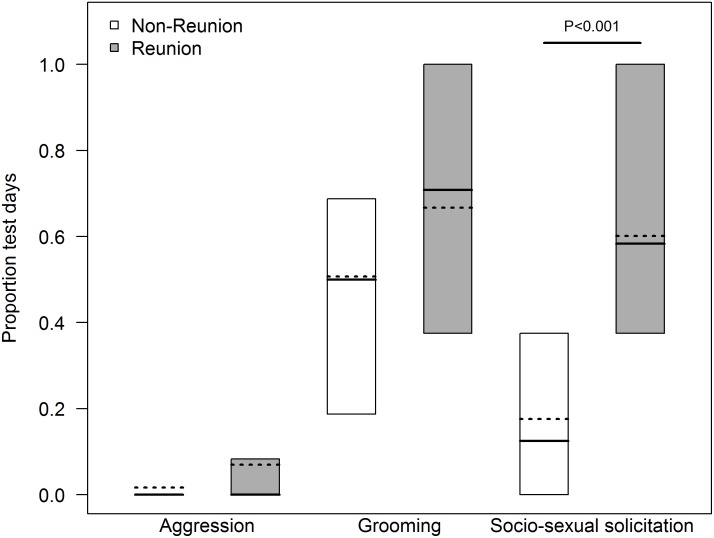
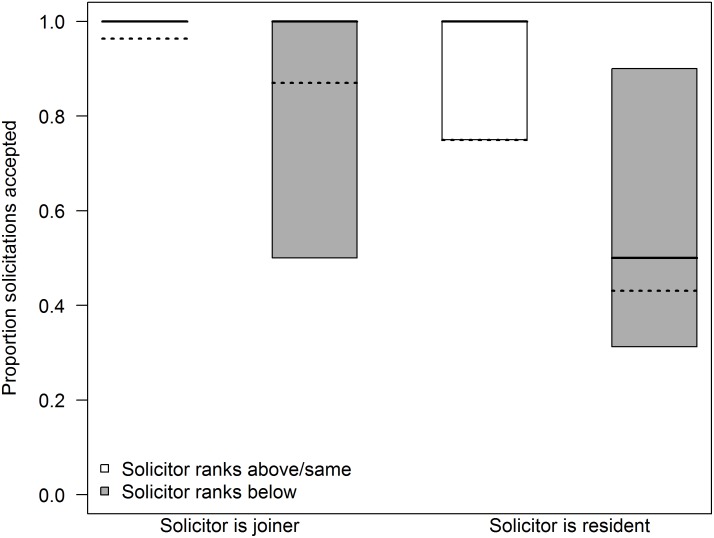
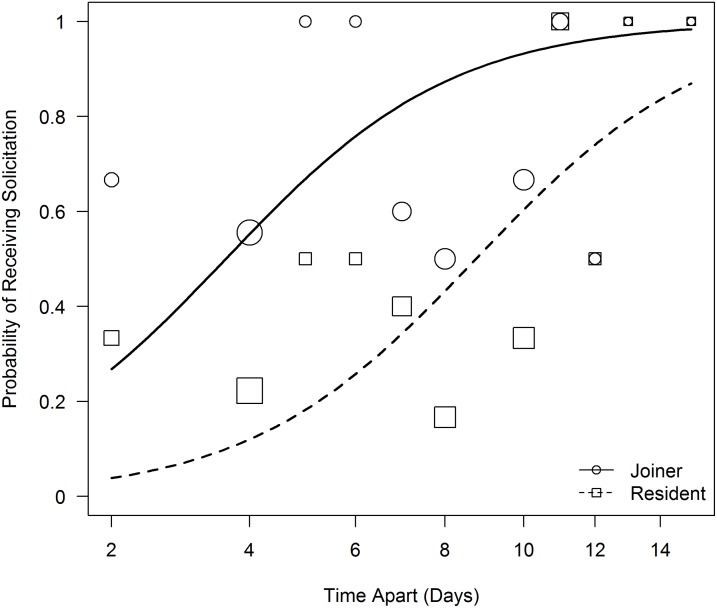
In species with a high degree of fission-fusion social dynamics, fusions may trigger social conflict and thus provide an opportunity to identify sources of social tension and mechanisms related to its alleviation. We characterized behavioral and endocrine responses of captive female bonobos (Pan paniscus) to fusions within a zoo facility designed to simulate naturalistic fission-fusion social dynamics. We compared urinary cortisol levels and frequencies of aggression, grooming and socio-sexual interactions between female bonobos while in stable sub-groups and when one "joiner" was reunited with the "residents" of another sub-group. We hypothesized that fusions would trigger increases in aggression and cortisol levels among reunited joiners and resident females. We further predicted that females who face more uncertainty in their social interactions following fusions may use grooming and/or socio-sexual behavior to reduce social tension and aggression. The only aggression on reunion days occurred between reunited females, but frequencies of aggression remained low across non-reunion and reunion days, and there was no effect of fusions on cortisol levels. Fusions did not influence patterns of grooming, but there were increases in socio-sexual solicitations and socio-sexual interactions between joiners and resident females. Joiners who had been separated from residents for longer received the most solicitations, but were also more selective in their acceptance of solicitations and preferred to have socio-sexual interactions with higher-ranking residents. Our results suggest that socio-sexual interactions play a role in reintegrating female bonobos into social groups following fusions. In addition, females who receive a high number of solicitations are able to gain more control over their socio-sexual interactions and may use socio-sexual interactions for other purposes, such as to enhance their social standing.
在具有高度裂变-融合社会动态的物种中,融合可能引发社会冲突,从而提供一个机会来识别社会紧张局势的根源以及与缓解紧张局势相关的机制。我们在一个旨在模拟自然主义裂变-融合社会动态的动物园设施内,对圈养雌性倭黑猩猩(Pan paniscus)对融合的行为和内分泌反应进行了特征描述。我们比较了雌性倭黑猩猩在稳定亚群体中以及当一只“加入者”与另一个亚群体的“居民”重新团聚时,尿液中皮质醇水平以及攻击、梳理毛发和社会性行为的频率。我们假设融合会引发重新团聚的加入者和居民雌性之间攻击行为和皮质醇水平的增加。我们进一步预测,在融合后社会互动中面临更多不确定性的雌性可能会利用梳理毛发和/或社会性行为来减少社会紧张局势和攻击行为。团聚日唯一的攻击行为发生在重新团聚的雌性之间,但在非团聚日和团聚日,攻击频率都很低,并且融合对皮质醇水平没有影响。融合并未影响梳理毛发的模式,但加入者和居民雌性之间的社会性行为请求和社会性行为有所增加。与居民分离时间更长的加入者收到的请求最多,但在接受请求时也更具选择性,并且更倾向于与地位较高的居民进行社会性行为。我们的结果表明,社会性行为在融合后将雌性倭黑猩猩重新融入社会群体中发挥着作用。此外,收到大量请求的雌性能够对其社会性行为获得更多控制权,并且可能将社会性行为用于其他目的,例如提高她们的社会地位。