State Key Laboratory of Microbial Metabolism and School of Life Sciences and Biotechnology, Shanghai Jiao Tong University, Shanghai, 200240, P.R. China.
Key Laboratory of Biogeography and Bioresource in Arid Land, Xinjiang Institute of Ecology and Geography, Chinese Academy of Sciences, Urumqi, 830011, P.R. China.
Sci Rep. 2017 Nov 7;7(1):14778. doi: 10.1038/s41598-017-15122-0.
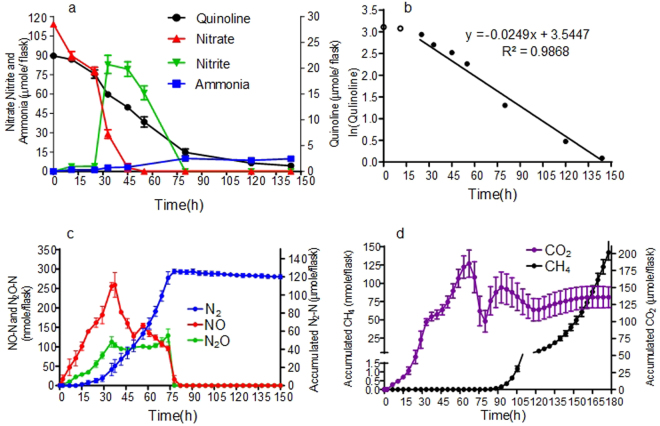
Quinoline is biodegradable under anaerobic conditions, but information about the degradation kinetics and the involved microorganisms is scarce. Here, the dynamics of a quinoline-degrading bacterial consortium were studied in anoxic batch cultures containing nitrate. The cultures removed 83.5% of the quinoline during the first 80 hours, which were dominated by denitrification, and then switched to methanogenesis when the nitrogen oxyanions were depleted. Time-resolved community analysis using pyrosequencing revealed that denitrifiying bacteria belonging to the genus Thauera were enriched during the denitrification stage from 12.2% to 38.8% and 50.1% relative abundance in DNA and cDNA libraries, respectively. This suggests that they are key organisms responsible for the initial attack on quinoline. Altogether, 13 different co-abundance groups (CAGs) containing 76 different phylotypes were involved, directly or indirectly, in quinoline degradation. The dynamics of these CAGs show that specific phylotypes were associated with different phases of the degradation. Members of Rhodococcus and Desulfobacterium, as well as Rhodocyclaceae- and Syntrophobacteraceae-related phylotypes, utilized initial metabolites of the quinoline, while the resulting smaller molecules were used by secondary fermenters belonging to Anaerolineae. The concerted action by the different members of this consortium resulted in an almost complete anaerobic mineralization of the quinoline.
在厌氧条件下,喹啉可生物降解,但有关降解动力学和涉及的微生物的信息却很少。在这里,研究了含有硝酸盐的缺氧分批培养物中喹啉降解细菌联合体的动力学。在最初的 80 小时内,培养物去除了 83.5%的喹啉,主要是通过反硝化作用,当氮的含氧阴离子耗尽时,然后切换到产甲烷作用。使用焦磷酸测序进行的时间分辨群落分析表明,属于 Thauera 属的反硝化细菌在反硝化阶段从 DNA 和 cDNA 文库中的 12.2%分别富集到 38.8%和 50.1%相对丰度,这表明它们是负责初始攻击喹啉的关键生物。总共涉及 13 个不同的共丰度组(CAG),包含 76 个不同的类群,直接或间接地参与了喹啉的降解。这些 CAG 的动态表明,特定的类群与降解的不同阶段有关。Rhodococcus 和 Desulfobacterium 的成员,以及与 Rhodocyclaceae 和 Syntrophobacteraceae 相关的类群,利用喹啉的初始代谢物,而生成的较小分子则被属于 Anaerolineae 的次级发酵剂利用。该联合体的不同成员的协同作用导致喹啉几乎完全进行了无氧矿化。