Hanson Christy, Osberg Mike, Brown Jessie, Durham George, Chin Daniel P
Macalester College, St. Paul, M innesota.
Bill and Melinda Gates Foundation.
J Infect Dis. 2017 Nov 6;216(suppl_7):S686-S695. doi: 10.1093/infdis/jix388.
Despite significant progress in diagnosis and treatment of tuberculosis over the past 2 decades, millions of patients with tuberculosis go unreported every year. The patient-pathway analysis (PPA) is designed to assess the alignment between tuberculosis care-seeking patterns and the availability of tuberculosis services. The PPA can help programs understand where they might find the missing patients with tuberculosis.
This analysis aggregates and compares the PPAs from case studies in Kenya, Ethiopia, Indonesia, the Philippines, and Pakistan.
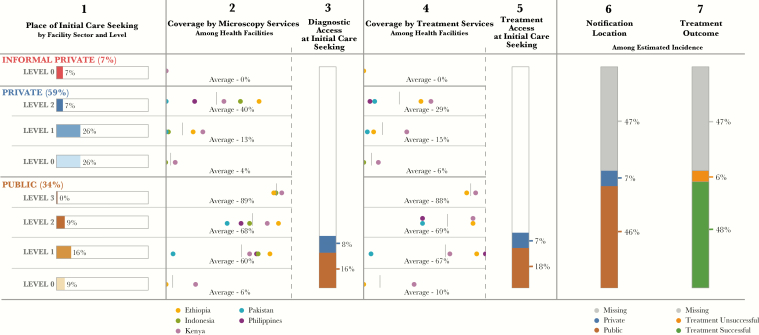
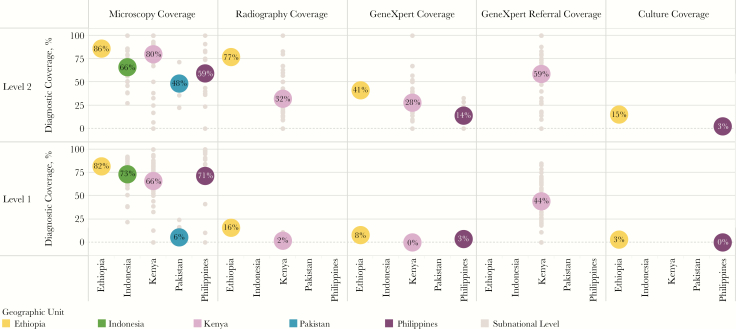
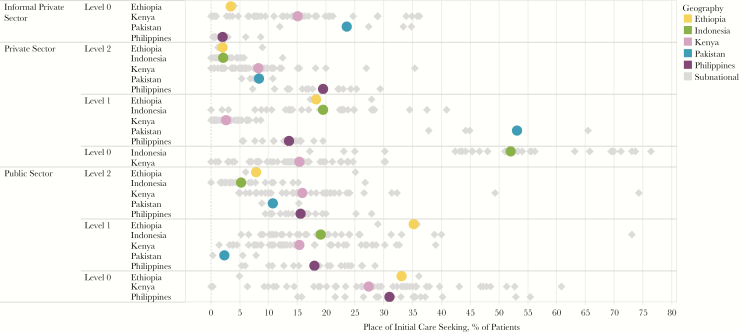
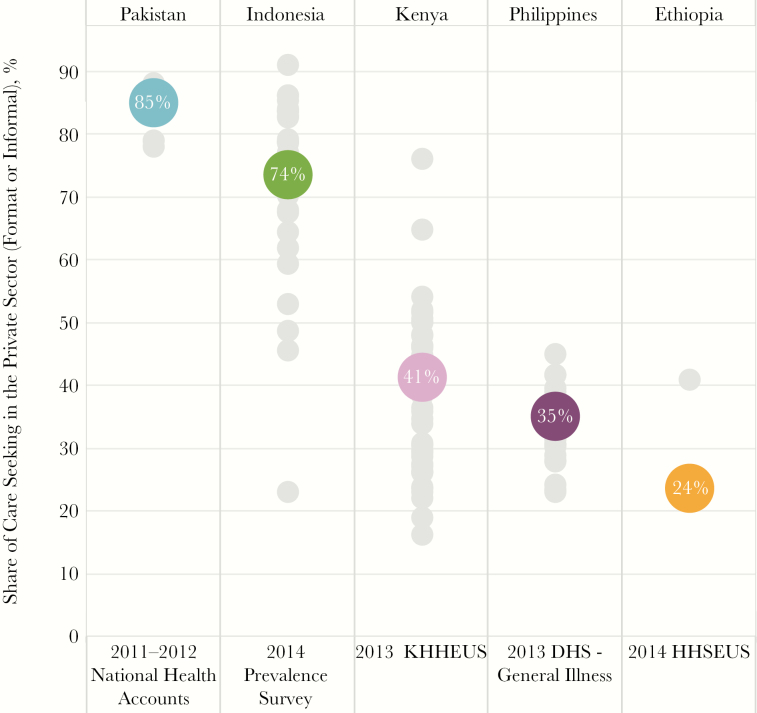
Across the 5 countries, 24% of patients with tuberculosis initiated care seeking in a facility with tuberculosis diagnostic capacity. Forty-two percent of patients sought care at level 0 facilities, where there was generally no tuberculosis diagnostic capacity; another 42% of patients sought care at level 1 facilities, of which 39% had diagnostic capacity. Sixty-six percent of patients initially sought care in private facilities, which had considerably less tuberculosis diagnostic capacity than public facilities; only 7% of notified cases were from the private sector. The GeneXpert system was available in 14%-41% of level 2 facilities in the 3 countries for which there were data. Tuberculosis treatment capacity tracked closely with the availability of diagnostic capacity. There were substantial subnational differences in care-seeking patterns and service availability.
The PPA can be a valuable planning and programming tool to ensure that diagnostic and treatment services are available to patients where they seek care. Patient-centered care will require closing the diagnostic gap and engaging the private sector. Extensive subnational differences in patient pathways to care call for differentiated approaches to patient-centered care.
尽管在过去20年里结核病的诊断和治疗取得了重大进展,但每年仍有数百万人未报告结核病情况。患者路径分析(PPA)旨在评估结核病就医模式与结核病服务可及性之间的匹配度。PPA有助于项目了解可能在哪里找到未报告的结核病患者。
本分析汇总并比较了肯尼亚、埃塞俄比亚、印度尼西亚、菲律宾和巴基斯坦案例研究中的PPA。
在这5个国家中,24%的结核病患者在具备结核病诊断能力的机构开始寻求治疗。42%的患者在0级机构寻求治疗,这些机构通常没有结核病诊断能力;另有42%的患者在1级机构寻求治疗,其中39%具备诊断能力。66%的患者最初在私立机构寻求治疗,私立机构的结核病诊断能力远低于公立机构;只有7%的报告病例来自私立部门。在有数据的3个国家中,14% - 41%的2级机构配备了GeneXpert系统。结核病治疗能力与诊断能力的可及性密切相关。就医模式和服务可及性在国家以下层面存在显著差异。
PPA可以成为一个有价值的规划和项目工具,以确保患者在寻求治疗的地方能够获得诊断和治疗服务。以患者为中心的护理需要缩小诊断差距并让私立部门参与进来。患者就医路径在国家以下层面存在广泛差异,这就需要采取差异化的以患者为中心的护理方法。