Division of Biological Chemistry and Drug Discovery, School of Life Sciences, University of Dundee, Dow Street, Dundee DD1 5EH, Scotland, U.K.
Essays Biochem. 2017 Nov 8;61(5):505-516. doi: 10.1042/EBC20170041.
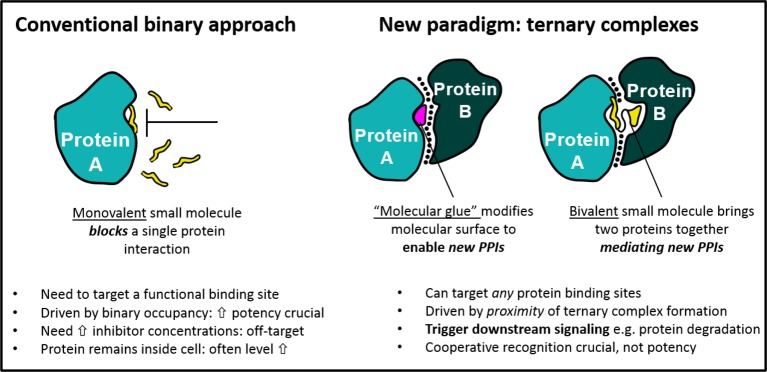
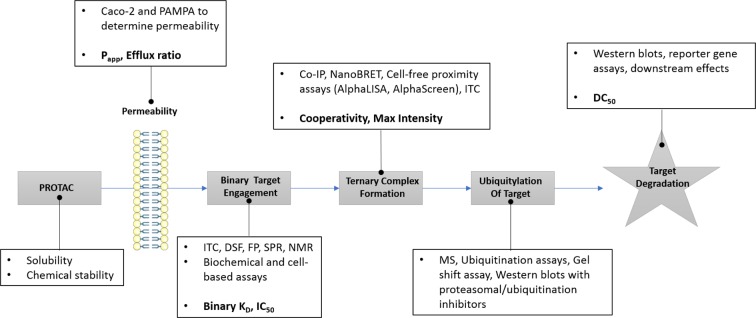
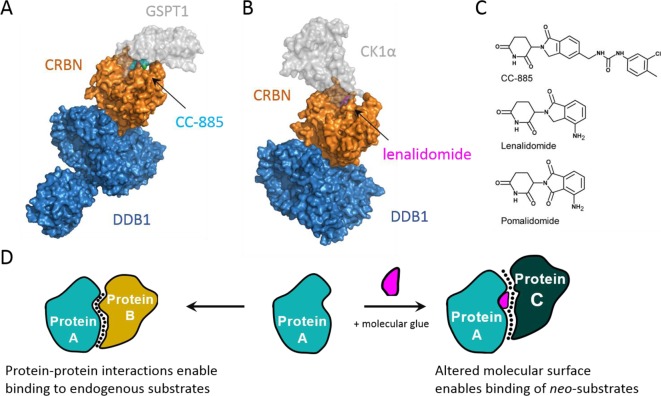
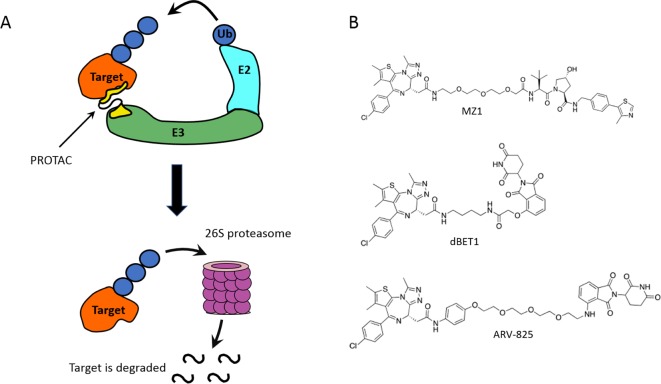
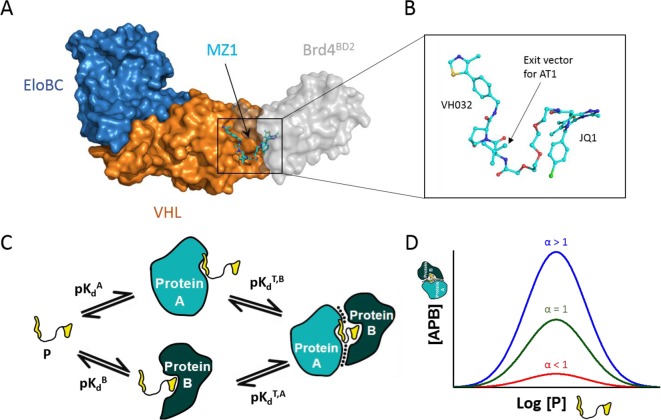
Molecular glues and bivalent inducers of protein degradation (also known as PROTACs) represent a fascinating new modality in pharmacotherapeutics: the potential to knockdown previously thought 'undruggable' targets at sub-stoichiometric concentrations in ways not possible using conventional inhibitors. Mounting evidence suggests these chemical agents, in concert with their target proteins, can be modelled as three-body binding equilibria that can exhibit significant cooperativity as a result of specific ligand-induced molecular recognition. Despite this, many existing drug design and optimization regimens still fixate on binary target engagement, in part due to limited structural data on ternary complexes. Recent crystal structures of protein complexes mediated by degrader molecules, including the first PROTAC ternary complex, underscore the importance of protein-protein interactions and intramolecular contacts to the mode of action of this class of compounds. These discoveries have opened the door to a new paradigm for structure-guided drug design: borrowing surface area and molecular recognition from nature to elicit cellular signalling.
分子胶和双价蛋白降解诱导剂(也称为 PROTACs)代表了药物治疗学中一种引人入胜的新模式:有可能以亚化学计量浓度敲低以前认为“不可成药”的靶标,而这在使用传统抑制剂时是不可能的。越来越多的证据表明,这些化学试剂与它们的靶蛋白结合,可以被模拟为三体结合平衡,由于特定配体诱导的分子识别,可以表现出显著的协同作用。尽管如此,许多现有的药物设计和优化方案仍然专注于二元靶标结合,部分原因是关于三元复合物的结构数据有限。最近降解分子介导的蛋白质复合物的晶体结构,包括第一个 PROTAC 三元复合物,强调了蛋白质-蛋白质相互作用和分子内接触对这类化合物作用模式的重要性。这些发现为基于结构的药物设计开辟了一个新的范例:借鉴自然界的表面积和分子识别来引发细胞信号转导。